

Method and System for Measuring the Zeta Potential of the Cylinder's Outer Surface
a technology of zeta potential and measurement method, which is applied in the direction of electrostatic separator, diaphragm, electrolysis, etc., can solve the problem of no method provided to measure the zeta potential of the outer surface of tubular membrane, and achieve the effect of simple system installation and easy operation
- Summary
- Abstract
- Description
- Claims
- Application Information
AI Technical Summary
Benefits of technology
Problems solved by technology
Method used
Image

Examples
first embodiment
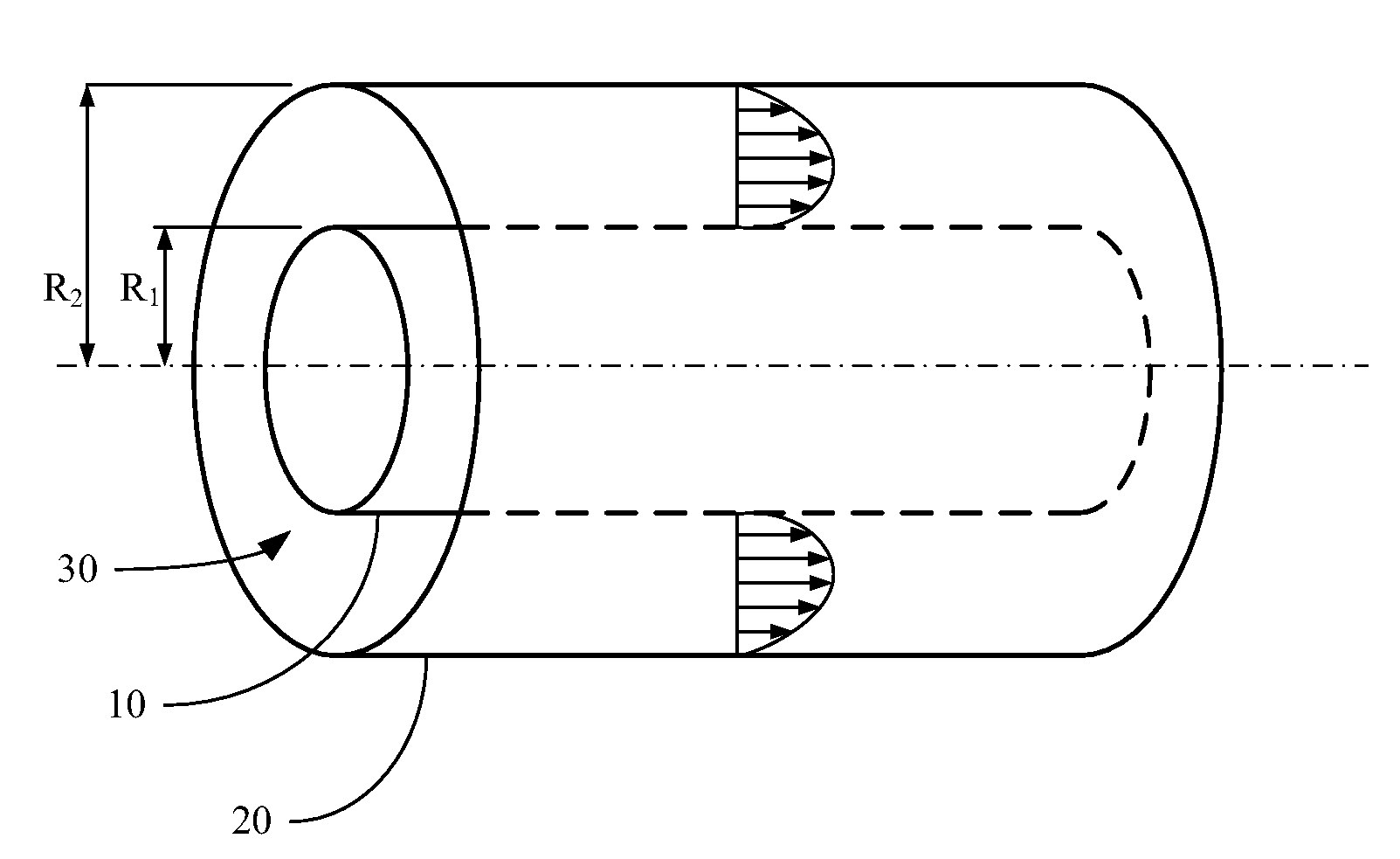
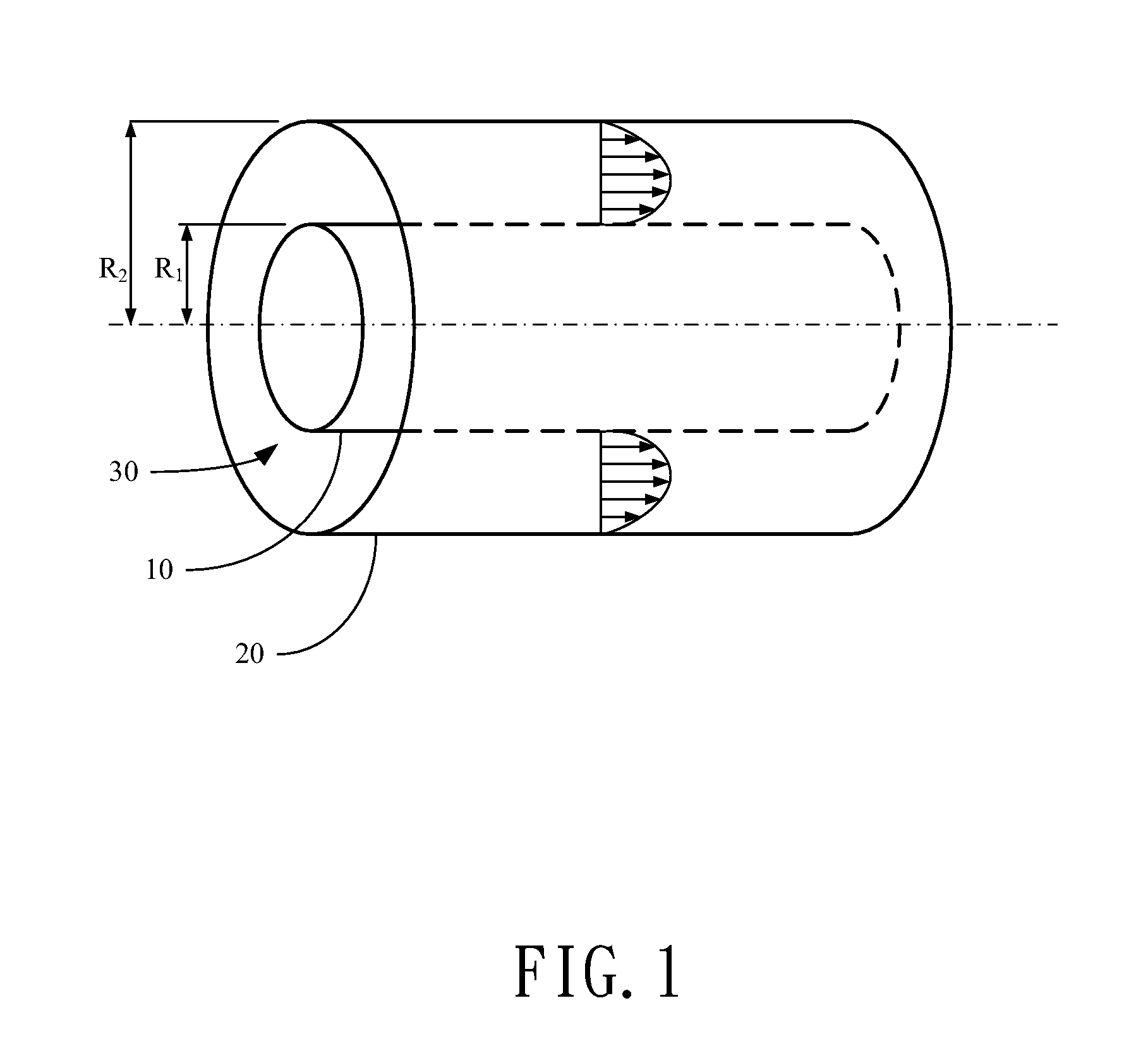
[0012]Referring to FIG. 1, the present invention discloses a method for measuring the zeta potential of the cylinder's outer surface. At first, a cylinder 10 having a first radius R1 and a reference tube 20 having a second radius R2 are provided. The first radius R1 is smaller than the second radius R2. There is channel between the cylinder 10 and the reference tube 20 to form a annular flow channel 30. In addition, the cylinder 10 is coaxial with the reference tube 20. Next, a solution is introduced to the annular flow channel 30. After that, the solution is forced by a pressure difference ΔP to flow through the annular flow channel 30, wherein the flow direction of the solution is parallel to the axial direction of the reference tube 20. The net electric charges in the electric double layer on the two walls move along with the flow so as to generate streaming potential. A measuring process is performed to measure the streaming potential difference Ē between the two ends of the ann...
second embodiment
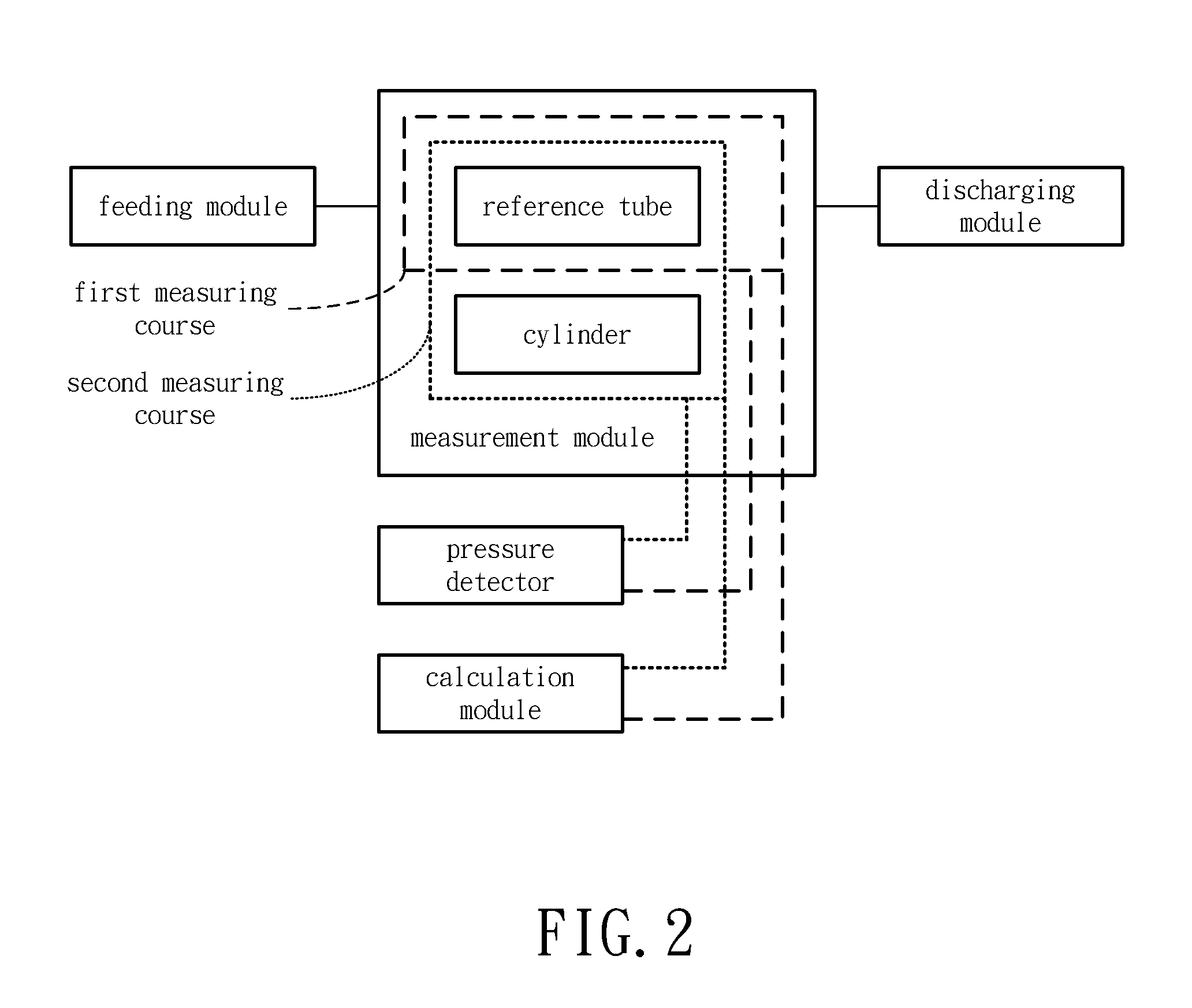
[0015]Referring to FIG. 2, the present invention discloses a measurement system for measuring the zeta potential of the cylinder's outer surface. The system comprises: a feeding module; a measurement module having a reference tube; a discharging module; at least one pressure detector; and a calculation module. The measurement module receives a solution from the feeding module, the solution is forced to flow through the inner side of the reference tube, which forms a straight flow channel, and then the solution is discharged to a discharging module so as to form a first measuring course. Thus, the measurement module generates a first potential difference signal via the first measuring course. Besides, the cylinder and the reference tube are assembled to form a second measuring course. The radius of the cylinder is smaller than that of the reference tube and the cylinder is coaxial with the reference tube. The solution received by the measurement module is forced to flow through the a...
PUM
| Property | Measurement | Unit |
|---|---|---|
| Electrical conductivity | aaaaa | aaaaa |
| Viscosity | aaaaa | aaaaa |
| Zeta potential | aaaaa | aaaaa |
Abstract
Description
Claims
Application Information
 Login to View More