Check patentability & draft patents in minutes with Patsnap Eureka AI!

Multilayer information recording medium and production method therefor

Inactive Publication Date: 2009-03-19
PANASONIC CORP
View PDF25 Cites 0 Cited by
  • Summary
  • Abstract
  • Description
  • Claims
  • Application Information

AI Technical Summary

Benefits of technology

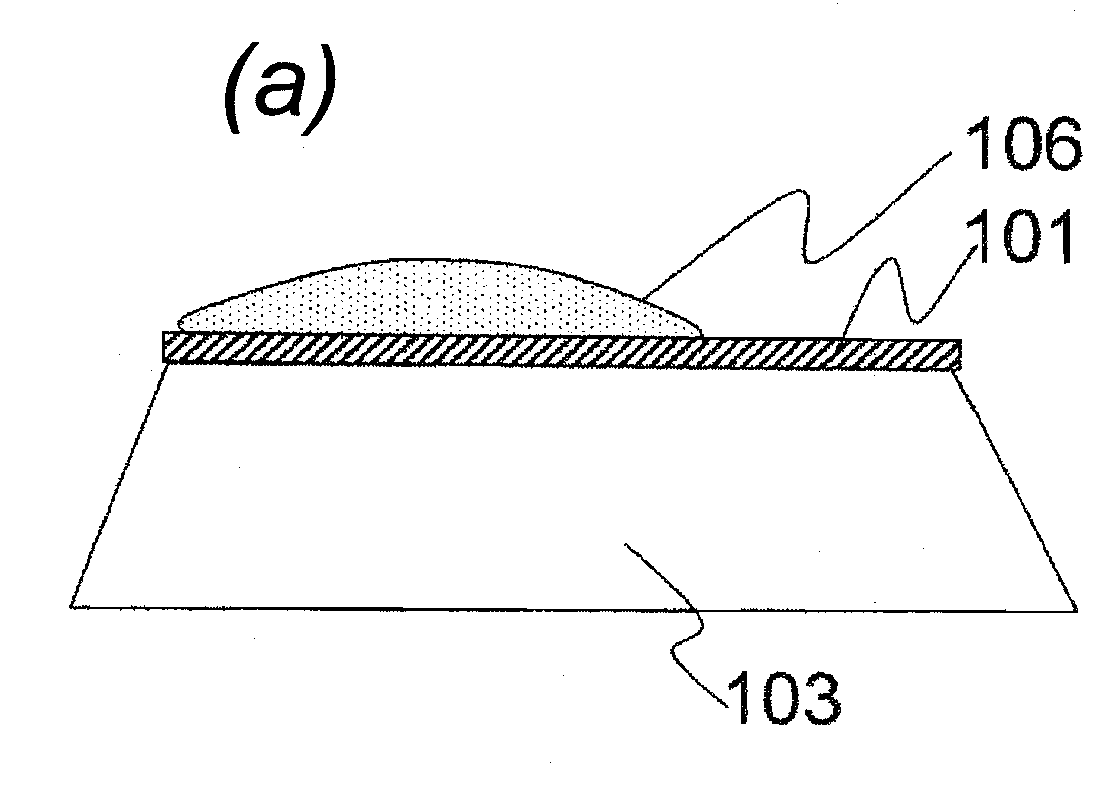
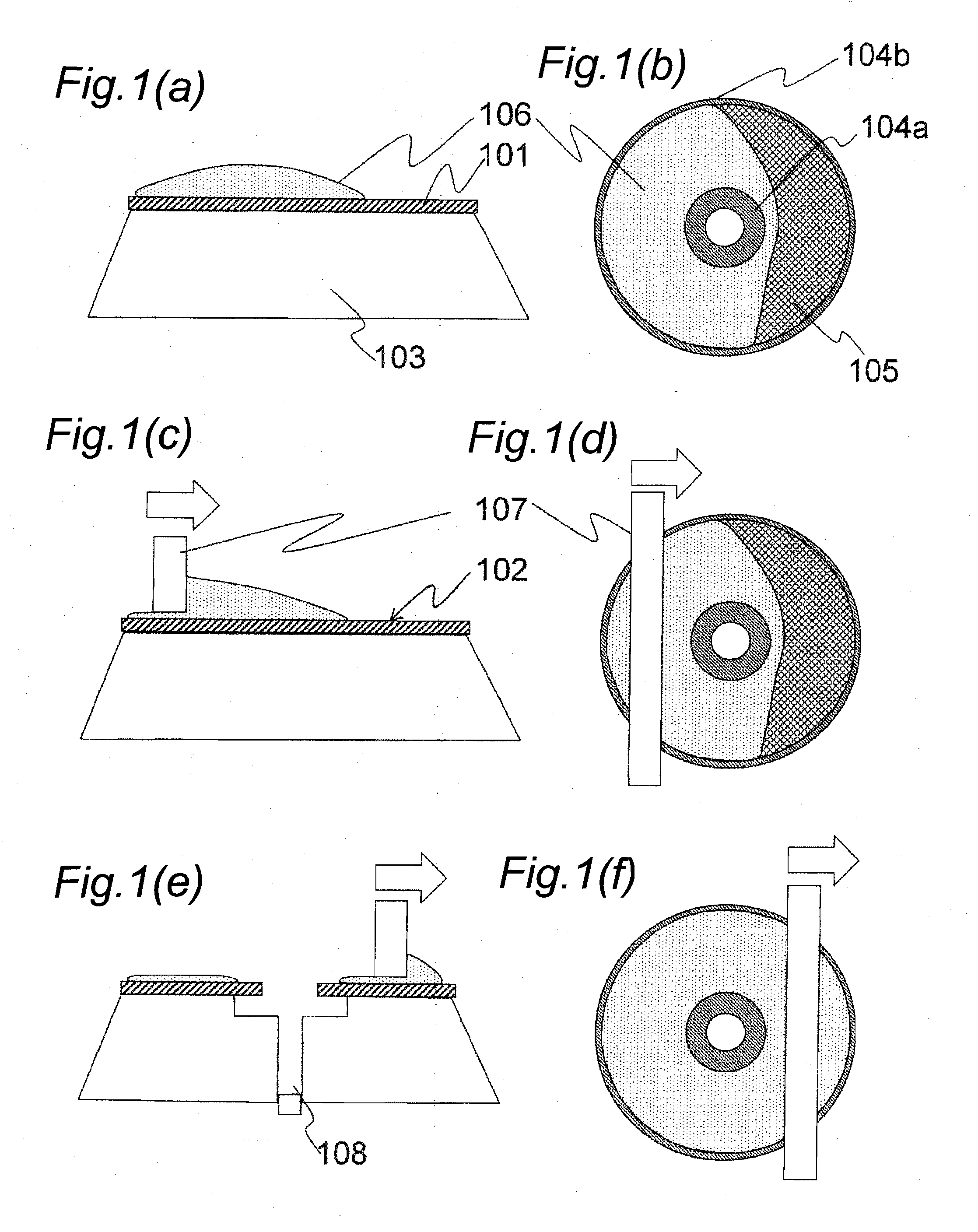
[0025]In order to solve the above problems of the prior art, it is therefore an object of the present invention to provide a multilayer information recording medium and a method for producing the multilayer information recording medium for the purposes of forming a resin layer between information recording layers so as to have a uniform thickness at high speed, and reducing the frequency of maintenance of production equipment so as to lower.
[0028]Further, it is preferred that the method for producing a multilayer information recording medium further includes, prior to feeding a resin onto the substrate, subjecting a specified area of the substrate to an oil repellent treatment to increase the contact angle of the specified area with the resin.
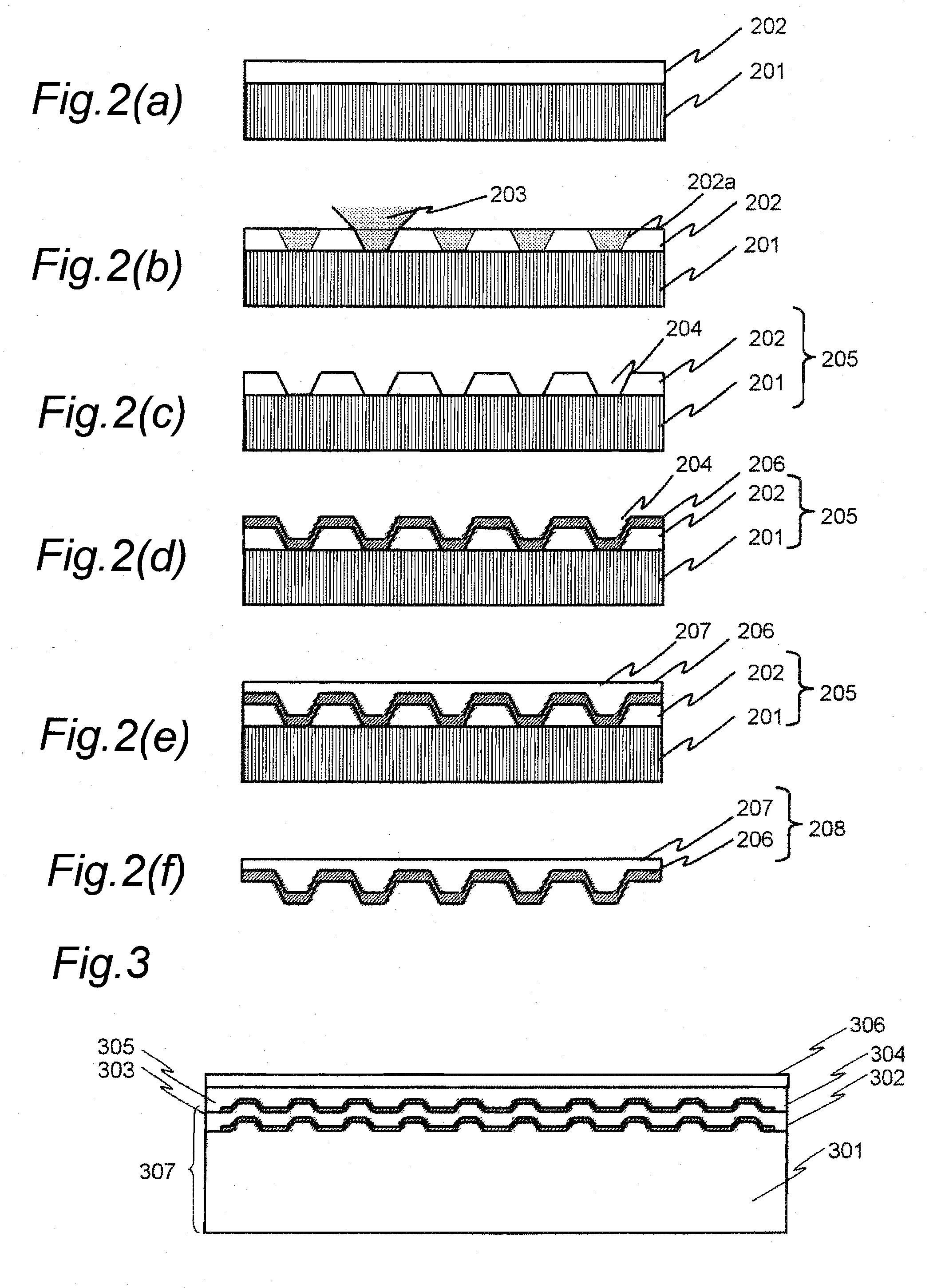
[0039]The information recording medium relating to the present invention is characterized in producing by the above described method for producing a multilayer information recording medium according to the present invention. The multilayer information recording medium according to the present invention has excellent uniformity in the thickness of a resin layer interposed between each pair of information recording layers, which makes it possible to achieve a small fluctuation in an optical path length from a light source to each information recording layer of the medium, to suppress a fluctuation in an aperture for a light spot resulting from optical aberration, and to stabilize focusing control and tracking control.
[0040]According to the present invention, it is possible to provide a multilayer information recording medium having excellent uniformity in the thickness of a resin layer interposed between each pair of information recording layers and therefore achieving good recording / reproducing of signals, and a method for producing such a multilayer information recording medium.

Problems solved by technology

When signals are recorded / reproduced onto / from a medium using laser light, there are problems that such a thickness variation in the signal substrate causes spherical aberration and thus an aperture for a light spot fluctuates, and the thickness variation in the signal substrate also adversely affects the focusing control for focusing a light spot on an information recording layer and the tracking control for allowing a light spot to follow a signal.
Furthermore, in the case of using a spin-coating method, it is necessary to perform spin-coating for each resin layer, and therefore it is difficult to reduce a tact time.

Method used

the structure of the environmentally friendly knitted fabric provided by the present invention; figure 2 Flow chart of the yarn wrapping machine for environmentally friendly knitted fabrics and storage devices; image 3 Is the parameter map of the yarn covering machine
View more

Image

Smart Image Click on the blue labels to locate them in the text.
Viewing Examples
Smart Image
  • Multilayer information recording medium and production method therefor
  • Multilayer information recording medium and production method therefor
  • Multilayer information recording medium and production method therefor

Examples

Experimental program
Comparison scheme
Effect test

first embodiment

[0133]FIG. 5 is a cross-sectional view of a multilayer information recording medium according to a first embodiment of the present invention. The multilayer information recording medium includes a first signal substrate 501, a first thin film layer 502, a second signal substrate 503, a second thin film layer 504, a third signal substrate 505, a third thin film layer 506, a fourth signal substrate 507, a fourth thin film layer 508, and a transparent layer 509. The first signal substrate 501 is a substrate having a signal surface provided with pits and / or guide grooves with concavo-convex shape, and the first thin film layer 502 is provided on the signal surface of the first signal substrate 501. The second signal substrate 503 has a signal surface provided with pits and / or guide grooves with concavo-convex shape, the signal surface being provided on the opposite side of the first signal substrate 501, and the second thin film layer 504 is provided on the signal surface of the second ...

second embodiment

[0181]A method for producing a multilayer information recording medium according to a second embodiment of the present invention is different from the method for producing a multilayer information recording medium according to the first embodiment in that a thin film containing a predetermined metal element is formed on a non-resin-coated region to provide with oil repellency to the non-resin-coated region. Other structures such as resin layers are formed in the same manner as in the case of the first embodiment. In the method for producing a multilayer information recording medium according to the second embodiment, an Au thin film (thickness: 40 nm) is formed on a non-resin-coated region of a signal transfer substrate with a magnetron sputtering apparatus to provide with oil repellency to the non-resin-coated region.

[0182]Hereinbelow, a method for forming a thin film containing a predetermined metal element on a non-resin-coated region will be described.

[0183]i) First, a first sig...

third embodiment

[0193]A method for producing a multilayer information recording medium according to a third embodiment of the present invention is different from the methods for producing a multilayer information recording medium according to the first and second embodiments in that a predetermined oil repellent seal is attached to a non-resin-coated region to provide with oil repellency to the non-resin-coated region. Other structures such as resin layers are formed in the same manner as in the case of the first embodiment. In the method for producing a multilayer information recording medium according to the third embodiment, an UV-curing resin is applied onto a signal transfer substrate after an oil repellent seal is attached to a non-resin-coated region of the signal transfer substrate.

[0194]Hereinbelow, a method for attaching a predetermined oil repellent seal to a non-resin-coated region to provide with oil repellency to the non-resin-coated region will be described.

[0195]i) First, a first si...

the structure of the environmentally friendly knitted fabric provided by the present invention; figure 2 Flow chart of the yarn wrapping machine for environmentally friendly knitted fabrics and storage devices; image 3 Is the parameter map of the yarn covering machine
Login to View More

PUM

PropertyMeasurementUnit
Thicknessaaaaaaaaaa
Diameteraaaaaaaaaa
Contact angleaaaaaaaaaa
Login to View More

Abstract

Disclosed herein is a method for producing a multilayer information recording medium having at least two information recording layers, in which a resin layer is formed between each pair of the information recording layers, the method including: holding a substrate; feeding a resin onto the substrate; and removing the excess resin by moving a squeegee throughout the entire surface of the substrate so that the interval between the bottom surface of the squeegee and the surface of the substrate is kept constant. The substrate may have a resin-coated region, onto which the resin is to be applied, and a non-resin-coated region, onto which the resin is not to be applied. In this case, the resin-coated region has a smaller contact angle with the resin than the non-resin-coated region. The method for producing a multilayer information recording medium may further include, prior to feeding a resin onto the substrate, subjecting a specified area of the substrate to an oil repellent treatment to increase the contact angle of the specified area with the resin.

Description

TECHNICAL FIELD[0001]This application claims priority based on Japanese Patent Application No. 2005-143746 filed in Japan on May 17, 2005, the disclosure of which is incorporated herein by reference.[0002]The present invention relates to a multilayer information recording medium for reproducing information or recording and reproducing information, and a method for producing such a multilayer information recording medium.BACKGROUND ART[0003]In recent years, the amount of information demanded is increasing, and therefore, in the field of information equipment, audiovisual equipment, and the like, attention is being given to an information recording medium, such as an optical disk, which is designed to have easy accessibility to data and a large storage capacity of data and contribute to downsizing of equipment in order to achieve higher-density information recording. For example, in the field of optical disks, there is proposed an optical recording medium having a storage capacity of ...

Claims

the structure of the environmentally friendly knitted fabric provided by the present invention; figure 2 Flow chart of the yarn wrapping machine for environmentally friendly knitted fabrics and storage devices; image 3 Is the parameter map of the yarn covering machine
Login to View More

Application Information

Patent Timeline
no application Login to View More
IPC IPC(8): B32B3/00B05D3/12G11B7/24G11B7/24038G11B7/258G11B7/2595
CPCG11B7/26G11B7/24038
Inventor TOMEKAWA, YUUKOTOMIYAMA, MORIONISHIKIORI, KEIJITSUKUDA, MASAHIKO
Owner PANASONIC CORP
Features
  • R&D
  • Intellectual Property
  • Life Sciences
  • Materials
  • Tech Scout
Why Patsnap Eureka
  • Unparalleled Data Quality
  • Higher Quality Content
  • 60% Fewer Hallucinations
Social media
Patsnap Eureka Blog
Learn More