[0006]One
advantage of the invention thus resides in the fact that while the surgical apparatus is in use, there is no need to reach around the instrument or even to set it down. This increases the ease of operation of the apparatus, largely excludes the possibility that it will be erroneously controlled because the wrong key has been actuated, and improves both quality and efficiency of the surgical procedure, because the individual
modes are rapidly accessible.
[0007]It is advantageous for the surgical apparatus that the control unit be designed so that the setting of at least one function position is delayed by a prespecified latency. This means that there is at least one function position that does not elicit an immediate response when detected by the control unit. That is, the control unit delays either the performance of a mode by the electrical instrument, or the change of mode itself. Thus, the physician himself has the opportunity independently to detect a defective operation of the switching rocker and to react to it soon enough to avoid erroneous controlling of the apparatus. With regard to the
mechanics, this
delay by the prespecified latency has still another
advantage. Often mechanically triggered sensors trigger with some
delay. Hence it can be the case that with the switching rocker a function position is adopted that one or both sensors do not immediately detect. If this should happen, the function position can be falsely detected by the control unit. A latency adapted to this delay when detecting the function position ensures that the correct function position will be detected.
[0008]Preferably, the guide device is designed so that a direct change between the function positions is prevented. Accordingly, there is a mechanical protection against the change from one function position to another. The change between the function positions can be selected from the initial position, only. Such a clear sequence of events prevents the occupation of “intermediate positions” (for instance, a position between the first and third function positions) and ensures an unambiguous and reliable operation of the surgical apparatus. Especially in connection with this mechanical protection, it is helpful for the control unit to be designed such that it enters an
error state, in order to
signal and / or to eliminate an error, when it is detected that a direct change from one function position into another has been carried out. Since the direct change is not possible on account of the mechanical protection described above, the control unit can diagnose an error in the
mechanics or sensors of the actuation device and inform or warn the user of the surgical apparatus accordingly. It is advantageous for the electrical instrument to be put into a
secure state when the apparatus has entered this
error state.
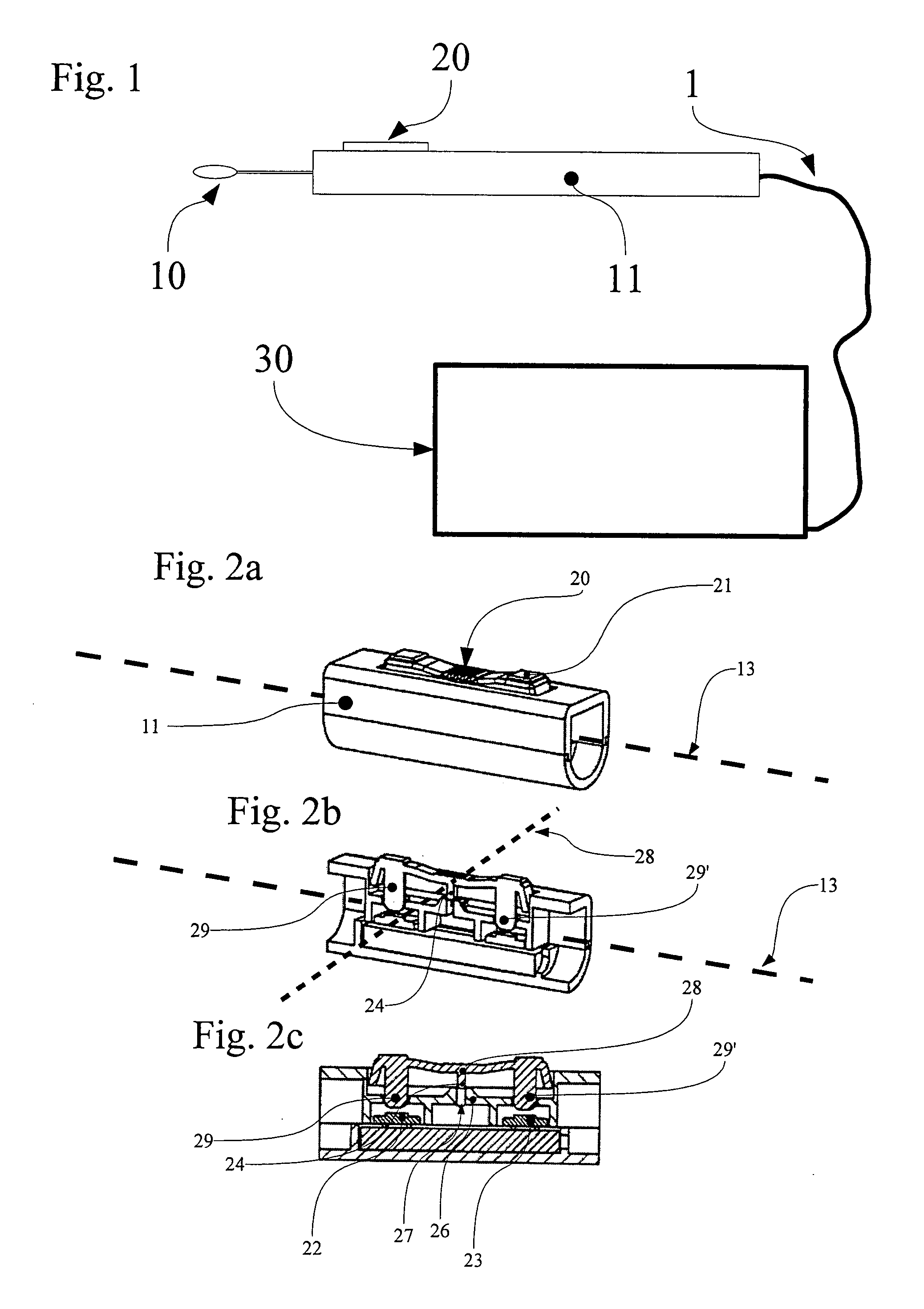
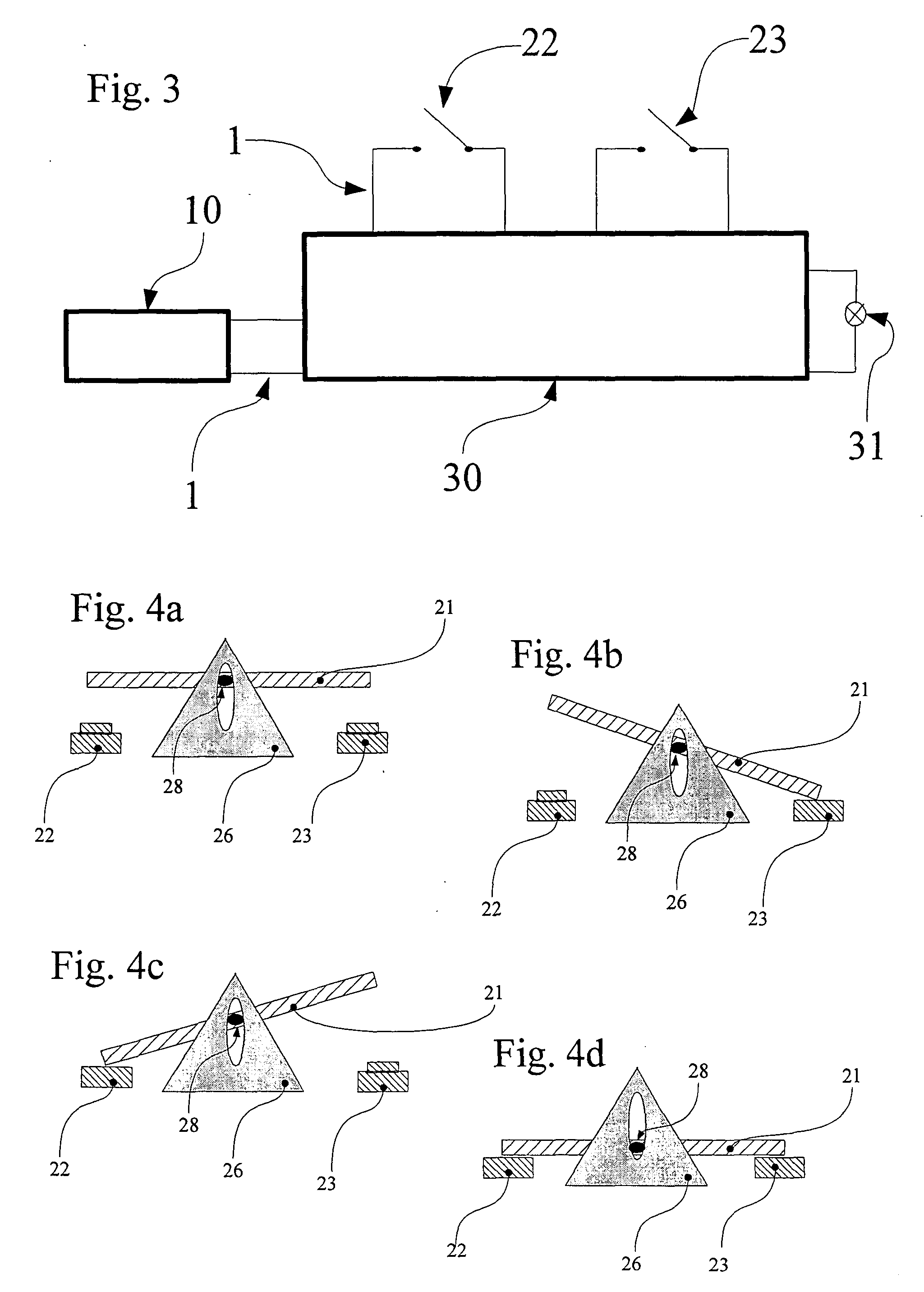
[0009]Preferably the sensors each comprise a key button. These two key buttons can be disposed so that in the first function position only the circuit involving the first button, in the second position only the circuit involving the second button, and in the third position both circuits are closed. This quite simple construction is robust and nevertheless enables the three function positions to be detected.
[0010]Preferably there is fixedly connected to the oblong operating element an oblong projection that extends into the
handle substantially perpendicular to the rocker axis and to a
long axis of the operating element, and that interacts functionally with a guide opening of the guide device in such a way that the operating element can be either rotated or pressed inward. The projection and the oblong operating element form a T-shaped body, the horizontal part of which corresponds to the operating element and the vertical part, to the projection. Starting from the initial state, it is possible to rotate about the rocker axis, which is positioned perpendicular to the
horizontal and vertical parts of the T-shaped body. However, if no
vertical force is acting on the T-shaped body, at least part of the projection extends into the guide opening and prevents rotation about the rocker axis. Owing to this arrangement, a direct change between the function positions can be prevented, which results in the advantages described above.
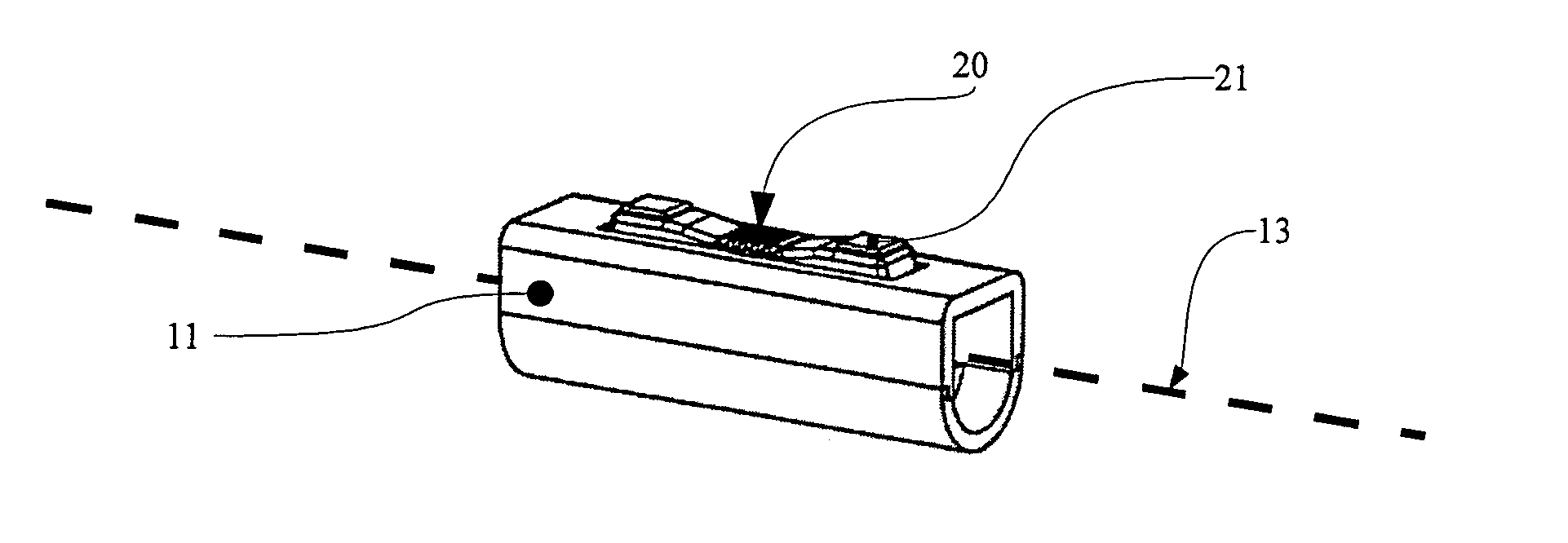
[0011]Preferably the switching rocker is disposed at the handle in such a way that it is possible simultaneously to operate the switching rocker and to guide the instrument with one hand. A comfortable as well as reliable handling of the instrument is thus guaranteed.


 Login to View More
  Login to View More