
Chip structure, substrate structure, chip package structure and process thereof
- Summary
- Abstract
- Description
- Claims
- Application Information
AI Technical Summary
Benefits of technology
Problems solved by technology
Method used
Image

Examples
first embodiment
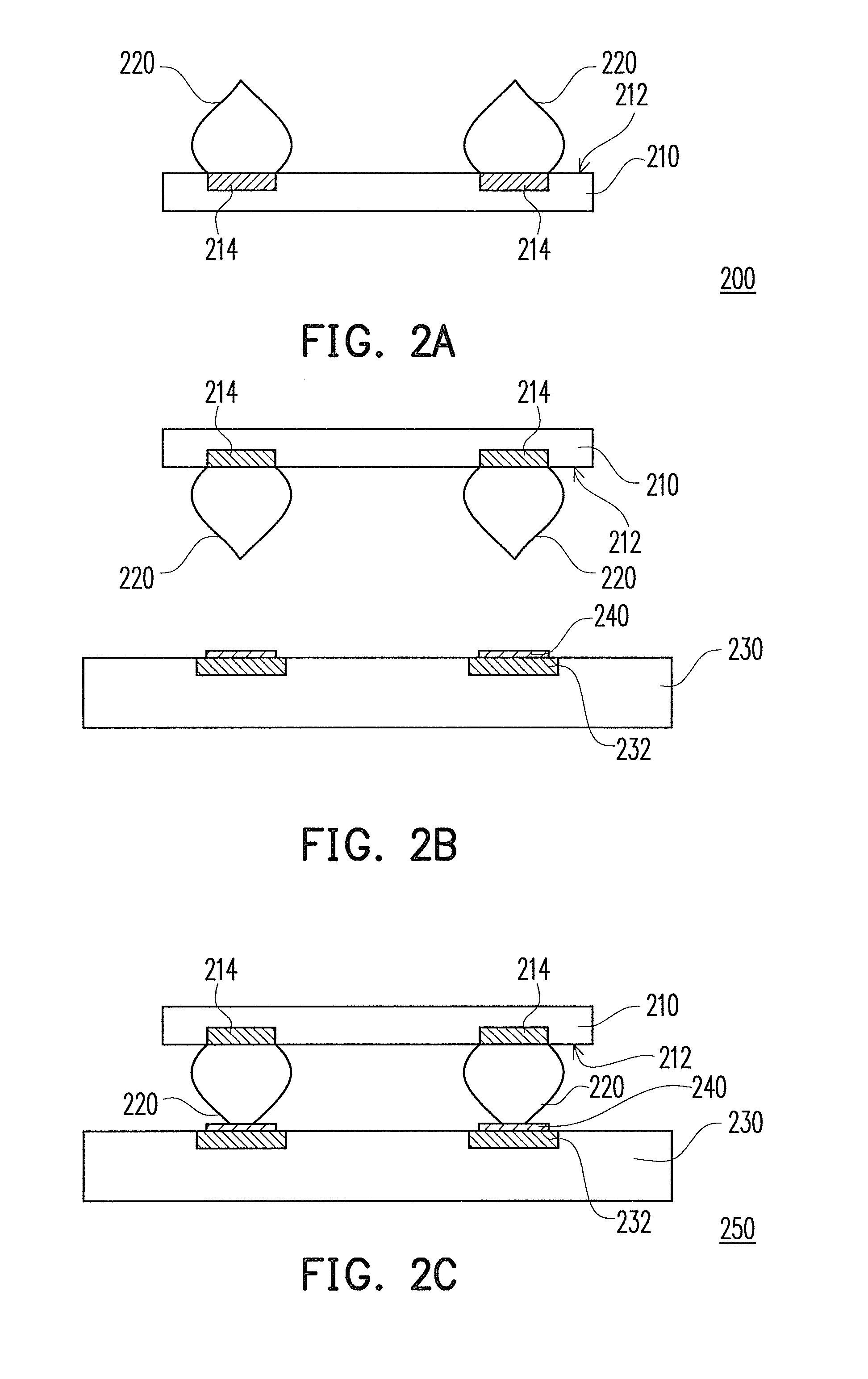
[0026]FIGS. 2A through 2C are schematic views of a chip package structure and a process of fabricating the same according to the present invention. Referring to FIG. 2A, a chip package structure 200 includes a chip 210 and a plurality of stud bumps 220. A plurality of bonding pads 214 are disposed on an active surface 212 of the chip 210, and the bonding pads 214 are, for example, made of aluminumn. Here, the bonding pads 214 serve as input / output interfaces of electronic signals. The chip 210 can be used in ball grid array (BGA) structures, such as semiconductor devices including light sensing devices, light emitting devices, or processors. The stud bumps 220 are bump-shaped gold balls formed by melting gold wires with use of a wire-bonding machine. After the gold balls are pressed onto the bonding pads 214, the gold wires are cut off. The use of the gold bumps formed by wire bonding and EFO is conducive to accelerating the manufacturing process and improving throughput, so as to e...
second embodiment
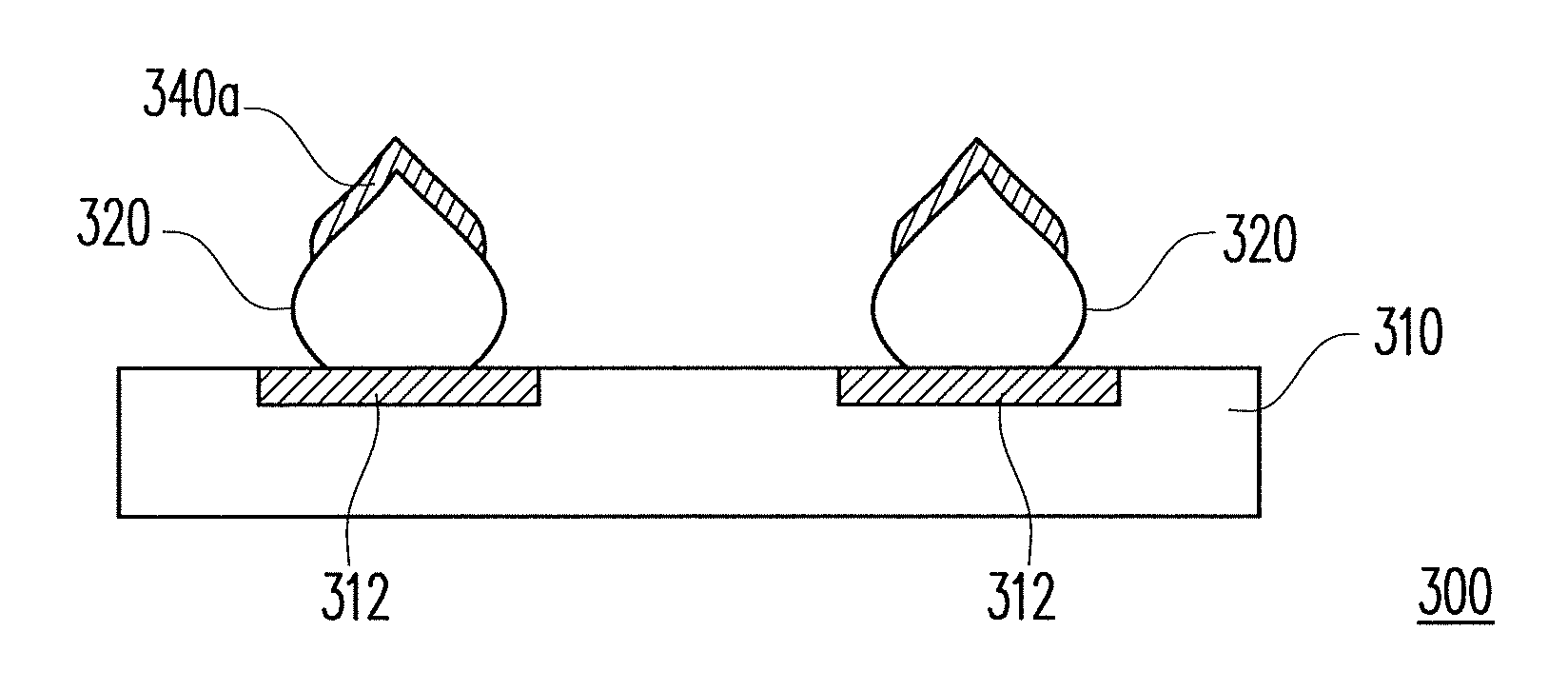
[0030]FIGS. 3A through 3C are schematic views of a chip package structure and a process of fabricating the same according to the present invention. Referring to FIG. 3A, a chip package structure 300 includes a substrate 310 and a plurality of stud bumps 320. The substrate 310 is, for example, a printed circuit board, and the substrate 310 has a plurality of contact pads 312 made of copper, for example. The stud bumps 320 are bump-shaped gold balls formed by melting gold wires with use of a wire-bonding machine. After the gold balls are pressed onto the bonding pads 312, the gold wires are cut off. The formation of the stud bumps 320 on the substrate 310 can prevent the wire-bonding machine from exerting an excessive strength to the chip. As such, integrated circuits within the chip are not damaged. Additionally, it is more cost-effective to fabricate the stud bumps 320 on the substrate 310. Besides, the yield and the throughput can be improved while the rework rate can be reduced.
[0...
PUM
| Property | Measurement | Unit |
|---|---|---|
| Percent by mass | aaaaa | aaaaa |
Abstract
Description
Claims
Application Information
 Login to View More