
Ultra low output impedance RF power amplifier for parallel excitation
- Summary
- Abstract
- Description
- Claims
- Application Information
AI Technical Summary
Benefits of technology
Problems solved by technology
Method used
Image

Examples
Embodiment Construction
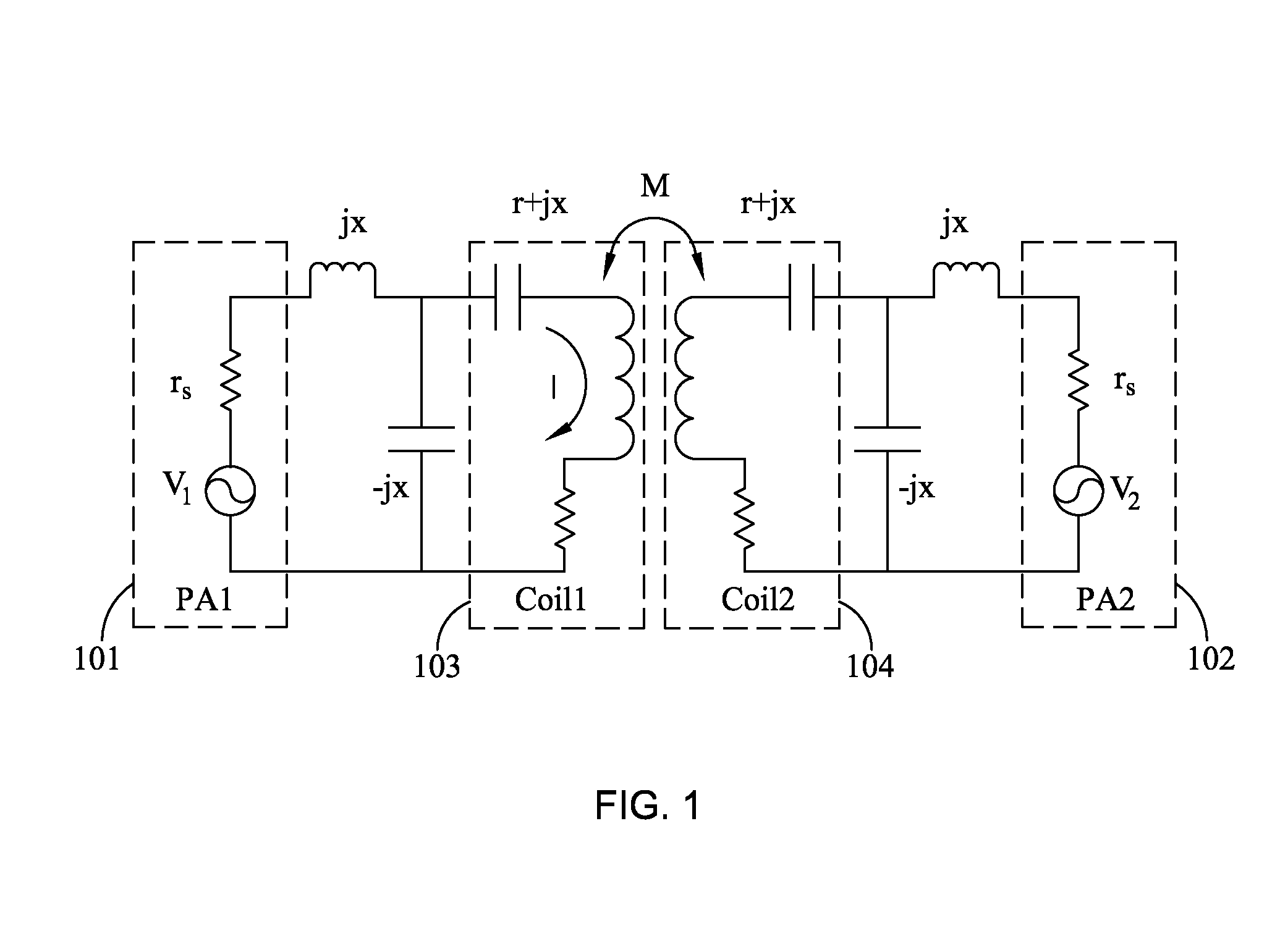
[0015]Referring to FIG. 1, it shows an equivalent circuit model of two identical coils 103, 104 driven by two independent RF power amplifiers 101, 102. Each power amplifier is modeled as a voltage source with a source resistance rs. The impedance of each coil without matching components is r+jx, and the inductive coupling between these two coils is captured by mutual inductance M. Representing a common configuration, the L-shaped matching network on each coil, which is consisted of a capacitor and an inductor, not only transforms the low impedance of the series resonant coil into a desired value (normally 50Q), but also amplifies the input current by x / r times. When both coils 103, 104 are driven by their corresponding amplifiers 101, 102, the current I running in coil 103 is consisted of two components, the desired one I(S) that is due to the controlling voltage V1 and the undesired (corruptive) one I(M) that is due to V2:
{I(S)=-jxV1rrS+ω2M2rS2 / (rrS+x2)+x2I(M)=-jxV2rrS+ω2M2rS2 / (rrS...
PUM
 Login to View More
 Abstract
Description
Claims
Application Information
 Login to View More