Process for the selective hydrodesulfurization of a gasoline feedstock containing high levels of olefins

a technology of olefins and hydrodesulfurization, which is applied in the petroleum industry, hydrocarbon oil refining, and refining to eliminate heteroatoms. it can achieve the effects of high selectivity, low phosphorus content, and high hydrodesulfurization activity

a technology of olefins and hydrodesulfurization, which is applied in the petroleum industry, hydrocarbon oil refining, and refining to eliminate heteroatoms. it can achieve the effects of high selectivity, low phosphorus content, and high hydrodesulfurization activity

US20090223866A1Inactive Publication Date: 2009-09-10CHEM RES & LICENSING CO

Image

Smart Image Click on the blue labels to locate them in the text.
Viewing Examples
Smart Image
  • Process for the selective hydrodesulfurization of a gasoline feedstock containing high levels of olefins
  • Process for the selective hydrodesulfurization of a gasoline feedstock containing high levels of olefins
  • Process for the selective hydrodesulfurization of a gasoline feedstock containing high levels of olefins

Examples

Experimental program
Comparison scheme
Effect test

example i

[0103]This Example describes the preparation of Catalyst A, which is a high activity catalyst suitable for use in the various embodiments of the inventive process. Also described in this example is a comparison catalyst, which is a commercially available catalyst, that was compared to Catalyst A in the selective hydrodesulfurization experiments described in Example II.

Catalyst A

[0104]In accordance with the invention, Catalyst A was prepared from an alumina support having a relatively high surface of at least 280 m2 / g, and which contained a low concentration of silica. The support for Catalyst A was prepared using a commercially available silica-alumina powder material, which contained 2 wt % silica with the remaining balance being substantially entirely alumina. The powder was mixed with deionized water in an amount to provide an approximate loss on ignition for the mixture of around 64 wt %. Also added to the mixture was approximately 1 wt % of a 69.8% nitric acid solution and appr...

example ii

[0107]This Example summarizes the experiment used to measure the performance of Catalyst A and the comparison catalyst in the selective hydrodesulfurization of an olefin-containing hydrocarbon feedstock having a concentration of sulfur.

[0108]The testing was performed using high throughput nanoreactors. Approximately 1 ml of crushed catalyst was used in each reactor. The feed to the reactors was a synthetically prepared gasoline feedstock that included a range of hydrocarbon components that are typically found in cracked gasoline (e.g., heptane, hexane, octane, octane, butylenes, and toluene), and it was spiked with organic nitrogen and sulfur compounds to provide concentrations thereof. The reactors were operated under suitable selective hydrodesulfurization temperature, pressure and space velocity process conditions.

[0109]Summaries of the results from the aforedescribed testing are presented for illustrative purposes in the comparative plots presented in FIG. 3 and FIG. 4.

[0110]FIG...

the structure of the environmentally friendly knitted fabric provided by the present invention; figure 2 Flow chart of the yarn wrapping machine for environmentally friendly knitted fabrics and storage devices; image 3 Is the parameter map of the yarn covering machine
Login to View More

PUM

PropertyMeasurementUnit
pore diameteraaaaaaaaaa
weight percentaaaaaaaaaa
Login to View More

Abstract

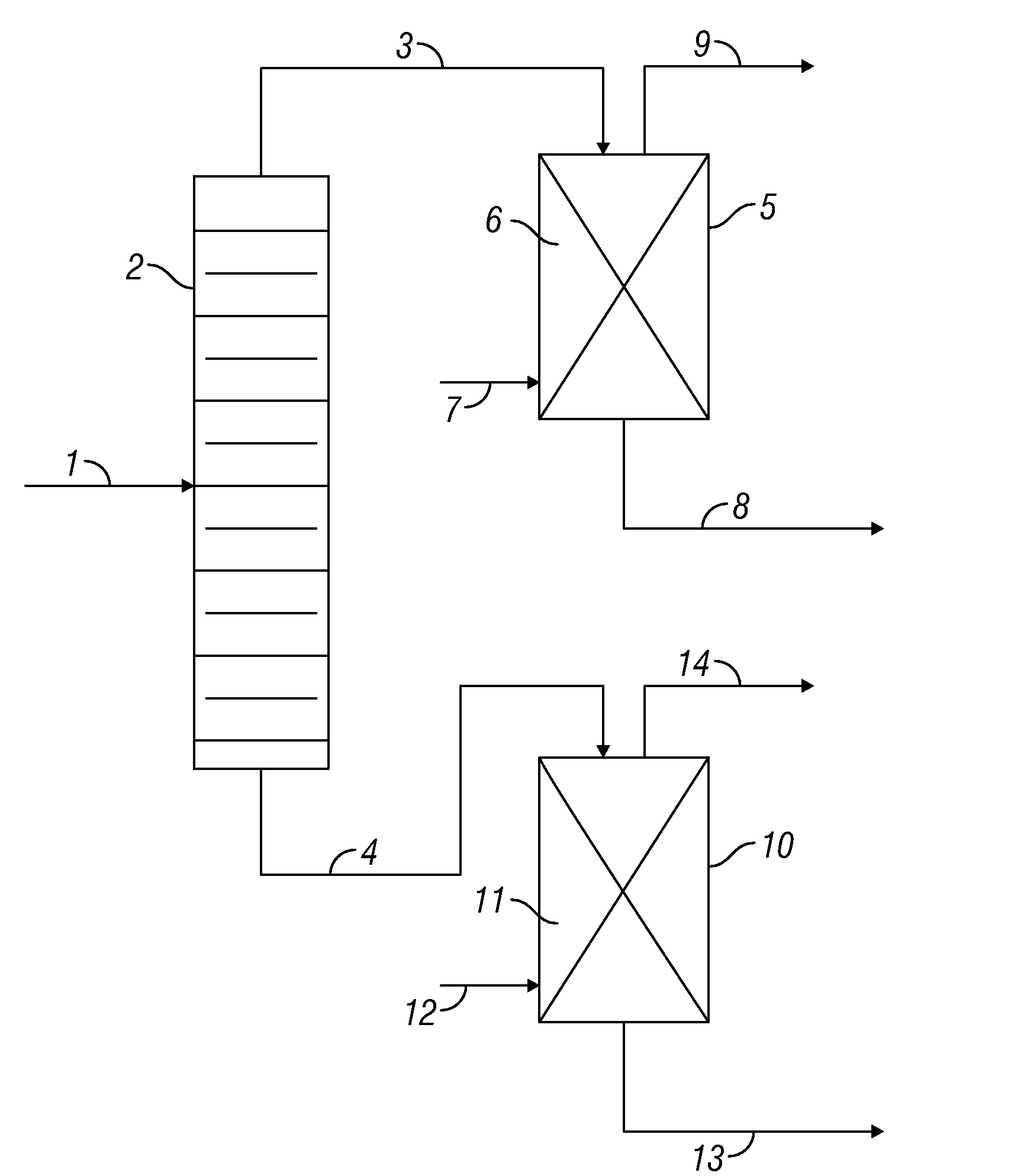
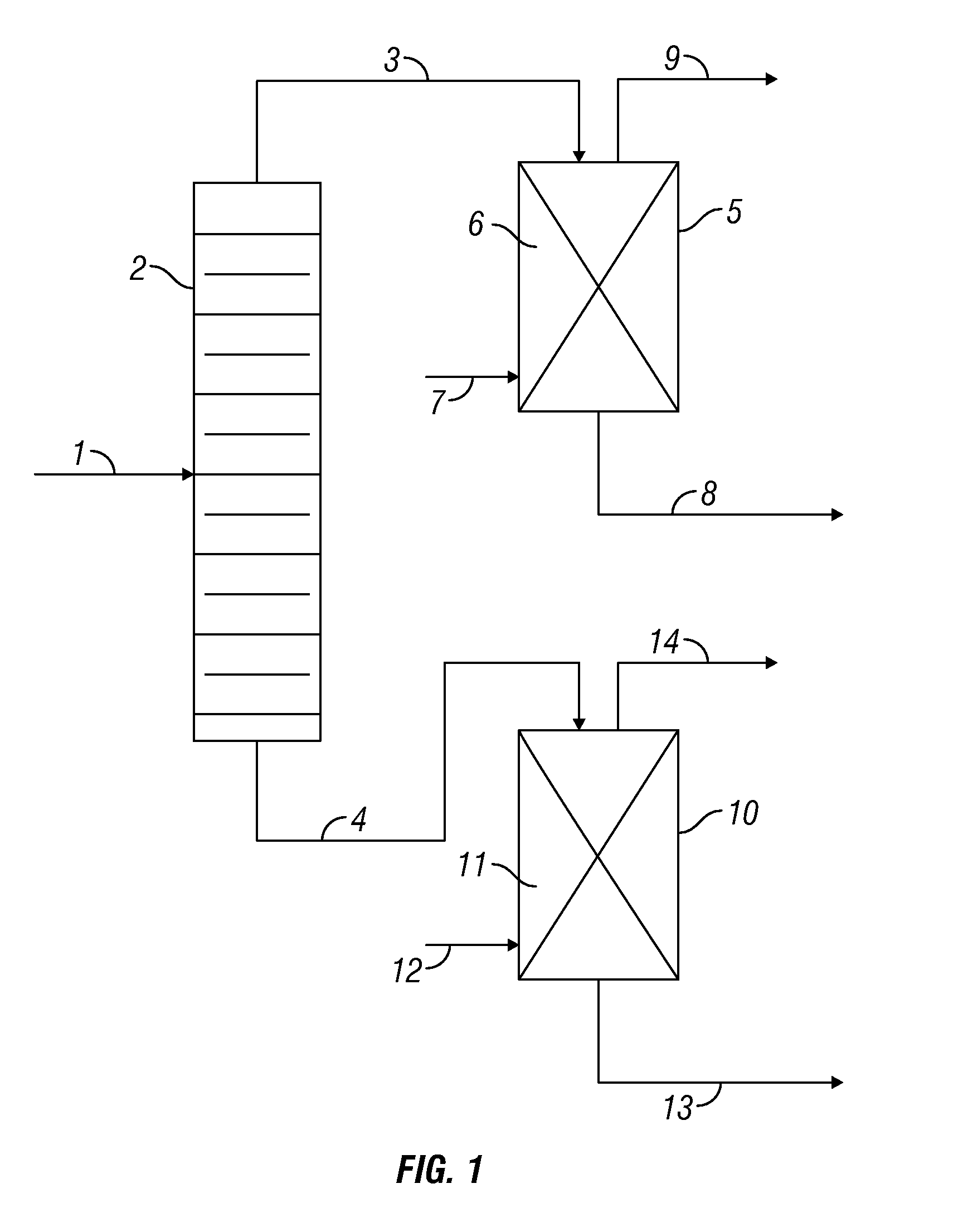
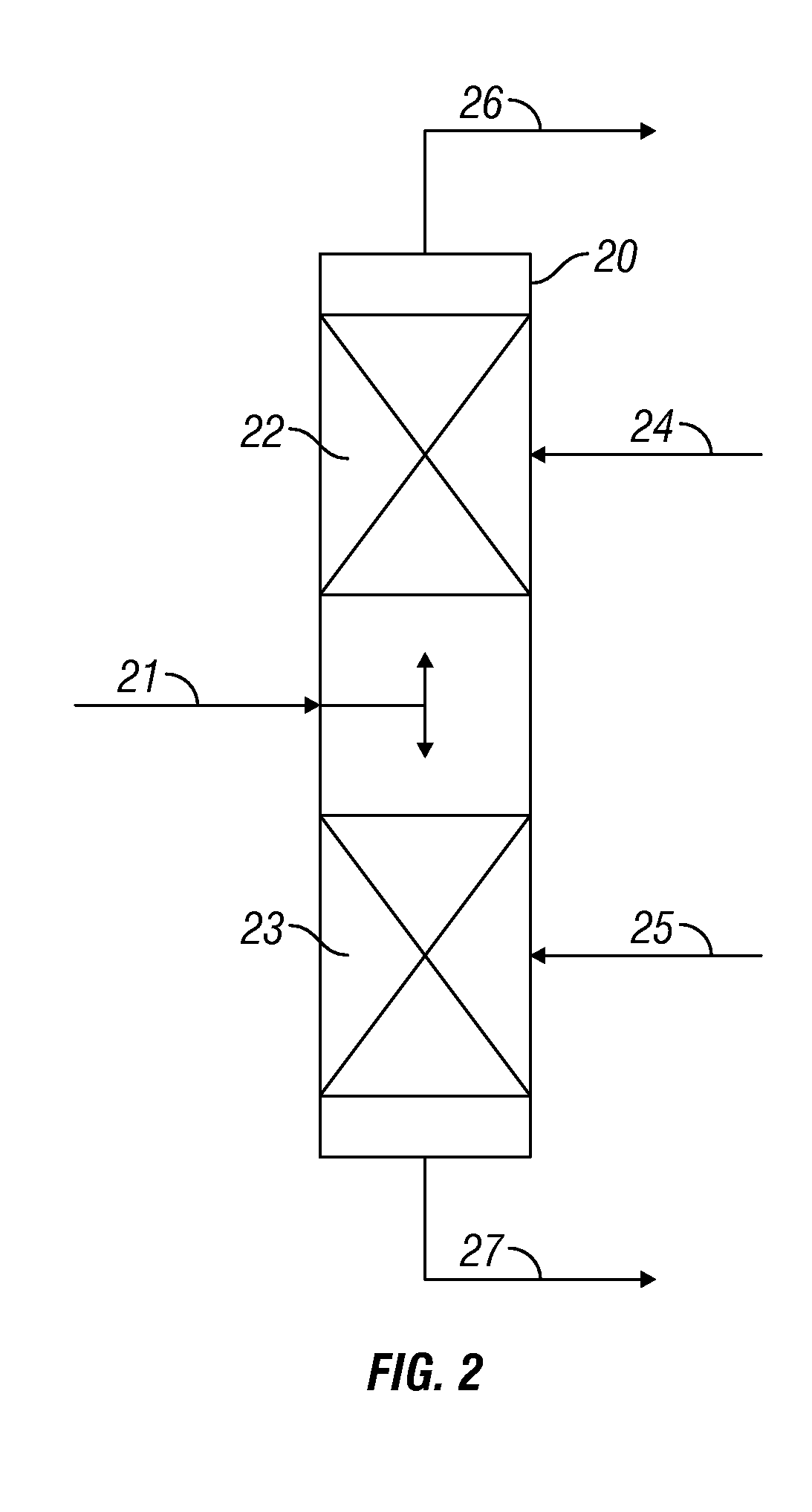
A process for selective hydrodesulfurization of a sulfur and olefin-containing hydrocarbon feedstock boiling in the naphtha or gasoline boiling range utilizing a particularly defined high activity hydrodesulfurization (HDS) catalyst composition comprising a cobalt component, a molybdenum component and little or no phosphorus, prepared on a special alumina support containing a low concentration of silica and having a high surface area of at least 280 m2 / g. In another aspect the process involves separating the feedstock into a light and a heavy fraction, followed by selectively hydrodesulfurizing the heavy fraction using a particularly defined high activity HDS catalyst and hydrodesulfurizing the light fraction with a particularly defined high selectivity HDS catalyst. The process also includes performing the separation into fractions and the selective hydrodesulfurization of the fractions in a distillation column reactor utilizing different particularly defined HDS catalysts.

Description

[0001]This application is a continuation-in-part application of prior application Ser. No. 12 / 043,847, filed Mar. 6, 2008, and this application is a continuation-in-part application of prior application Ser. No. 12 / 043,841, filed Mar. 6, 2008, and this application claims the benefit of U.S. Provisional Application No. 61 / 051,300, filed May 7, 2008, and this application claims the benefit of U.S. Provisional Application No. 61 / 051,278, filed May 7, 2008, and this applications claims the benefit of U.S. Provisional Application No. 61 / 051,294, filed May 7, 2008.FIELD OF INVENTION[0002]This invention relates to the selective hydrodesulfurization of an olefin-containing hydrocarbon feedstock boiling in the naphtha or gasoline boiling range.BACKGROUND OF INVENTION[0003]Gasoline regulations are increasingly creating a need to treat various refinery streams and products, for example, cracked gasoline blending material, including coker naphtha and gasoline from a catalytic cracking unit, to ...

Claims

the structure of the environmentally friendly knitted fabric provided by the present invention; figure 2 Flow chart of the yarn wrapping machine for environmentally friendly knitted fabrics and storage devices; image 3 Is the parameter map of the yarn covering machine
Login to View More

Application Information

Patent Timeline
10 Sep 2009
Publication
US20090223866A1
IPC
C10G45/04
CPC
C10G45/08
Inventors
BHAN, OPINDER KISHAN