
Surface-based nucleic acid assays employing morpholinos
a nucleic acid assay and surface technology, applied in specific use bioreactors/fermenters, biomass after-treatment, biochemical apparatus and processes, etc., can solve the problems of high s conditions, not having a monitoring method, and complex surface hybridization practice, etc., to achieve the effect of reducing the background of cross-hybridization, increasing electrostatic stringency, and reducing the complexity of cross-hybridization
- Summary
- Abstract
- Description
- Claims
- Application Information
AI Technical Summary
Benefits of technology
Problems solved by technology
Method used
Image

Examples
examples
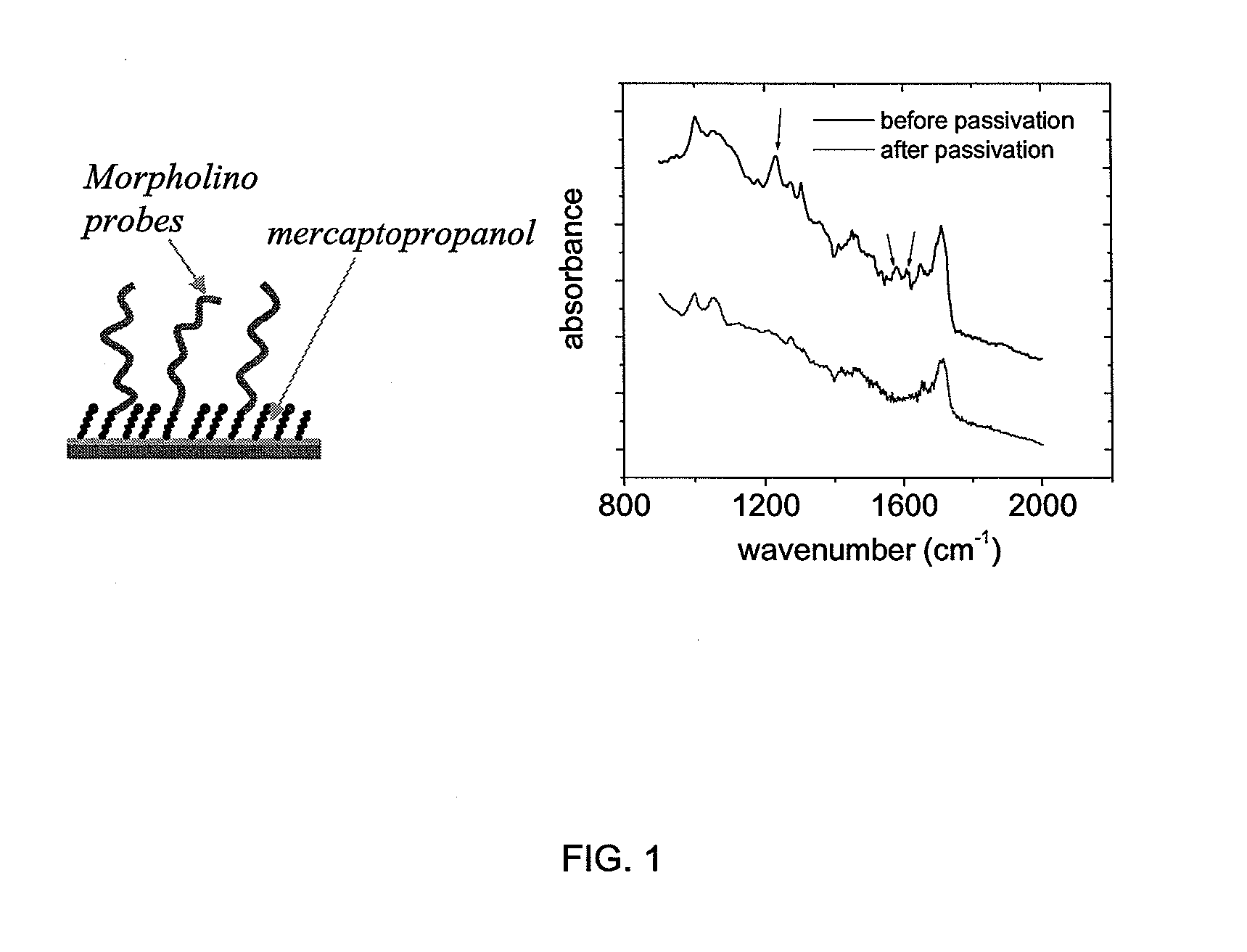
[0065]Morpholino probe films, and for comparison DNA probe films, on gold electrode supports were prepared using methods adapted from the literature. In a first step, both Morpholino probe strands and DNA probe strands modified with sulfhydryl or disulfide terminal groups were chemisorbed to the gold support, with the terminal groups reacting to form thiolate bonds with the gold. In addition to this end-specific attachment, the affinity of the nucleic bases for gold causes adsorption of the probes through the base sites. This surface adsorption interferes with the ability to undergo facile hybridization with target species. Therefore, in a second step, the nonspecific backbone-surface interactions were displaced by exposing the probe layer to a solution of an alkanethiol. The sulfhydryl moiety on the alkanethiol preferentially chemisorbs to the gold to displace the weaker base-gold interactions and to passivate, or block, the gold surface against further adsorption.
[0066]Mercaptopro...
PUM
| Property | Measurement | Unit |
|---|---|---|
| Temperature | aaaaa | aaaaa |
| Nanoscale particle size | aaaaa | aaaaa |
| Ionic strength | aaaaa | aaaaa |
Abstract
Description
Claims
Application Information
 Login to View More