Suction cups as described by Lassley tend to flex when pressure is applied to the base during
wax scraping and brushing procedures causing undesirable movement of the ski or snowboard during the tuning process.
The suction cups also tend to lose suction or have difficulty keeping a vacuum when there are scratches, irregularities, dust or
dirt on the surface of the ski or snowboard, or when the surface of the ski or snowboard is not flat.
Brill describes anti-slip pads that rely on friction to hold a ski or snowboard in place when positioned base-up, however relying on adhesion of the anti-slip pads alone is not enough to prevent unwanted movement during the aforementioned
wax scraping and brushing procedures.
As snowboards are typically three times wider than skis it is difficult to provide a support wide enough to support the entire width of a snowboard that does not hinder or interfere with base tuning procedures when a relatively narrow ski is placed on the same support.
As is the case with U.S. Pat. No. 6,663,094 to Weissenborn, Bunnell's ski support is limited in its ability as it cannot be used to tune a ski without a binding or hold a ski to facilitate binding mounting.
Further disadvantages exist as Bunnell's support is rather large, cumbersome and not very versatile.
One
disadvantage of Clarke's apparatus is due to the size of the board rest.
Removing the snowboard bindings is
time consuming and unnecessary for most tuning procedures.
Further, the support apparatus described by Clarke only supports the snowboard in the immediate vicinity of the bindings leaving the snowboard
shovel and
tail portions unsupported and thereby allowing unwanted flexing and / or movement during tuning procedures.
A further
disadvantage of Clarke'
s system is that each board rest does not seem to have any provision to be readily detached from each support member, so it is necessary to re-
mount the entire support apparatus to a supporting work surface each time the apparatus is used which is inconvenient and cumbersome.
Such fixed jaw clamps are not ideal for holding a variety of new wider shaped skis as the ski is typically offset relative to the ski support members when clamped and therefore not centered and unstable when resting on the supports.
Recent performance enhancing changes to bicycle frames including the introduction of non-circular square, rectangular, oval, asymmetric teardrop and other new aerodynamic frame tubes and seat post cross-sections have made clamping a wide variety of frames difficult and impractical.
Disadvantages to Gantois' stand are apparent as the transversely extending shaft used to
mount a fork does not have any provision to be readily detached and / or interchanged with longer or shorter shafts.
Also, as a result of recent performance enhancements to the bicycle frame bottom bracket, particularly the introduction of integrated bottom bracket designs where bottom bracket bearings are placed directly in the frame itself, the static
crank axle support Gantois describes does not support a wide variety of new bottom bracket shells with non-circular cross sections.
Further, Gantois's stand is not height adjustable so as to allow vertical adjustment of the bicycle to bring specific areas of a bicycle into easier reach of the worker, and the generally upright position of the bicycle relative to the stand changes depending on the size of bicycle frame being held which is undesirable when work is performed on a variety of bicycles.
In general the bicycle support stands mentioned above are expensive, cumbersome and not very versatile.
A
disadvantage of Knitt's
vise is that the position of the firearm relative to the support changes depending on the thickness of gunstock placed in the
assembly which can be problematic when performing sighting operations.
Disadvantages exist with Rickling's support as the apparatus requires
individual adjustment of each jaw to clamp the gunstock which is onerous and the clamp may not center the gunstock correctly.
Disadvantages with Durkee's disclosure are apparent as the elongated track required to house engagement nuts,
vise jaws and the spacing member is difficult to
mount, space consuming on a
workbench, and not generally portable.
Further, Durkee's clamping device does not retract a ski
brake when clamping a ski and is not very versatile as no means are provided to hold a ski by the ski binding or hold objects other than skis.



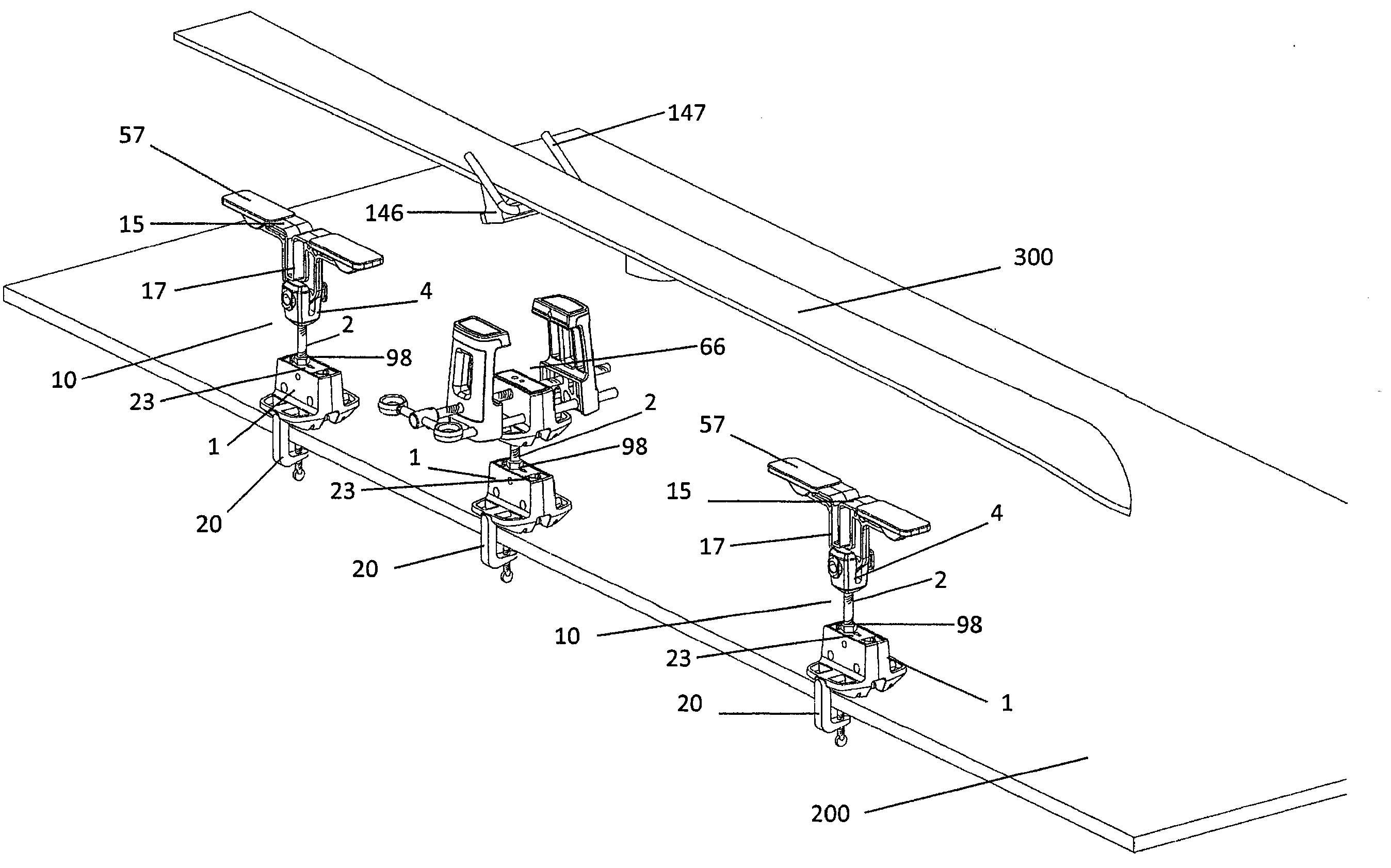
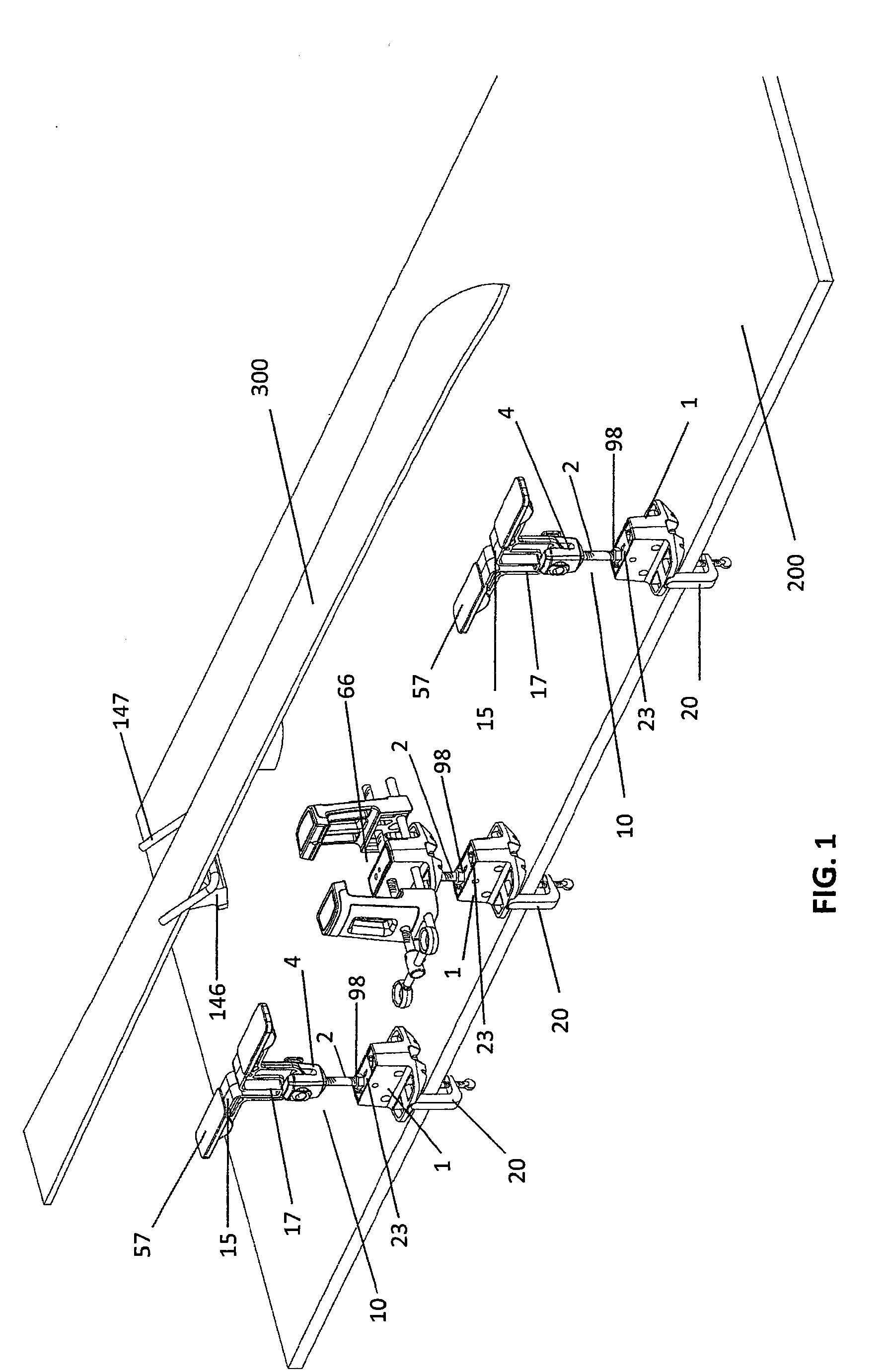
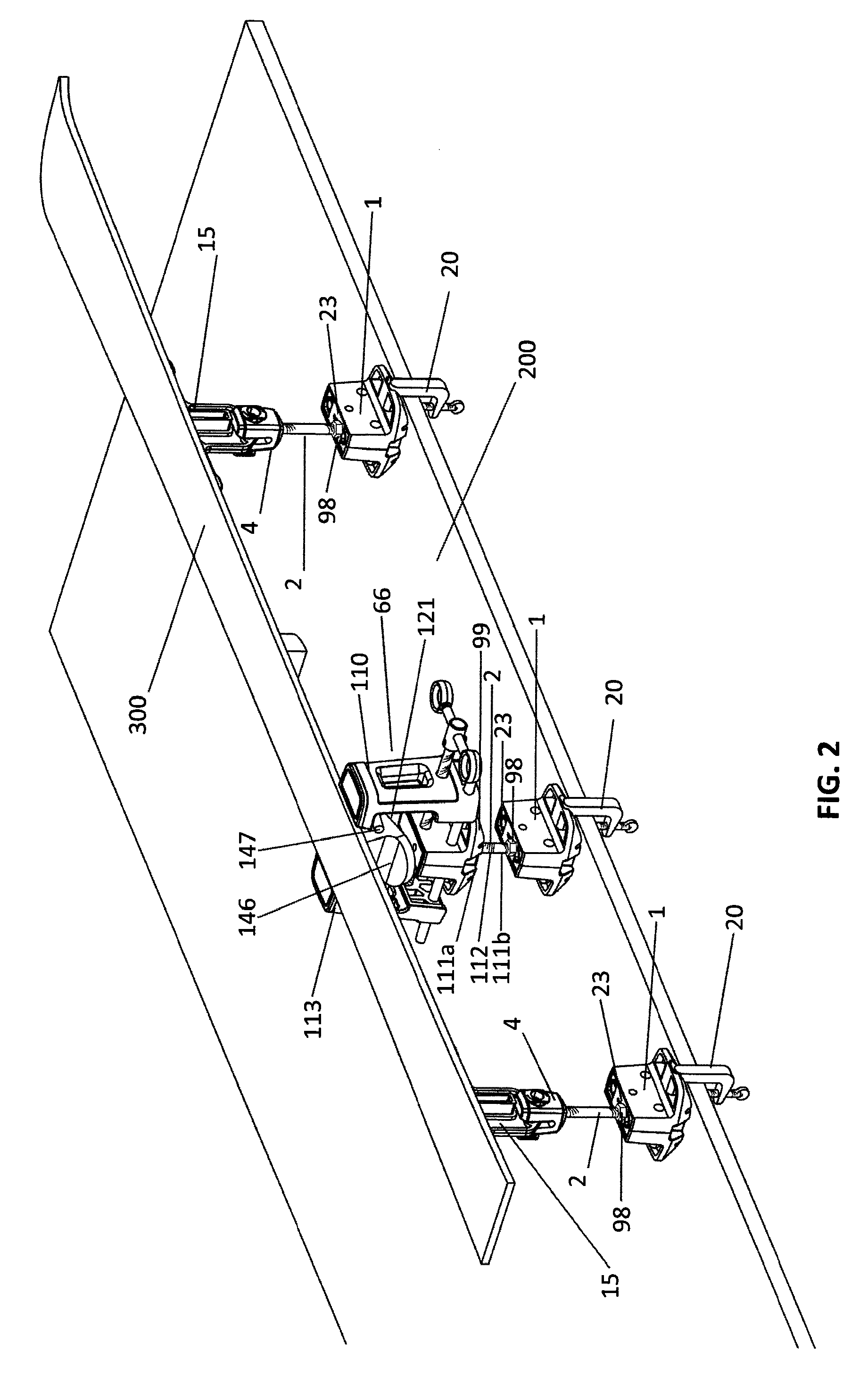
 Login to View More
  Login to View More