

Methods and compositions for stem cell self-renewal
a stem cell and composition technology, applied in the field of stem cell self-renewal, can solve the problems blockage of cell proliferation, and inability to understand the role of pten in stem cells and tumorigenesis, and achieve the effect of expanding the number of stem cells
- Summary
- Abstract
- Description
- Claims
- Application Information
AI Technical Summary
Benefits of technology
Problems solved by technology
Method used
Image

Examples
example 1
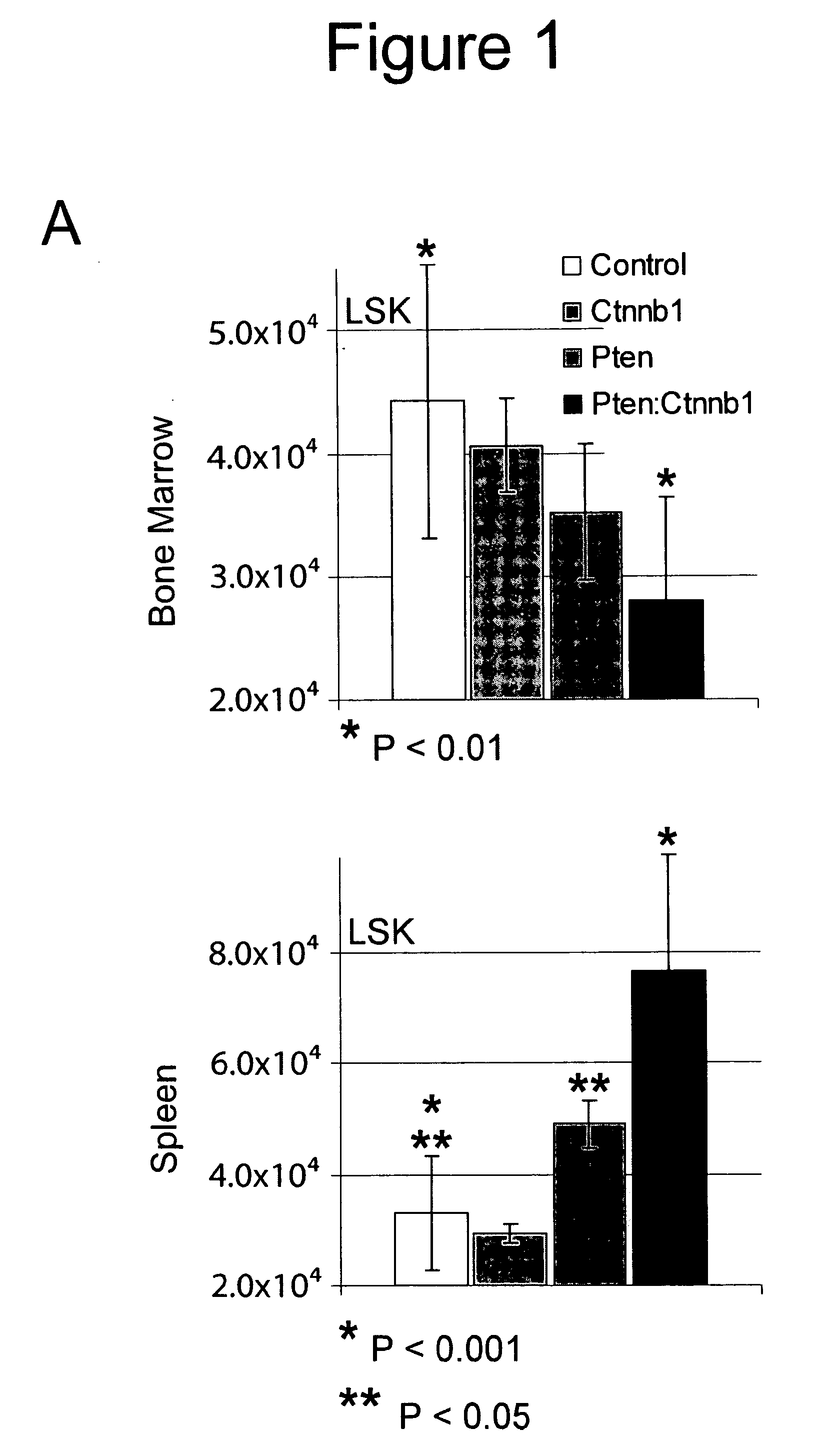
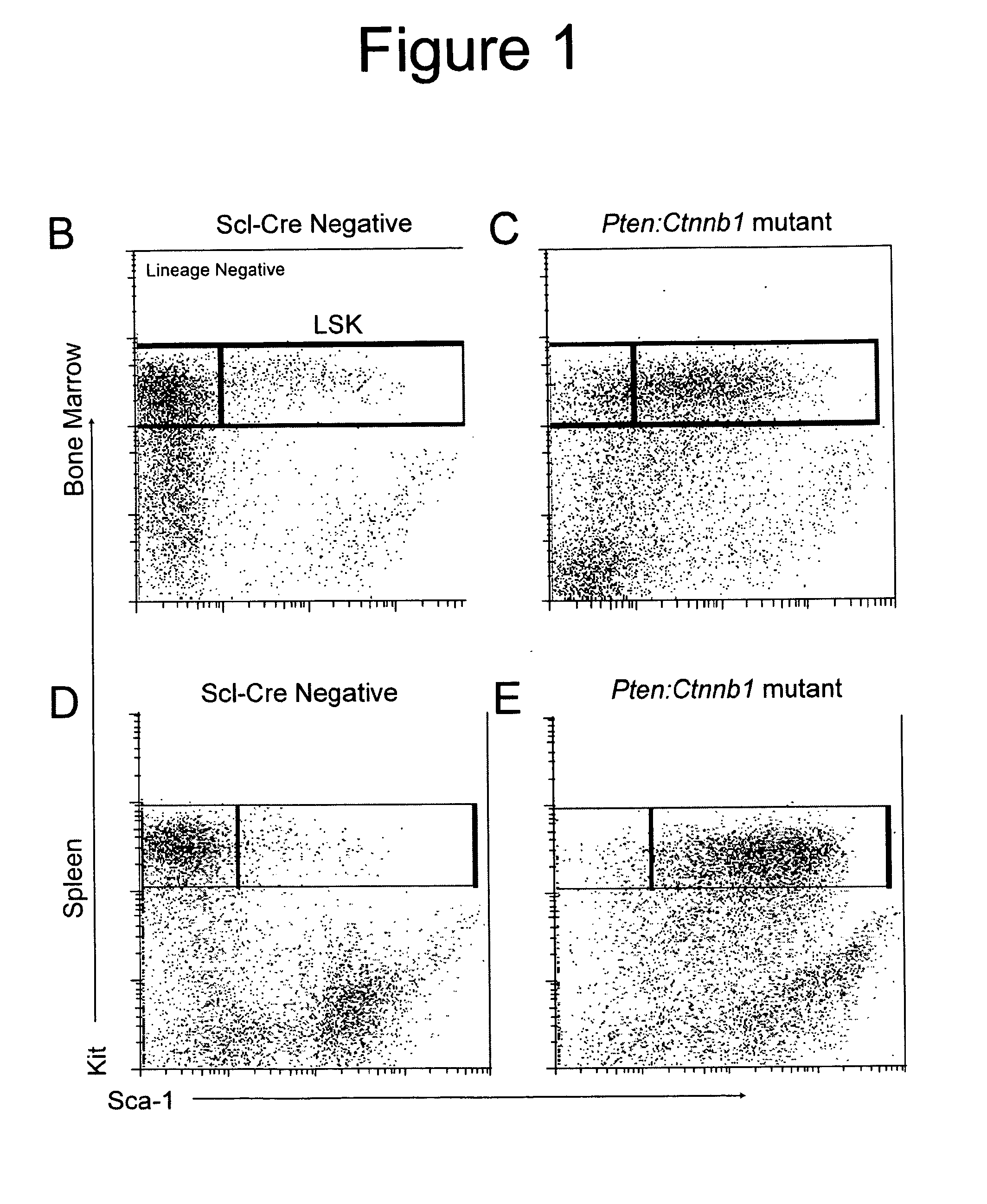
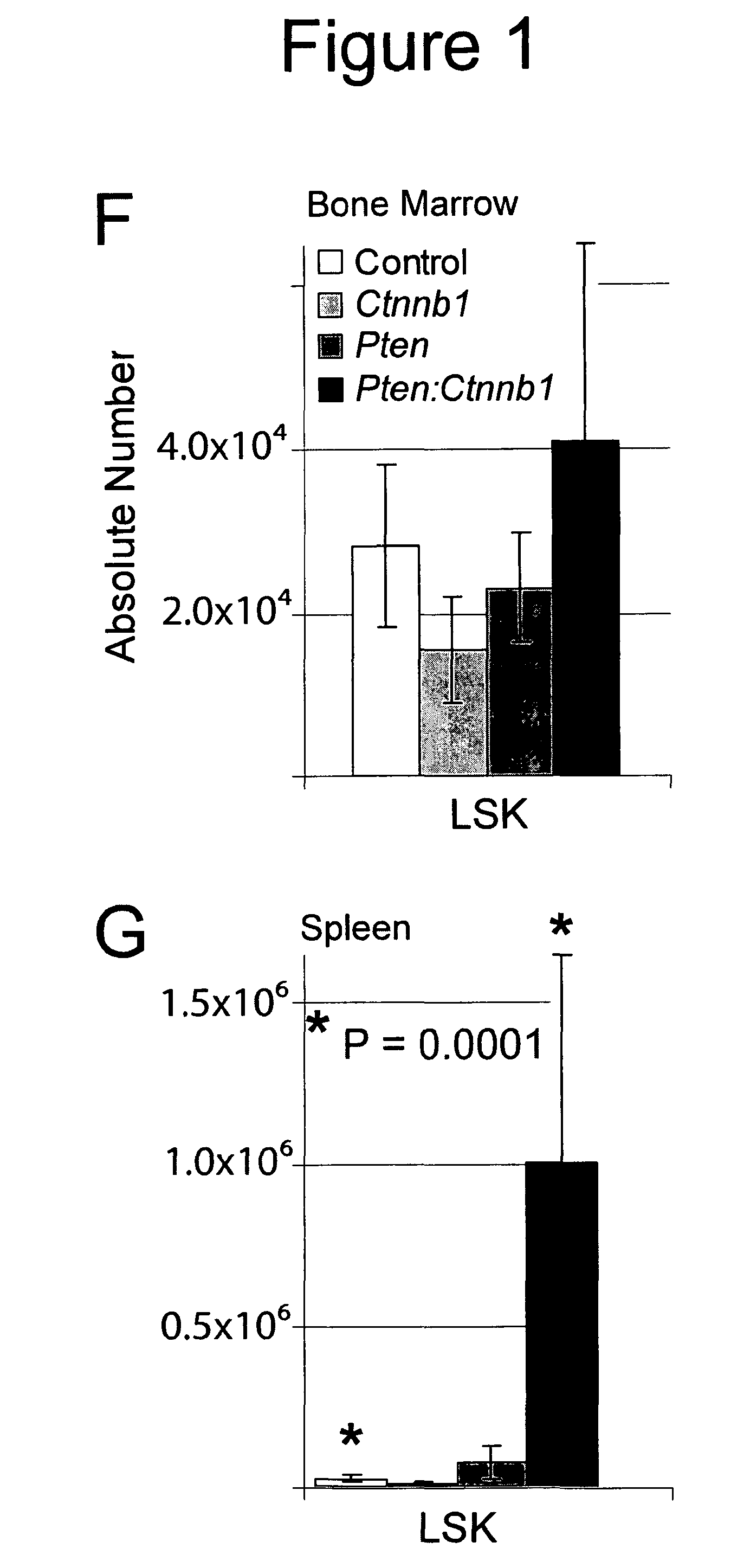
Loss of PTEN with Constitutively Active β-Catenin Leads to HSC Expansion with Loss of Early Hematopoietic Progenitors
Induction of PTEN / Constitutively Active β-Catenin Double Mutant Mice
[0146]Mice with homozygous floxed (fl) alleles of Pten (Ptenfl / fl) were bred with Ctnnb1fl / fl mice in which exon 3 of the mouse β-catenin gene (where all phosphorylation target serine / threonine residues are located) was sandwiched by two loxP sequences. (Harada, N., et al., Embo J, 18 (21): 5931-42 1999. Yilmaz, O. H., et al., Nature, 441:475-82 2006. Zhang, J., et al., Nature, 441 (7092): 518-22 2006.) Double heterozygous mice from this cross were then crossed to generate Ptenfl / fl Ctnnb1fl / + mice (since Ctnnb1 is a gain-of-function allele, only heterozygous mice for Ctnnb1 are necessary). Concurrently, Ptenfl / fl mice were bred with Scl-Cre+ transgenic mice to generate Scl-Cre+ Ptenfl / + mice. These were then crossed to generate Scl-Cre+Ptenfl / fl mice (“Pten”). Finally, Ptenfl / fl Ctnnb1fl / + mice were ...
example 2
In Vitro Culture of Control and Mutant LSK Cells
Cell Culture
[0159]LSK or LSK Flk2− cells were sorted into 96-well U-bottom tissue culture plates at 100 cells / well with 200 μl media / well. Cells were incubated at 37° C., 5% O2, 5% CO2 (balance N2) for the indicated number of days. One-half total volume of media (see Table 1, below for the base media) was carefully pipetted from the top and replaced with fresh media every other day.
TABLE 1Base MediaComponentsSourceStemSpan Media: (Iscove's-modified Stem Cell Technologies;Dulbecco's medium (IMDM) supplementedCat. No. 09600with 1% bovine serum albumin, 10 μgml−1 recombinant human insulin, 200 μgml−1 iron-saturated transferrin, 0.1mM 2-mercaptoethanol and 2 mM glutamine.)10 μg / ml HeparinSigma, Cat. No. H-31490.5X Penicillin / StreptomycinSigma, Cat. No. P433310 ng / ml recombinant mouse (rm) StemBiovision, Cat. No.Cell Factor4328-1020 ng / ml rm-ThrombopoietinCell Sciences, Inc, Cat.No. CRT401B
Double Mutant HSCs Expand Dramatically In Vitro and...
example 3
Transplantation Analysis of Pten and Pten:Ctnnb1 LSK Cells after 5 Weeks of Culture
[0165]For the following experiments, cells were cultured in the same manner as described in Example 2. As in Example 2, the base media of Table 1 was supplemented with 20 ng / ml rm-IGF-2 (R&D Systems, 792-MG) and 10 ng / ml recombinant human FGF-1 (Affinity BioReagents, ORP16010).
[0166]At 5 weeks culture, Pten and Pten:Ctnnb1 LSK cultures were re-sorted and 1000 LSK cells (CD45.2+) from each were transplanted into lethally irradiated (10Gy) CD45.1+ recipient mice along with 2×10⁵ congenic whole bone marrow competitor cells. Because wild-type cells did not survive 5 weeks culture, 1000 fresh wild-type LSK cells were also transplanted as a separate control group. At 4 weeks post-transplant, there was no detectable engraftment from peripheral blood analysis of mice transplanted with either Pten or Pten:Ctnnb1 LSK cultures (data not shown). At 5 weeks post-transplant, bone marrow from recipient mice was anal...
PUM
| Property | Measurement | Unit |
|---|---|---|
| molecular weight | aaaaa | aaaaa |
| molecular weight | aaaaa | aaaaa |
| molecular weight | aaaaa | aaaaa |
Abstract
Description
Claims
Application Information
 Login to View More