Unlock instant, AI-driven research and patent intelligence for your innovation.

Feedback Control for Shape Memory Alloy Actuators

a technology of shape memory alloy and actuator, applied in the direction of instrumentation, electric digital data processing, structural/machine measurement, etc., can solve the problems of large hysteresis, limited application, and complex control schemes based on such thermomechanical models

Active Publication Date: 2011-01-06
CANADIAN SPACE AGENCY
View PDF14 Cites 8 Cited by
  • Summary
  • Abstract
  • Description
  • Claims
  • Application Information

AI Technical Summary

Benefits of technology

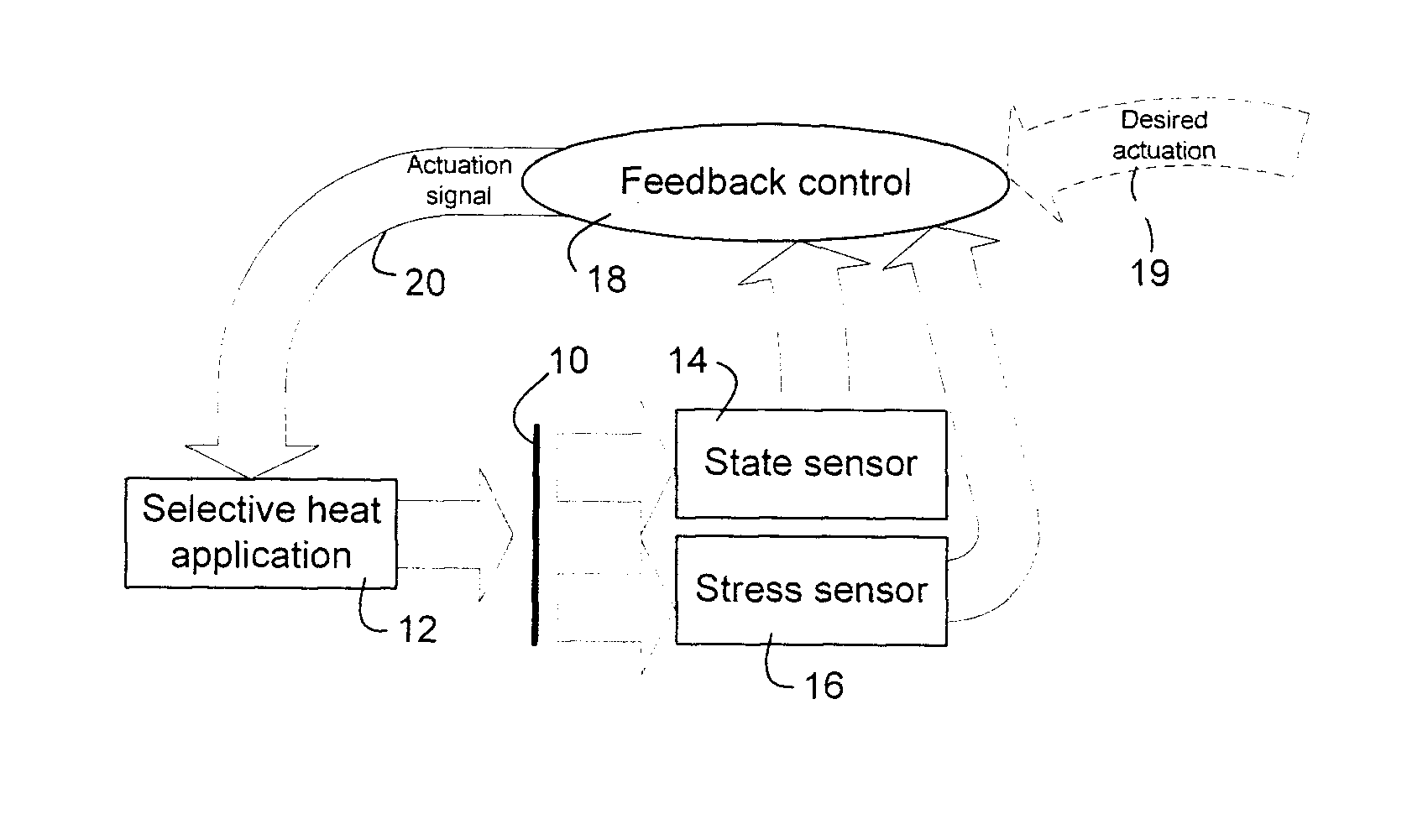
[0014]Applicant has found that surpisingly good quality feedback control of SMA actuators is possible using feedback from a state sensor, and a force sensor.

Problems solved by technology

Wider application of SMAs in these and other fields has been proposed, in such fields as space and aerospace, precise mechanical or optical systems, and in robotics, but this wider application has been so far limited due to the difficulty in achieving a precise strain output regulation.
Hysteresis is a significant problem.
The first method suffers several drawbacks: (1) the model parameters typically are determined experimentally (or are not accurate) because they depend on the specific type of SMA actuator (alloy composition and heat-treatment) and on the external thermal environmental parameters; (2) there has not been a widely applicable model developed that permits generalization to different situations; and (3) control schemes based on such thermomechanical models are very complex due to the need to deal with SMA's inherent hysteresis with minor loops.
The power supply requirements makes the SMA actuator control system bulky.
This is particularly challenging if multiple SMA actuators need to be used, for multiple actuation states, etc.
This method also presents drawbacks which include: (1) it permits only stepwise rather than continuous strain output regulation, and the size of the steps is limited by the number of segments; and (2) because the SMA is intrinsically thermo-activated, when one SMA segment is activated through electrical heating, heating will typically spread to neighboring segments, which can cause partial activation of those segments, thus resulting in relatively poor strain output regulation precision.
The addition of insulation between the segments slows down the cooling thermal response of the segments, and also limits the coupling of the mechanical actuation of the segments together resulting in a more failure prone and complicated actuator.
While the article does compute a compound hysterisis graph from these two, there is no teaching or suggestion of what parameters are necessary or sufficient to produce precise strain output regulation of a SMA.
The hysteretic characterization is one problem that is shown to vary with actuators and setups.
Unfortunately this teaches a regulator that is bulky, an expensive as noted above.
Julien teaches little of practical use for applications of precision control feedback systems.

Method used

the structure of the environmentally friendly knitted fabric provided by the present invention; figure 2 Flow chart of the yarn wrapping machine for environmentally friendly knitted fabrics and storage devices; image 3 Is the parameter map of the yarn covering machine
View more

Image

Smart Image Click on the blue labels to locate them in the text.
Viewing Examples
Smart Image
  • Feedback Control for Shape Memory Alloy Actuators
  • Feedback Control for Shape Memory Alloy Actuators
  • Feedback Control for Shape Memory Alloy Actuators

Examples

Experimental program
Comparison scheme
Effect test

Embodiment Construction

[0043]Herein a method and apparatus are provided for precision control of a SMA actuator.

[0044]FIG. 1 is a graph showing a typical actuation of a SMA actuator that is known in the art. The SMA actuator used to produce this graph is a Ni—Ti SMA actuator supplied by Dynalloy Inc. USA. This is a typical example of contraction-type SMA actuators, and it consists of an SMA element in the form of a wire. The SMA actuator is designed for electronic coupling so that a current can be applied across the length of the SMA wire to apply heat to the SMA wire, to actuate it, and cause contraction. The heat applied is produced by resistance to the current through the SMA wire, in accordance with resistive heating, as is well known in the art. Naturally environmental controls are provided to ensure that the heat applied to actuate the SMA wire is dissipated within a desired response time. As previously mentioned, the relationship between temperature of a SMA and its state of deformation (strain out...

the structure of the environmentally friendly knitted fabric provided by the present invention; figure 2 Flow chart of the yarn wrapping machine for environmentally friendly knitted fabrics and storage devices; image 3 Is the parameter map of the yarn covering machine
Login to View More

PUM

No PUM Login to View More

Abstract

Control feedback for regulating strain output of a shape memory alloy (SMA) actuator using a stress sensor for outputting an indication of a mechanical resistance applied against the SMA actuator, and a state sensor for outputting an indication of a state of actuation of the SMA actuator has been found to be surprisingly accurate. Advantageously feedback detection can be provided with sensors that have low power requirements and can be controlled with simple electronics.

Description

CROSS-REFERENCE TO RELATED APPLICATIONS[0001]The present application is related to U.S. provisional patent application Ser. No. 61 / 064,213, filed Feb. 21, 2008.FIELD OF THE INVENTION[0002]This invention relates in general to regulation of strain output of a shape memory alloy (SMA) actuator, and in particular to a feedback control mechanism for precise control over strain output of SMA actuators.BACKGROUND OF THE INVENTION[0003]Shape memory alloys (SMAs), typically but not limited to Ni—Ti alloy, possess unique characteristics that permit them to generate a large strain output and force. The SMAs are also flexible in nature permitting high pseudoelasticity. It can easily operate as an On / Off type actuator, and it has found some applications in various fields ranging from medical, to industry, and to aerospace. Wider application of SMAs in these and other fields has been proposed, in such fields as space and aerospace, precise mechanical or optical systems, and in robotics, but this ...

Claims

the structure of the environmentally friendly knitted fabric provided by the present invention; figure 2 Flow chart of the yarn wrapping machine for environmentally friendly knitted fabrics and storage devices; image 3 Is the parameter map of the yarn covering machine
Login to View More

Application Information

Patent Timeline
no application Login to View More
IPC IPC(8): G01L1/22G05B15/02
CPCF03G7/065G05D15/01G01L5/103
Inventor JIANG, XIN XIANGNIKANPOUR, DARIUS
Owner CANADIAN SPACE AGENCY
Features
  • R&D
  • Intellectual Property
  • Life Sciences
  • Materials
  • Tech Scout
Why Patsnap Eureka
  • Unparalleled Data Quality
  • Higher Quality Content
  • 60% Fewer Hallucinations
Social media
Patsnap Eureka Blog
Learn More