[0006]It is an object of the invention to improve an eccentric drive arrangement of the kind described above such that an increased operating reliability is provided with reduced friction losses.
[0009]With the arrangement according to the invention, a holding force can be applied to the two
contact pressure surfaces, independently of each other and directly, without it being necessary to transfer this holding force through the outer shearing blade and to the inner shearing blade. Accordingly, no additional friction caused by the holding force occurs between the two shearing blades. Friction and wear are reduced. Also, the temperature developed because of friction is limited, so that the
lubricant fill of the eccentric gear arrangement can unfold without impairing its lubricating effect. The drive power, which is required at high loads, is reduced, while the service life caused by wear is increased.
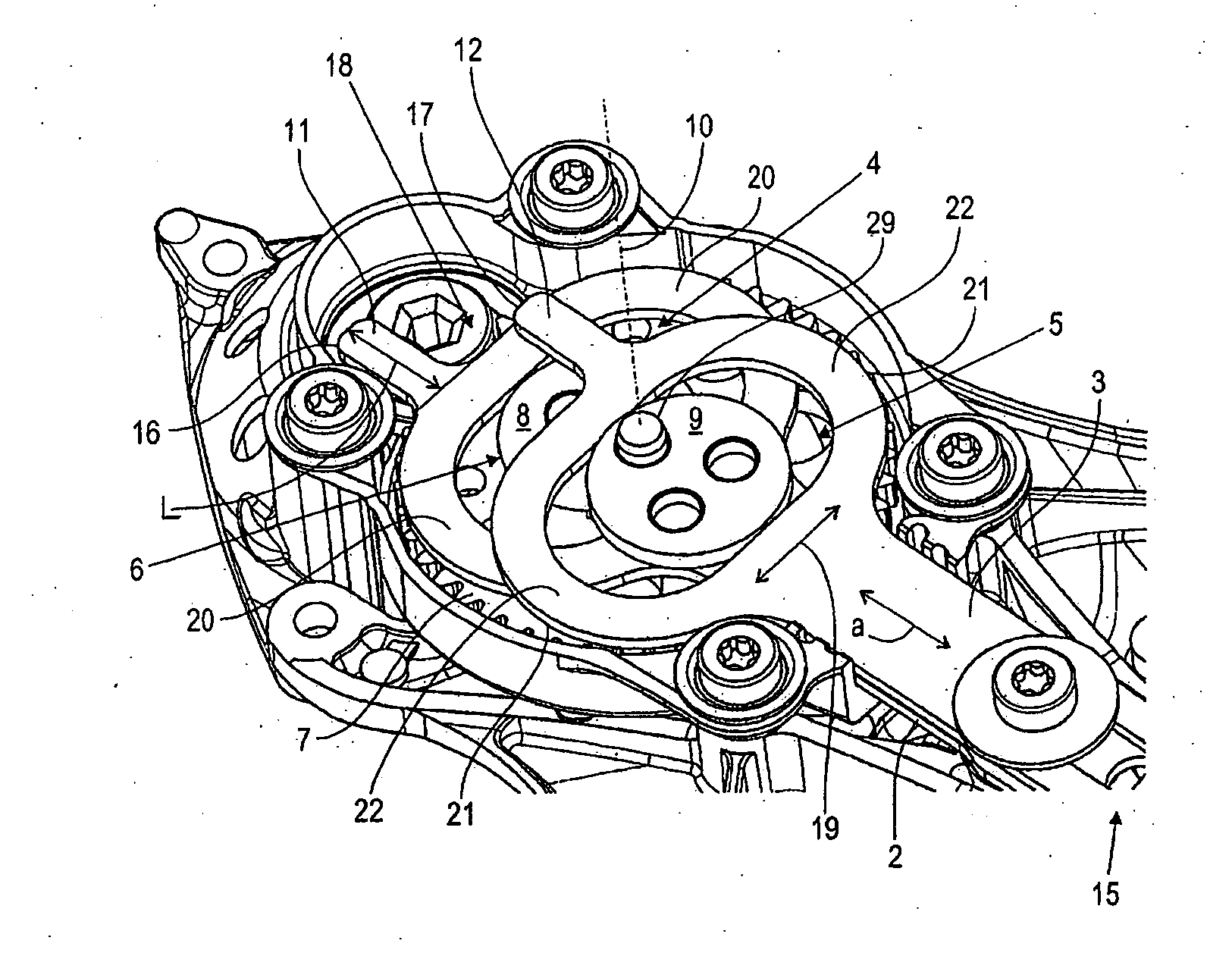
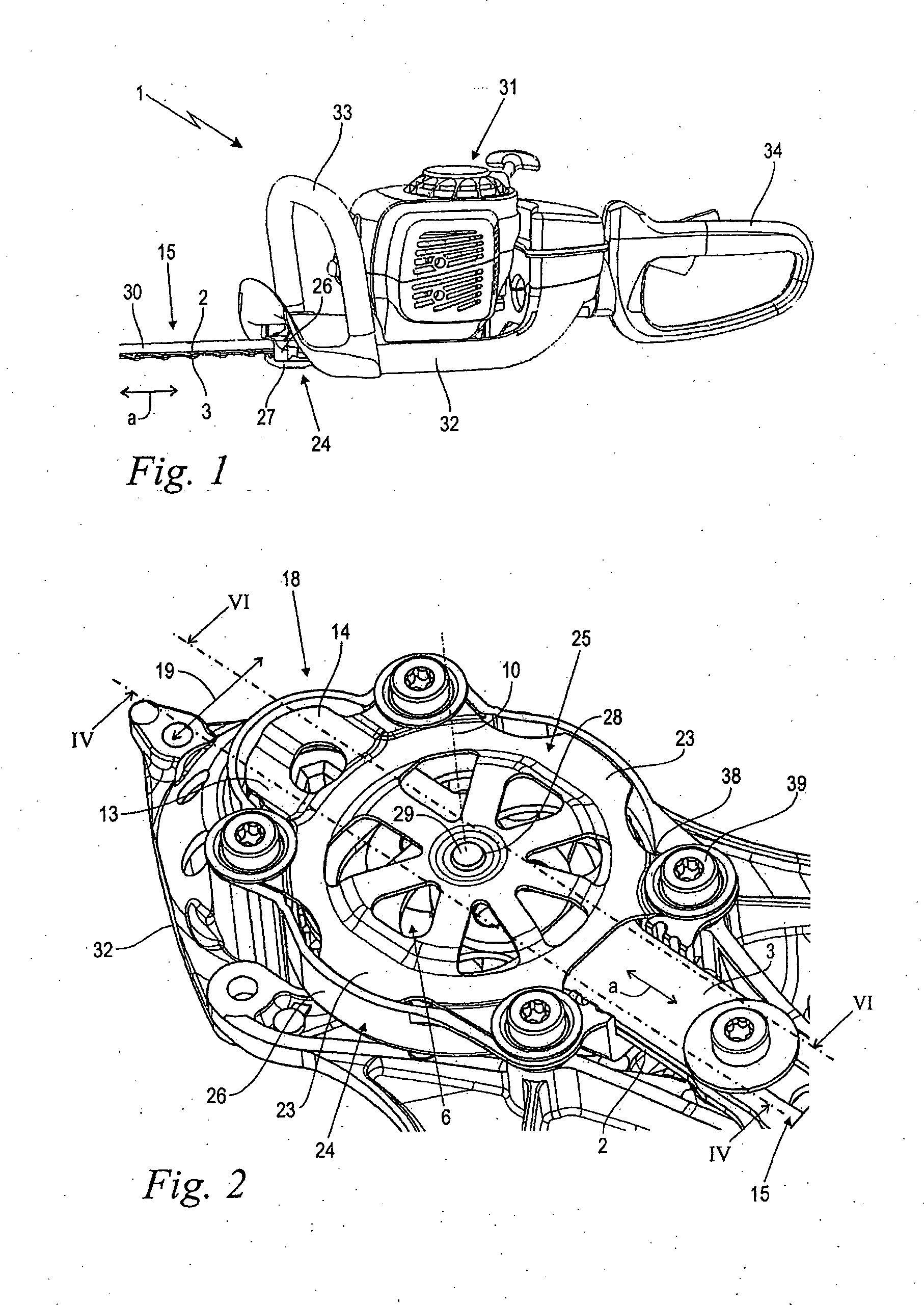
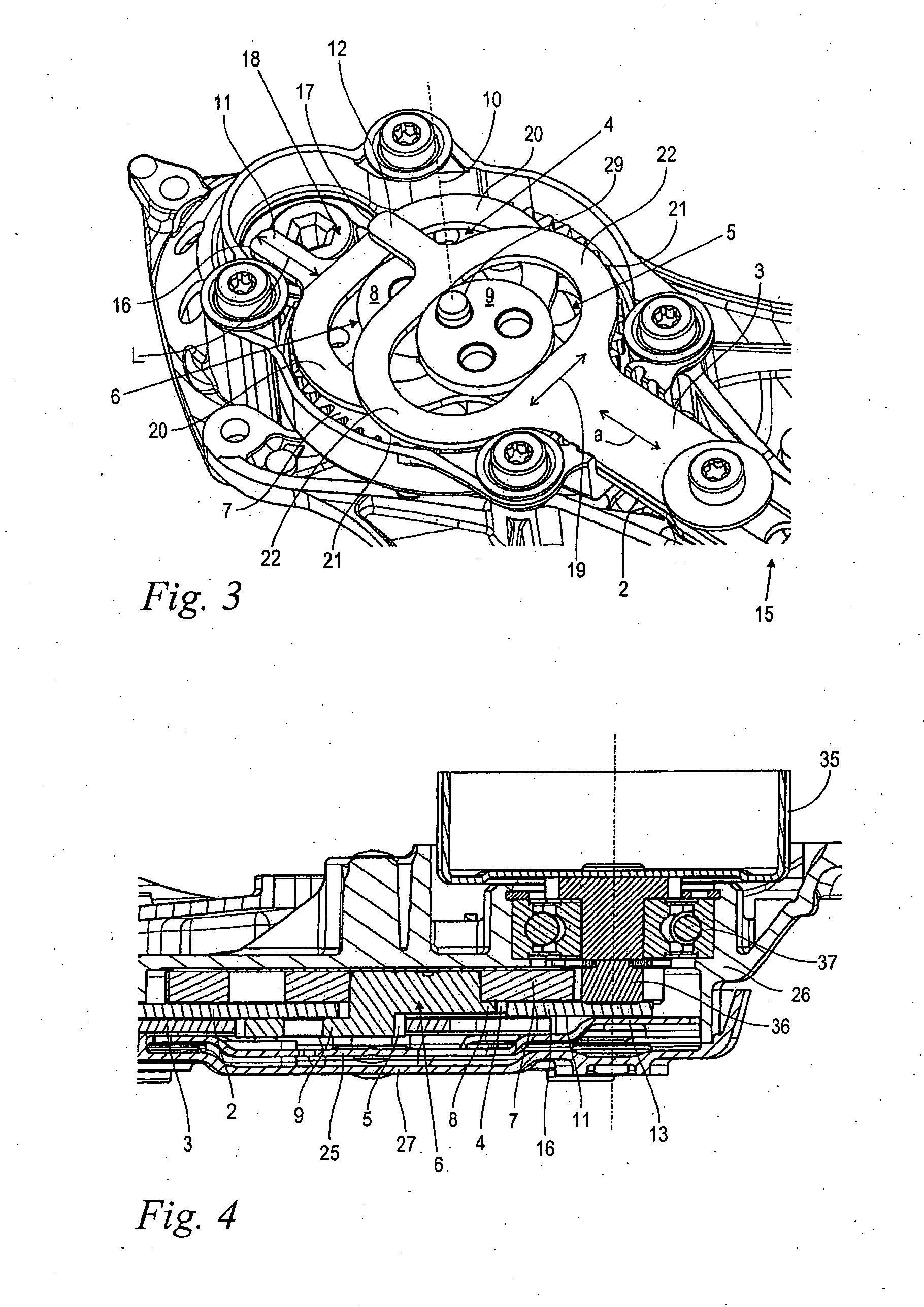
[0010]It can be practical to arrange the contact pressure surfaces, for example, laterally of the connecting links. In this case, the contact pressure surface of the first shearing blade lies, for example, on the left-hand side and the contact pressure surface of the second shearing blade lies on the opposite right-hand side. Thus, the two contact pressure surfaces are prevented from covering each other, so that a contact pressure force can be applied directly onto the contact pressure surfaces by means of the downholder. In an advantageous embodiment, the shearing blades have respective contact pressure extensions running parallel to the displacement path. The contact pressure extensions are arranged on a rear end of the shearing blades
lying opposite to the shearing sections in the direction of the displacement path and are offset laterally with respect to each other in a lateral direction
lying transversely to the displacement path. The contact pressure surfaces are formed on the contact pressure extensions. A mutual covering is avoided independently of the displacement path because of the
lateral offset of the two contact pressure extensions. The contact pressure extensions are arranged on the rear end and extend in the longitudinal direction of the shearing blades, that is, in the direction of the displacement path. For this reason, little installation space is needed in the lateral direction, whereby the arrangement can be kept slim and compact. Lateral eccentricities in the introduction of force are minimized.
[0011]In an advantageous further embodiment, the contact pressure extensions with their contact pressure surfaces are of a length which is at least approximately equal to the displacement path. This ensures that the downholders at least approximately can act on the assigned contact pressure surfaces over the entire displacement path. Accordingly, the down-holding effect is maintained at least approximately over the entire displacement path.
[0013]A gear housing is provided for accommodating the eccentric wheel as well as the shearing blades in the region of their connecting links and their contact pressure surfaces. Here, it can be practical to configure the downholders directly on the gear housing, that is, on the housing cover thereof. However, it is advantageous to arrange, in the gear housing, a holding plate including the downholders. Especially at least one and preferably the two further downholders are arranged on the holding plate, with the downholders acting on the lateral contact pressure surfaces. In this way, the housing is relieved of load, so that it can be manufactured of thin-walled and lightweight light-
metal casting or the like. The holding plate can, for example, be manufactured of steel plate or any other high-strength material for accommodating the high holding forces, regardless of the selected material of the gear housing.
[0015]In a preferred embodiment, the holder plate is held between the housing shell and the housing cover of the gear housing especially via threaded fasteners and / or via clamping and / or via form-locking. After removal of the housing cover, the holding plate can be removed easily, for example, to be able to exchange the shearing blades. Furthermore, the attachment of the holding plate between the housing shell and the housing cover leads to a favorable and large surface distribution of force introduction which favors the objective of a lightweight construction.


 Login to View More
  Login to View More