
Anti-amyloid beta antibodies conjugated to sialic acid-containing molecules
- Summary
- Abstract
- Description
- Claims
- Application Information
AI Technical Summary
Benefits of technology
Problems solved by technology
Method used
Image

Examples
example 1
Chimeric 6E10
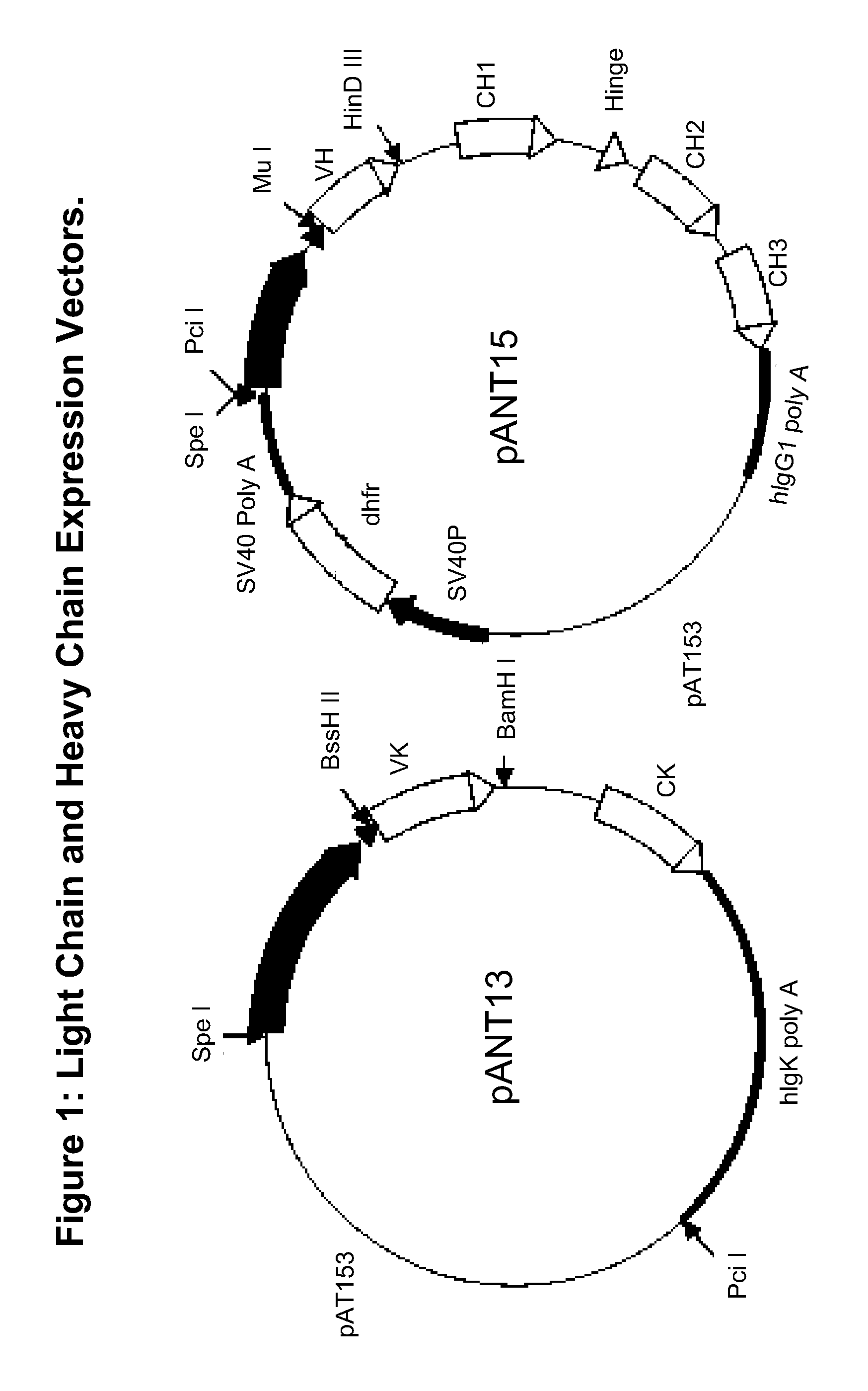
[0161]mRNA was extracted from the hybridoma 6E10 cells (Covance, Inc., Emeryville, Calif.) using a Poly A Tract System 1000 mRNA extraction kit (Promega Corp. Madison Wis.) according to manufacturer's instructions. mRNA was reverse transcribed as follows. For the kappa light chain, 5.0 microliter of mRNA was mixed with 1.0 microliter of 20 pmol / microliter MuIgGκVL-3′ primer OL040 (Table 2) and 5.5 microliter nuclease free water (Promega Corp. Madison Wis.). For the lambda light chain, 5.0 microliter of mRNA was mixed with 1.0 microliter of 20 pmol / microliter MuIgGλVL-3′ primer OL042 (Table 2) and 5.5 microliter nuclease free water (Promega Corp. Madison Wis.). For the gamma heavy chain, 5 microliter of mRNA was mixed with 1.0 microliter of 20 pmol / microliter MuIgGVH-3′ primer OL023 (Table 1) and 5.5 μl nuclease free water (Promega Corp. Madison Wis.). All three reaction mixes were placed in the pre-heated block of the thermal cycler set at 70° C. for 5 minutes. These we...
example 2
Deimmunized 6E10
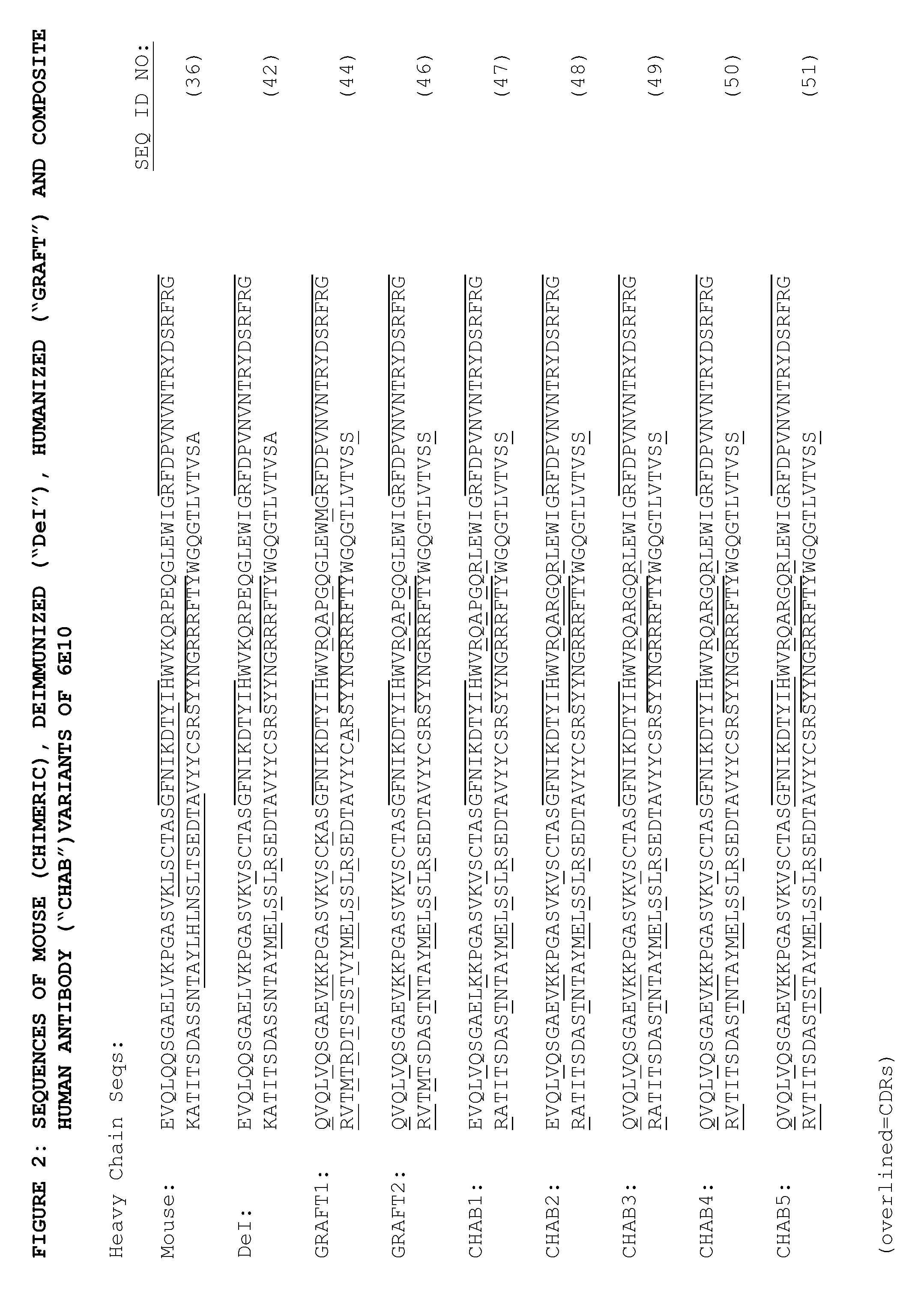
[0170]Peptides of 15 amino acids length with overlaps of 12 amino acids were synthesised from the VH and VL sequences of mouse 6E10 (FIG. 2). For VH and VL, 36 and 34 peptides respectively were synthesised, in both cases starting from the N terminal amino acid in the sequence. These peptides were then analysed in human T cell assays using the method described in PCT / GB2007 / 000736 (Antitope Ltd). This revealed the presence of four T cell epitopes from the following peptides:
(amino acids 19-33 of SEQ ID NO: 36)VH19-33KLSCTASGFNIKDTY;(amino acids 79-93 of SEQ ID NO: 36)VH79-93TAYLHLNSLTSEDTA;(amino acids 10-24 of SEQ ID NO: 37)VL10-24SLTVTAGEKVALTCK;and(amino acids 79-93 of SEQ ID NO: 37)VL79-93LTISSVQAEDLAVYY.
[0171]The peptides are underline in the “mouse” sequence provided in FIG. 2.
[0172]A range of variants of these peptides were retested in human T cell assays incorporating amino acid substitutions for amino acids present at the corresponding positions in other anti...
example 3
Humanized 6E10
[0174]Humanized VH and VL sequences were designed by comparison of mouse 6E10 sequences and homologous human VH and VL sequences. From this analysis, the human VH region VH1-46 was chosen to provide frameworks for grafting of 6E10 VH CDRs as shown in FIG. 2 (‘Graft1’, SEQ ID NO:44). The human VL region B3 was chosen to provide frameworks for grafting of 6E10 VL CDRs as shown in FIG. 2 (‘Graft’, SEQ ID NO:45). A variant of the humanized VH sequence was designed as shown in FIG. 2 (‘Graft2’, SEQ ID NO:46) where six framework residues (amino acids 23, 48, 71, 73, 78 and 93 using Kabat numbering) were converted back to the corresponding mouse VH residues. The retention of these six amino acids was considered important due to internal folding or interactions with CDRs (for example, see US2006073137 (Celltech Limited)). Humanized V region genes were constructed using the mouse 6E10 VH and VL templates for PCR using long overlapping oligonucleotides to introduce amino acids f...
PUM
| Property | Measurement | Unit |
|---|---|---|
| Fraction | aaaaa | aaaaa |
| Fraction | aaaaa | aaaaa |
| Density | aaaaa | aaaaa |
Abstract
Description
Claims
Application Information
 Login to View More