It is believed that NAND flash would be extremely difficult to scale below 45 nanometers (nm).
Likewise,
DRAM has issues related to scaling of the trench capacitors leading to very complex designs which are becoming increasingly difficult to manufacture, leading to higher cost.
Design of different memory technology in a product adds to design complexity,
time to market and increased costs.
For example, in hand-held multi-media applications incorporating various memory technologies, such as NAND Flash,
DRAM and
EEPROM / NOR
flash memory, complexity of design is increased as are manufacturing costs and
time to market.
Another
disadvantage is the increase in size of a device that incorporates all of these types of memories therein.
This is primarily due to a dramatic drop in the price of the
flash memory.
NOR flash memories are primarily used for applications where non-volatility is essential, but the size of the memory is small and the memory is seldom read or written.
This is mostly used in NAND flash to enhance the memory density, but normally adversely affects the speed of the memory.
Another form of dominant memory is the dynamic RAM (
DRAM), which is volatile and costly but has faster random read / write time than non-
volatile memory in the form of flash.
Static RAM is the most expensive memory used.
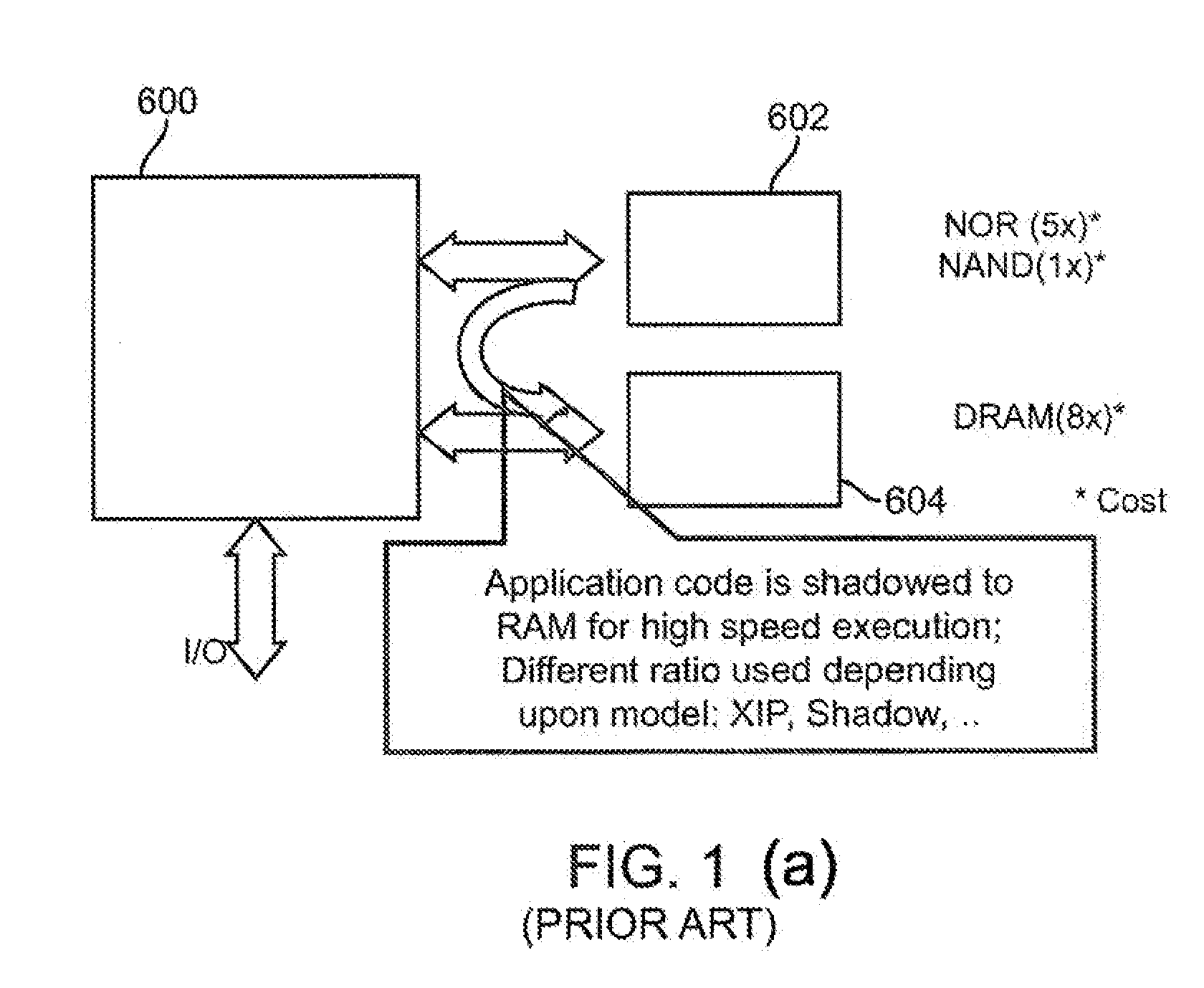
In the current marketplace, NOR tends to be approximately five times more costly than MLC NAND, due primarily to its
cell size.
DRAM has a
cell size of 8F2 but is harder to manufacture due to its various trench-
capacitor design requirements.
Additionally, as the process geometry decreases, the design of NAND and
DRAM memory become more difficult to scale.
For example, NAND has various issues related to
capacitive coupling, fewer electrons / bit, poor error-rate performance and worse reliability due to its poor read-write endurance.
It is believed that NAND, especially MLC NAND would be extremely difficult to scale below 45 nano meters (nm).
Likewise, DRAM has issues related to scaling of its trench capacitors leading to very complex designs which are becoming very difficult to manufacture, thereby leading to increased manufacturing costs.
This is a dominant part of the overall cost for mobile multi-media products.
The problem with all of the currently available hybrid designs is the
large size and therefore high costs and high
power consumption associated therewith.
That is, ROM and RAM are manufactured on multiple chips, and perhaps a monolithic die, resulting in larger real estate being consumed by use of such memory, and therefore increased costs.
This capacity usage on a
printed circuit board (PCB) that additionally has other chips (or
semiconductor), such as a controller, make such designs approximately 5 to 10 times more expensive than the NAND memory.
Additionally,
power consumption is high due to the operations of non-volatile and volatile memory, of which the volatile memory has to stay on the
standby power all the time.


 Login to View More
  Login to View More