

Low friction coating on vein catheter
- Summary
- Abstract
- Description
- Claims
- Application Information
AI Technical Summary
Benefits of technology
Problems solved by technology
Method used
Image



Examples
example 1
[0054]A saturated solution of 20.2 wt % of boric acid in methanol was prepared and a clean cannula of stainless steel was provided. The cannula was dip coated by dipping the cannula in the solution. The dipping rate, i.e. the speed at which the cannula was lowered into the solution, and the speed at which the cannula was removed from the solution was 20 mm / s. The cannula was paused at its lowest point in the dipping procedure for two seconds.
Friction Study
[0055]Coated and uncoated cannulas were pushed through a latex cloth and the force needed to introduce the cannulas through the opening in the cloth was measured.
[0056]For uncoated cannulas a force of 0.8 N was needed while coated only needed a force of 0.2 N at a steady-state pressure.
[0057]The force needed to remove a tubular catheter from coated and uncoated cannulas was also tested. The force need from uncoated was 4.5 N and for coated 1.9 N. Furthermore, the scattering of the force needed was also much broader for u...
example 2
Penetration Test and Cannula / Catheter Separation
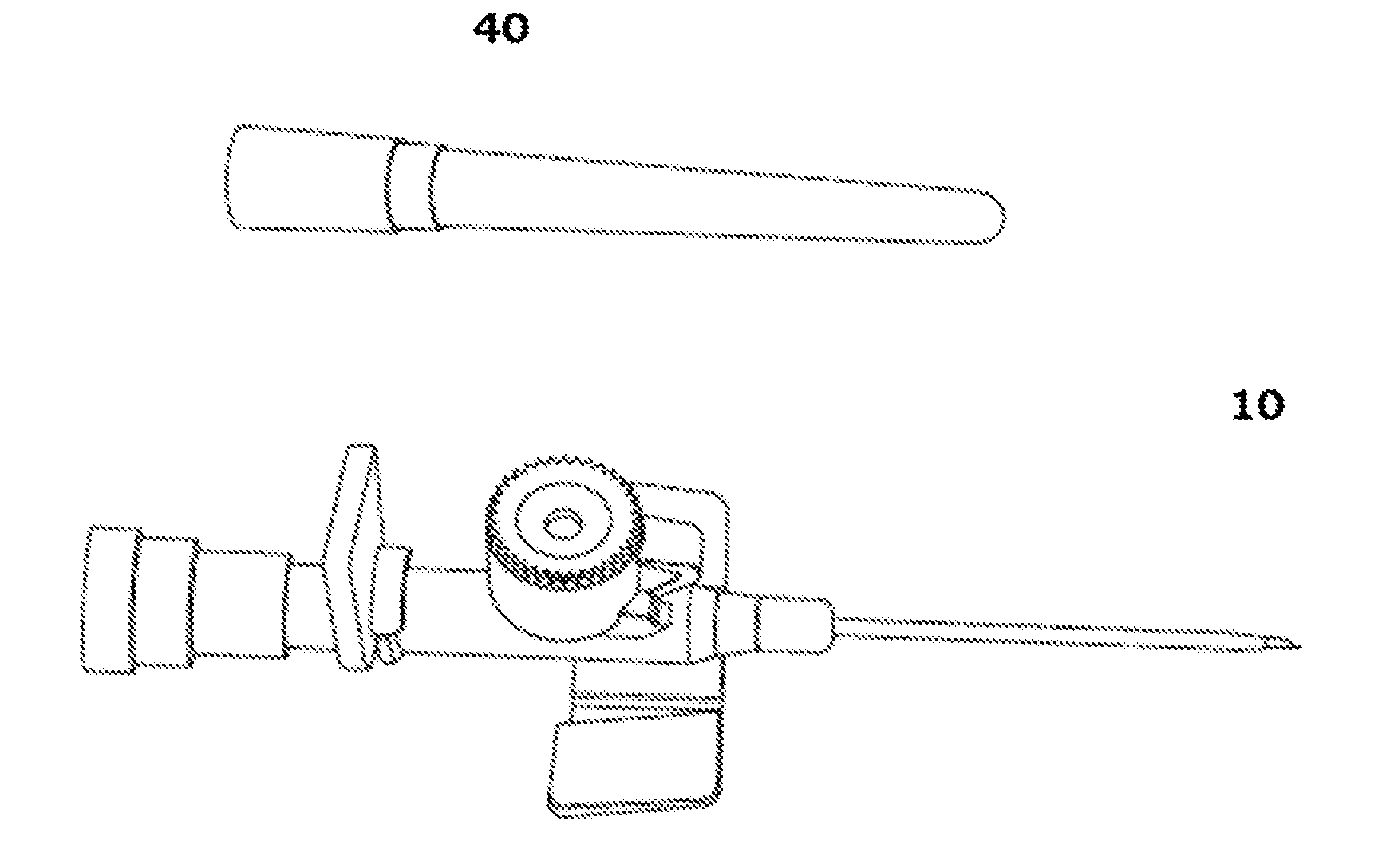
[0058]Cannulas for peripheral venous catheters were coated with boric acid by means of a dip coating technique according to the present invention. The boric acid serves as a solid lubricant. The cannulas were thereafter tested with regards to tip penetration and cannula / catheter separation force. The tests were performed on coated and uncoated cannulas using an in-house built test equipment.
[0059]The cannulas and catheters used in these tests were parts from the peripheral venous catheters Venflon Pro 1.1. The dip coatings were performed in an in-house built automatized dip coating equipment using a non-flammable boric acid solution (methanol-water solution with 30 wt % methanol, saturated with boric acid). The cannulas were removed from the solution at a speed of 10-25 mm / min. Cannulas and catheters were considered clean as received and no additional cleaning was made. Prior to coating, the cannulas were investigated by mic...
PUM
| Property | Measurement | Unit |
|---|---|---|
| Speed | aaaaa | aaaaa |
| Speed | aaaaa | aaaaa |
| Time | aaaaa | aaaaa |
Abstract
Description
Claims
Application Information
 Login to View More