However, such a
resource contention management mechanism, implemented to cope with a demand for additional resources originating from a
virtual machine, can affect one or more other virtual machines.
Thus, when a
virtual machine is migrated from a source host
server to a destination host server, the migrated
machine can suffer from a degradation of performance levels that can vary according to the load of the source host server and / or of the destination host server, according to the load of the
virtual machine and the nature of the applications that it runs.
Upon the migration, the virtual
machine may, in the worst case, suffer an unacceptable occasional loss of
connectivity (the term normally used to describe this loss of
connectivity is “down time”).
This fault of isolation of a virtual
machine with respect to events occurring in another virtual machine constitutes a new type of security
vulnerability.
With this new type of
attack, the harmful effect is obtained as it were by edge effect.
The current
attack detection mechanisms are unsuited to detecting and analyzing this new type of attack.
The new type of
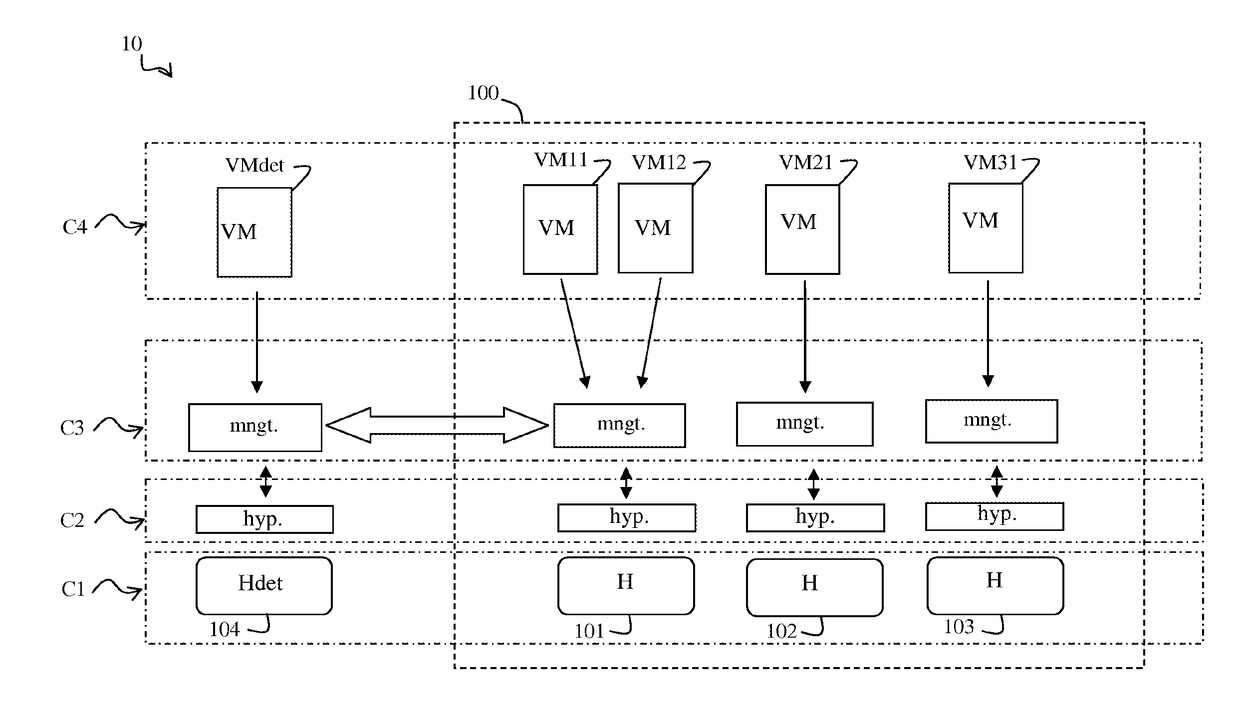
vulnerability, linked to the degradation of the performance levels of a virtual machine inherent in the implementation of migrations of virtual machines from one host server to another, is exploited by an attacker who, after having taken control of several virtual machines, influences the consumption of a critical resource by these machines in order to trigger the untimely migrations of virtual machines in the
system of host servers.
These migrations, usually implemented occasionally to cope with occasional rises in the consumption load of a resource are then more numerous than in a case of normal operation of the system and provoke a degradation of the performance levels of the system as a whole.
In effect, the migrations have a cost and
impact the bandwidth which is used to transmit information concerning the migrated virtual machine; they also
impact the memory and processor consumptions of the source and destination host servers upon the migration.
The observation of each of these machines in isolation does not therefore make it possible to suspect an attack and raise a security alert.
On the other hand, the degradation of the performance levels is not felt on one or more machines of which the attacker would have taken control and which would knowingly be the objective of the attack, but on virtual machines that are not compromised which suffer, by edge effect, the damage resulting from an implementation of an excessively large number of migrations in the system of servers, or cluster.
It is in fact estimated that the untimely migrations are provoked mainly by the execution of extremely fluctuating consumption profiles which thereby have a significant
impact on the distribution of the load of the host servers which make up the system.


 Login to View More
  Login to View More