Image recognition system and method

a technology of image recognition and image, applied in image analysis, instruments, computing, etc., can solve the problems of image loss of metadata, image corruption by noise, etc., to improve the efficiency of the pattern recognition device, reduce processing, and reduce degradation.

US20170249535A1Active Publication Date: 2017-08-31TEMASEK LIFE SCIENCES LABORATORY
5 Cites 15 Cited by

Patent Information

Authority / Receiving Office
US · United States
Current Assignee / Owner
Publication Date
2017-08-31

Smart Images

  • Figure 1
    Figure 1
  • Figure 2
    Figure 2
  • Figure 3
    Figure 3
Patent Text Reader

Abstract

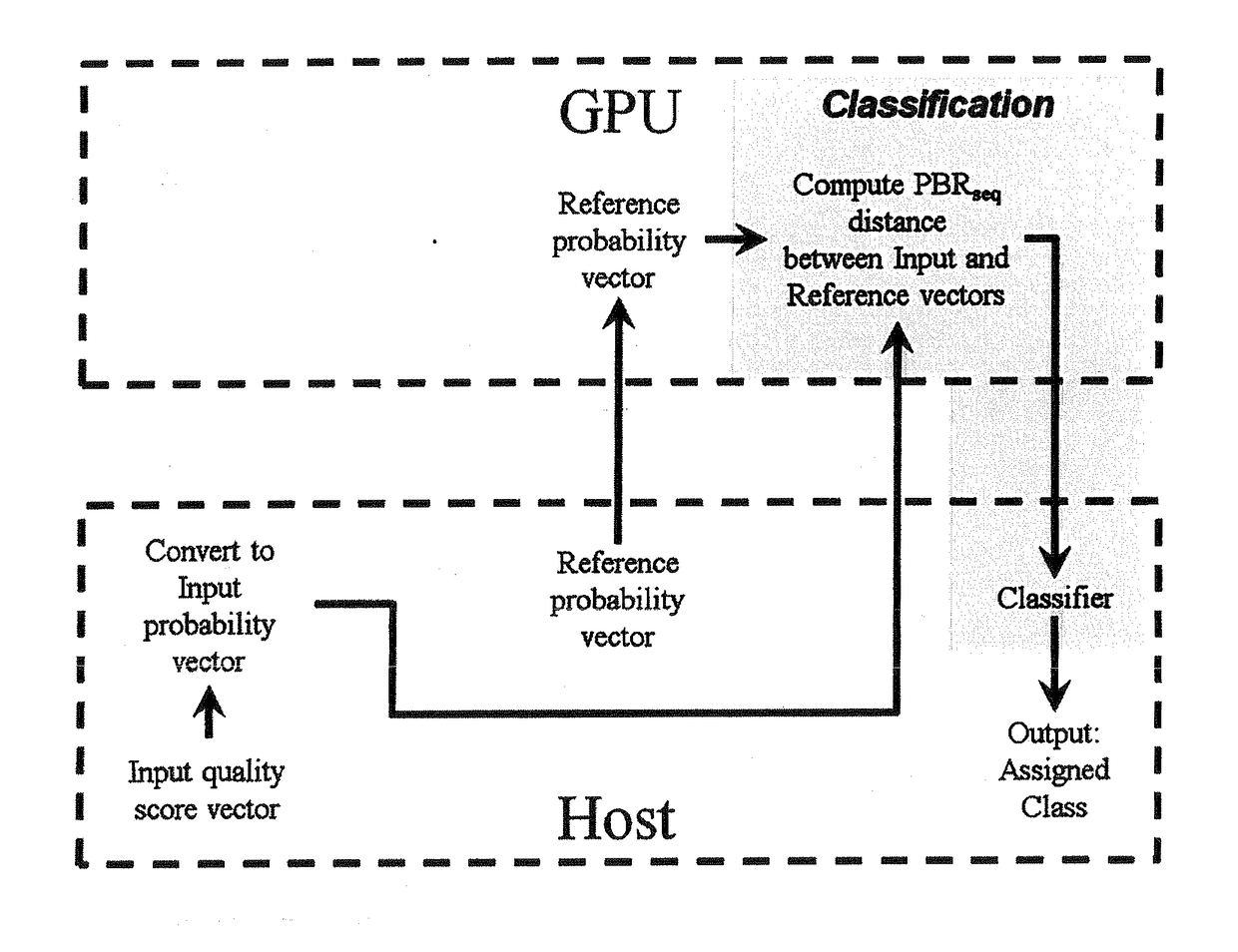
An improved system and method for digital image classification is provided. A host computer having a processor is coupled to a memory storing thereon reference feature data. A graphics processing unit (GPU) having a processor is coupled to the host computer and is configured to obtain, from the host computer, feature data corresponding to the digital image; to access, from the memory, the one or more reference feature data; and to determine a semi-metric distance based on a Poisson-Binomial distribution between the feature data and the one or more reference feature data. The host computer is configured to classify the digital image using the determined semimetric distance.
Need to check novelty before this filing date? Find Prior Art

Description

BACKGROUND OF THE INVENTION

[0001] Field of the Invention

[0002] The present invention relates generally to improved systems and methods for image recognition. More particularly, the present invention relates to systems and methods for pattern recognition in digital images. Even more particularly, the present invention relates to systems and methods for performing image classification and recognition functions utilizing a new and novel semi-metric distance measure called the Poisson-Binomial Radius (PBR) based on the Poisson-Binomial distribution.

[0003] Description of the Related Art

[0004] Machine learning methods such as Support Vector Machines (SVM), principal component analysis (PCA) and k-nearest neighbors (k-NN) use distance measures to compare relative dissimilarities between data points. Choosing an appropriate distance measure is fundamentally important. The most widely used measures are the sum of squared distances (L2 or Euclidean) and the sum of absolute differences (L1 or Manh...

Examples

Embodiment Construction

[0036]The Poisson-Binomial distribution is defined by the probability mass function for n successes given independent but non-identical probabilities (p1, . . . , pN) of success. These events exist in a probability space (Ω,F,P). The distribution is unimodal with mean μ being the summation of pi where i increments from 1 to N, and variance σ2 being the summation of (1-pi)pi where i increments from 1 to N.

[0037]A special case of this distribution is the binomial distribution where pi has the same value for all i. The Poisson-Binomial distribution may be used in a broad range of fields such as biology, imaging, data mining, bioinformatics, and engineering. While it is popular to approximate the Poisson-Binomial distribution to the Poisson distribution. This approximation is only valid when the input probabilities are small as evident from the bounds on the error defined by Le Cam's theorem [19] given by

∑n=0∞|P(Ωn)-λNne-λNn!|<2∑i=1Npi2.(2)

where P(Ωn) gives the probability of n succe...