
Compounds for the treatment of obesity and methods of use thereof
a technology of compounds and obesity, applied in the field of compounds to regulate obesity, can solve the problems of reducing life expectancy and/or increasing health problems, obesity increases the risk of many physical and mental conditions, and obesity is found to reduce life expectancy, so as to reduce body fat, reduce food intake, and induce weight loss
- Summary
- Abstract
- Description
- Claims
- Application Information
AI Technical Summary
Benefits of technology
Problems solved by technology
Method used
Image

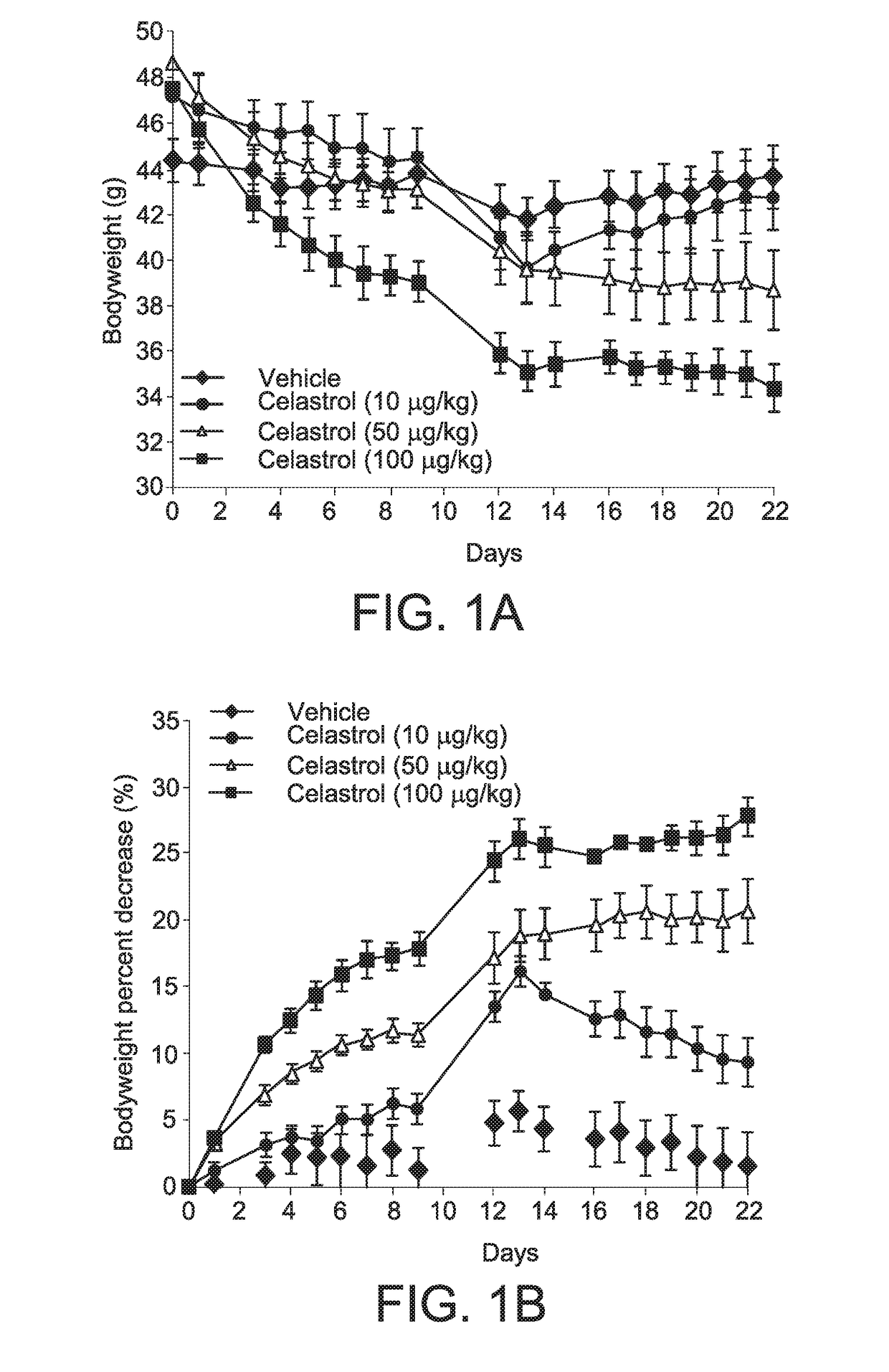
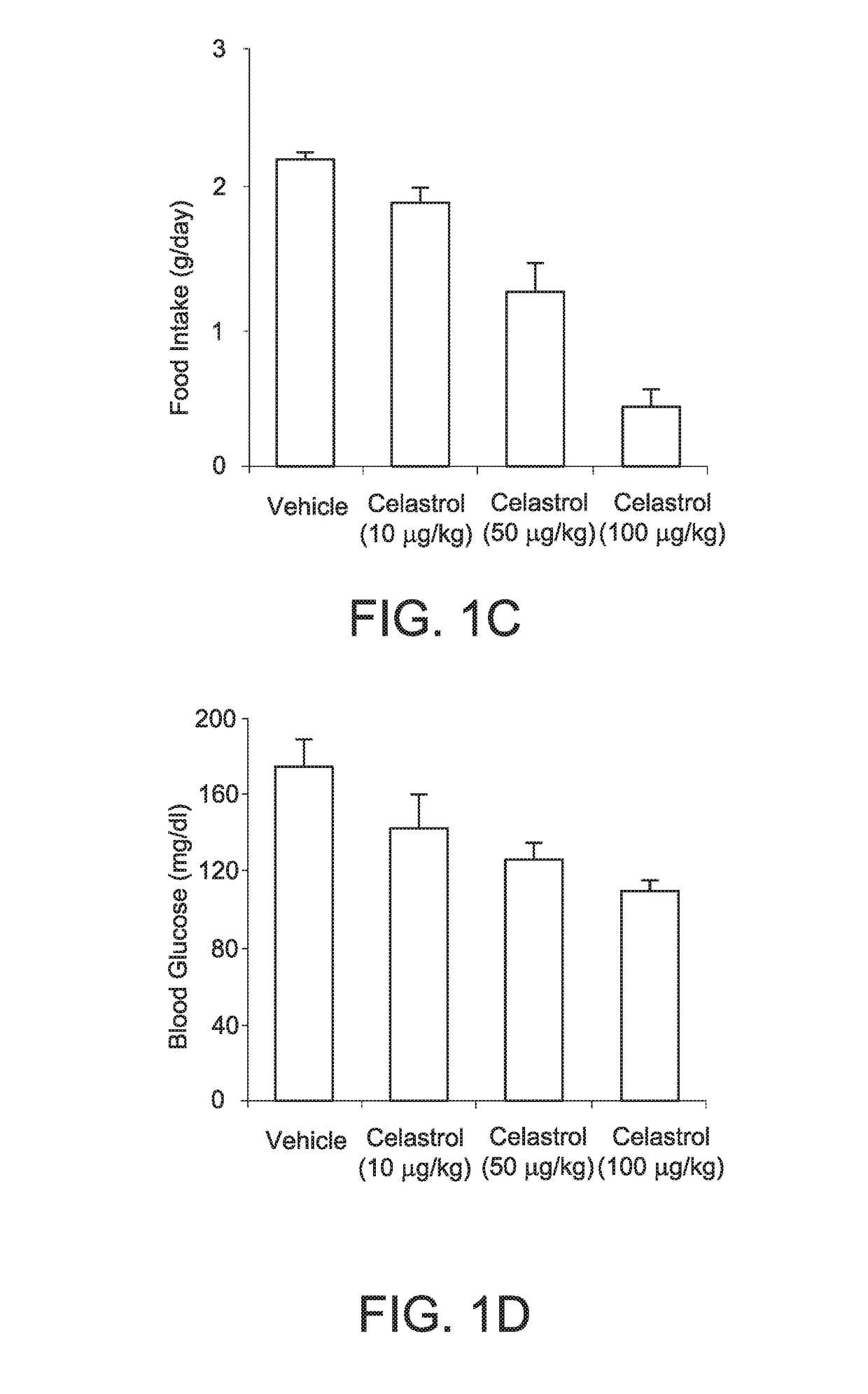
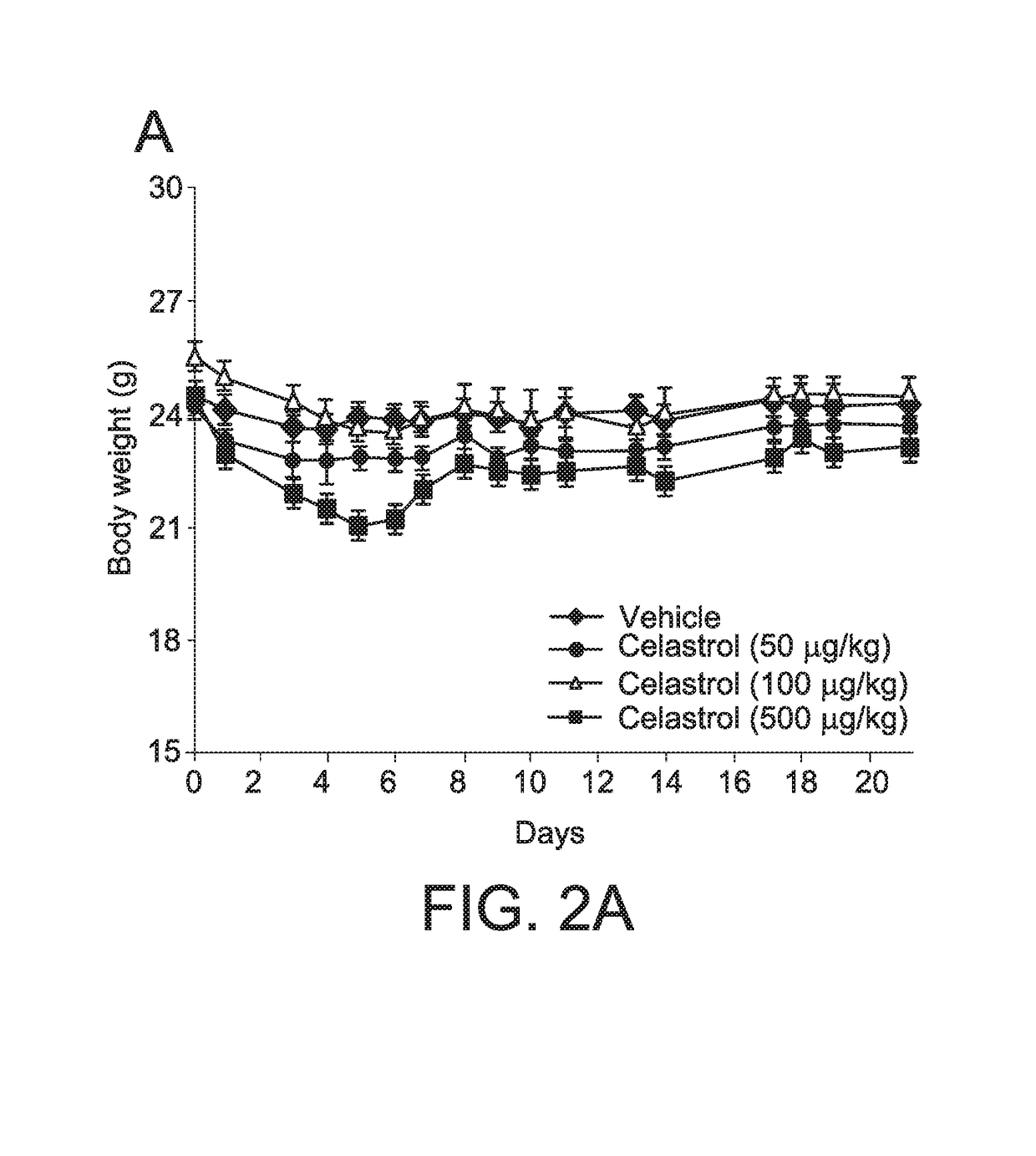
Examples
example 1
ation of Celastrol to Obese Mice
[0338]Celastrol was obtained from commercial sources. C57Bl / 6J mice were placed on high fat diet (HFD; Research Diets, D12451, 45 kcal % fat) feeding for 16 weeks. After establishment of obesity and leptin resistance, mice were first administered celastrol at different doses (10, 50 and 100 μg / kg), in 25 μl DMSO, once per day) and vehicle (DMSO, 25 μl) by intraperitoneal (i.p.) injection. The animals had free access to food and water unless otherwise stated.
[0339]In all experiments, four days prior to drug administration, the animals went through an acclimation period where they were given saline (25 μl) to reduce the effect of stress created by i.p. injection. Following four days acclimation, celastrol was administered to HFD-fed obese mice daily by i.p. injection at increasing doses (10, 50 and 100 μg / kg) for three weeks in 25 μl of DMSO. A control group received the same volume of DMSO by i.p. injection.
[0340]As shown in FIG. 1A, i.p. administratio...
example 2
ation of Celastrol to Lean Mice
[0341]Celastrol was administered to lean mice on chow diet at 50, 100 or 500 μg / kg for three weeks by i.p. injections using the same protocol described above. As shown in FIG. 2A and FIG. 2B, celastrol induced a significant but small decrease in food intake; however, it did not induce bodyweight loss in lean mice, even when administered to lean mice at five times higher doses than effective to reduce body weight in obese mice. These findings suggest that the anorectic effect of celastrol is limited to obese animals. In lean mice, only the highest dose tested (500 μg / kg) induced a significant decrease in blood glucose (FIG. 2C, p<0.05) following 2 weeks of drug injections.
[0342]Other compounds of the invention are assayed in similar fashion.
[0343]In combination, these findings suggest that celastrol can be administered in an effective amount (e.g., 100 μg / kg in these studies) to induce body weight loss in obese mice, but not in lean mice.
example 3
on of the Leptin Dependence of Celastrol's Activity
[0344]Celastrol (100 μg / kg, once a day, in 25 μl DMSO) was administered to leptin deficient (ob / ob) and leptin receptor deficient (db / db) mouse models of obesity. Neither of these mouse models showed a significant decrease in appetite upon celastrol administration (ob / ob mice, FIG. 3; db / db mice, FIG. 4). In both ob / ob and db / db mice, body weight continued to increase similar to the control (vehicle treated) group (ob / ob, FIG. 3A; db / db FIG. 4A). In addition, celastrol failed to decrease the 6-hour fasted blood glucose in either ob / ob (FIG. 3C), or db / db (FIG. 4C) mice after 2 weeks of drug injections.
[0345]Other compounds of the invention are assayed in similar fashion.
[0346]The ability of celastrol to exert anti-obesity effects when orally administered was also examined. Celastrol induced a robust and significant decrease in body weight (FIG. 5A, p<0.001), and food intake (FIG. 5B, p<0.001) in HFD-fed obese mice when administered ...
PUM
| Property | Measurement | Unit |
|---|---|---|
| pH | aaaaa | aaaaa |
| pH | aaaaa | aaaaa |
| pH | aaaaa | aaaaa |
Abstract
Description
Claims
Application Information
 Login to View More