This helps you quickly interpret patents by identifying the three key elements:
Problems solved by technology
Method used
Benefits of technology
Benefits of technology
The present patent is about a kit and method for constructing a transposon that can introduce a foreign gene into host cells without affecting global gene expression. The kit includes five plasmids, which are designed to select terminal repeats that can be used to create the transposon. The method involves co-expressing these plasmids in host cells and then using a transposase to introduce the foreign gene into the host cells. The transposon is made up of an expression cassette with a non-prokaryotic promoter and the foreign gene, as well as two terminal repeats that are positioned upstream or downstream of the expression cassette. The method can be used with different types of host cells, such as mammalian or insect cells.
Problems solved by technology
The cis-acting enhancement likely disturbs the global gene expression pattern, and thus, leading to an undesired result.
Method used
the structure of the environmentally friendly knitted fabric provided by the present invention; figure 2 Flow chart of the yarn wrapping machine for environmentally friendly knitted fabrics and storage devices; image 3 Is the parameter map of the yarn covering machine
View more
Image
Smart Image Click on the blue labels to locate them in the text.
Viewing Examples
Smart Image
Click on the blue label to locate the original text in one second.
Reading with bidirectional positioning of images and text.
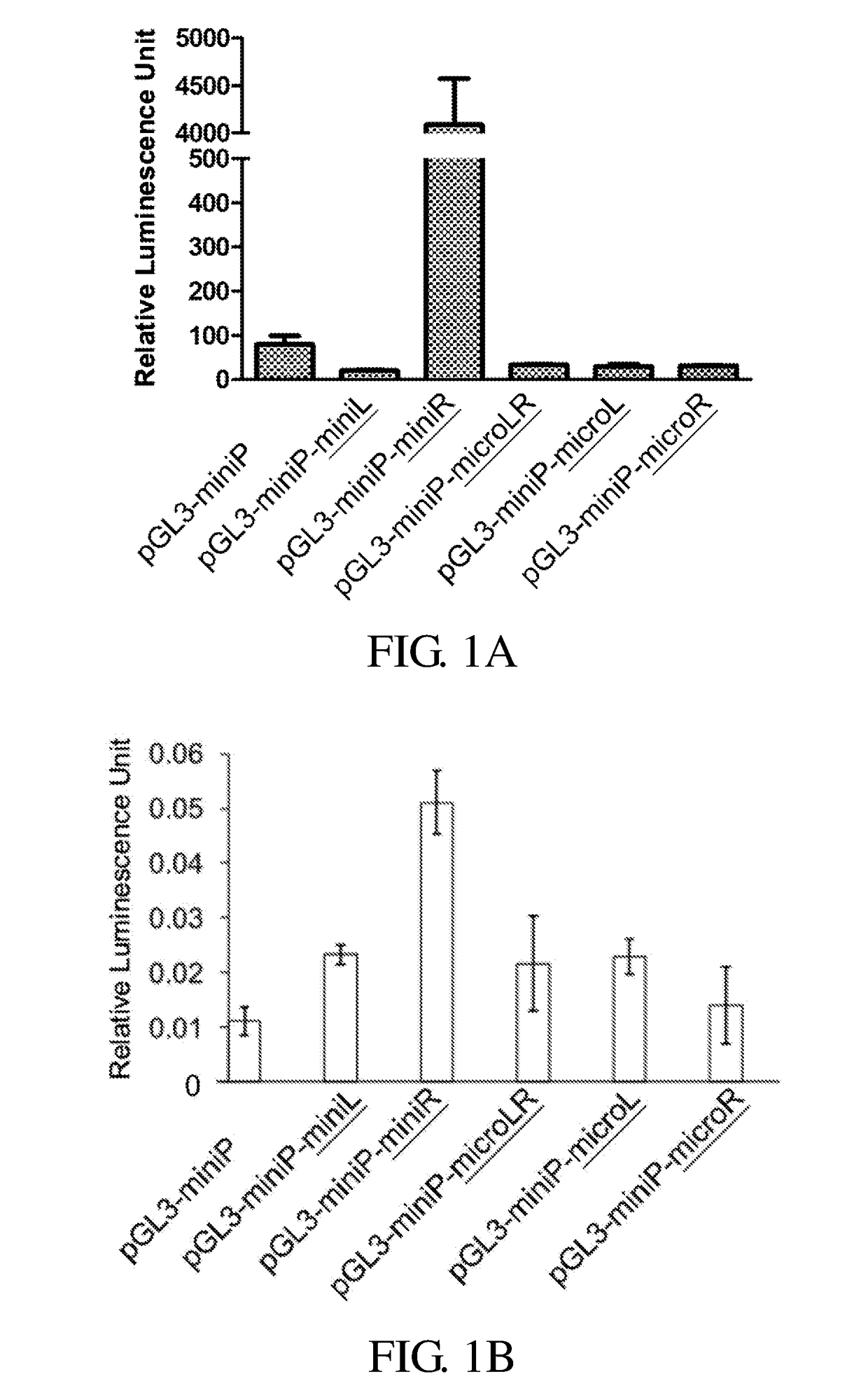
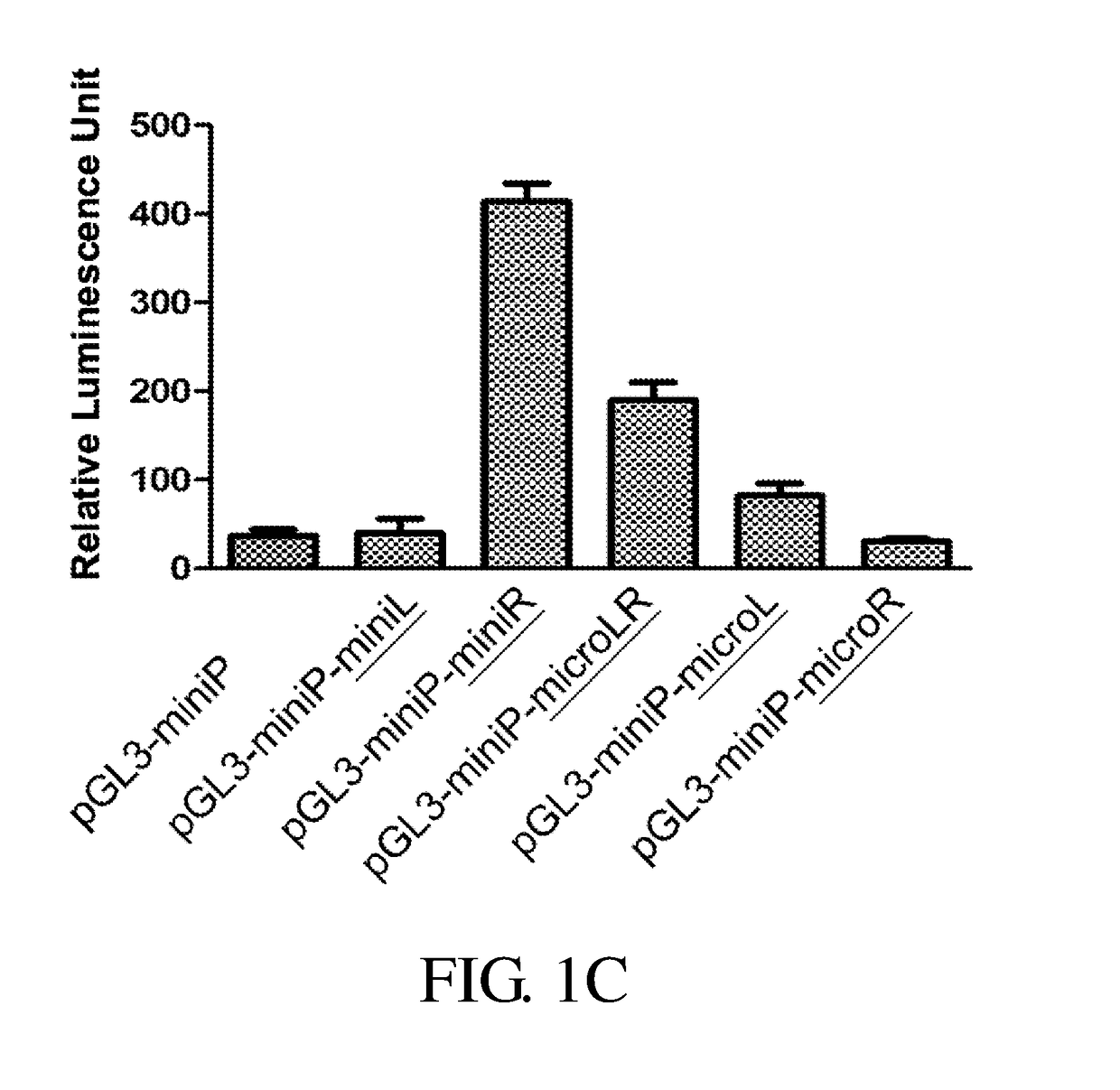
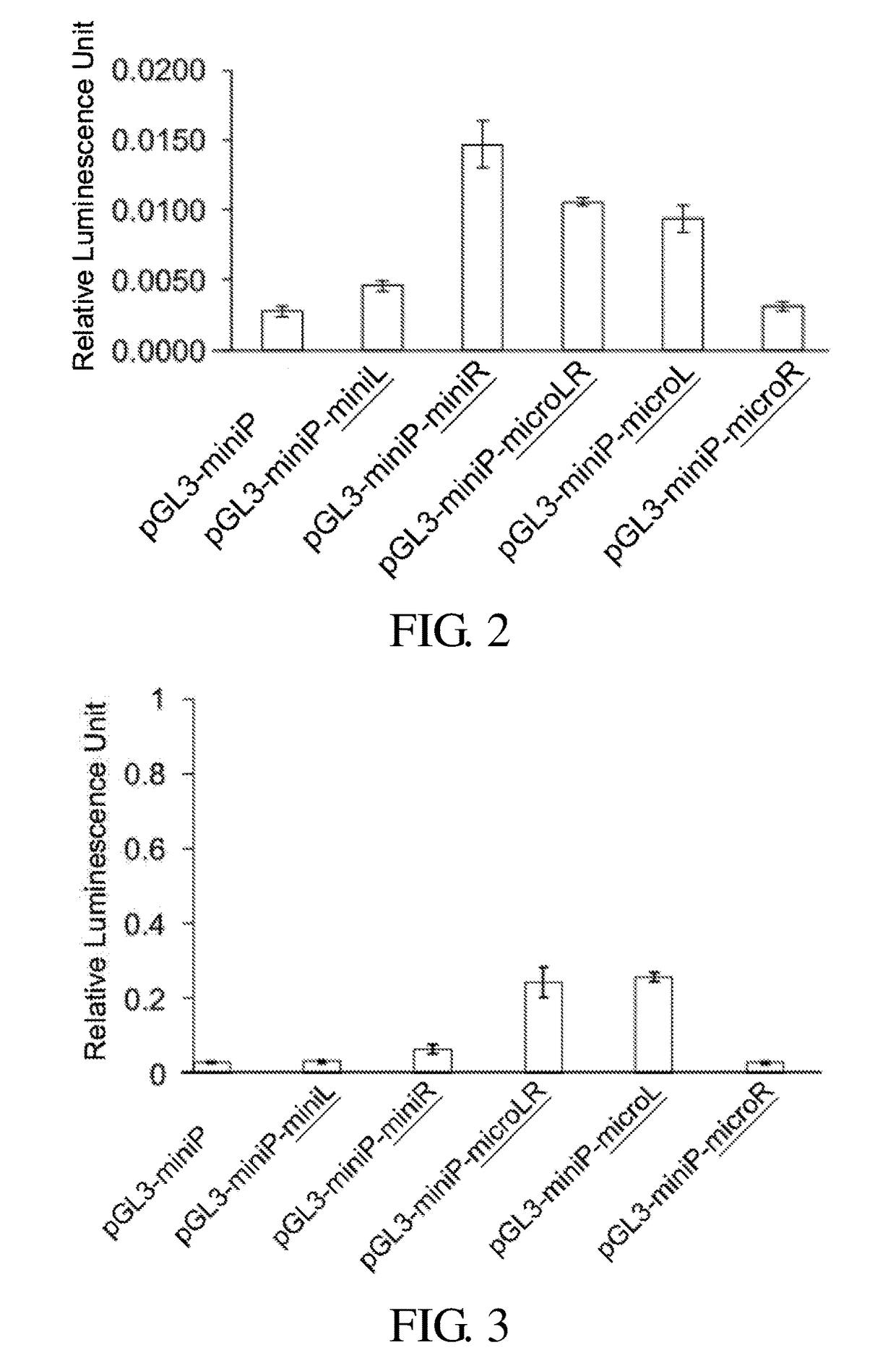
[0088]In this example, one control plasmid (i.e., pGL3-miniP) and five tested plasmids (i.e., pGL3-miniP-miniL, pGL3-miniP-miniR, pGL3-miniP-microLR, pGL3-miniP-microL, and pGL3-miniP-microR) were respectively transfected into host cells, including Sf9 cell (FIG. 1A), ESC (FIG. 1B), HEK293 cell (FIG. 1C) and Jurkat T cell (FIG. 2). The enhancer activities of those plasmids were analyzed by the enhancerassay as described in “Materials and Methods”.
[0089]As the data of FIG. 1A indicated, the Sf9 cells transfected with pGL3-miniP-miniR exhibited highest luciferase activity over that transfected with any of other plasmids (i.e., pGL3-miniP, pGL3-miniP-miniL, pGL3-miniP-microLR, pGL3-miniP-microL, and pGL3-miniP-microR). As to mammalian cells, among the plasmids that were tested, the expression level of luciferase conferred by the plasmid comprising pGL3-miniP-microR was closest to that comprising pGL3-miniP (ESC, FIG. 1B; HEK293 cell, FIG. 1C; Jur...
[0091]The enhancer activities of the terminal repeats were also evaluated in human MSCs derived from Wharton's jelly. Results are depicted in FIG. 3.
[0092]Compared with the control group, the terminal repeats of SEQ ID NOs: 3 and 6 may respectively enhance the expression of the reporter genes, whereas neither the terminal repeats of SEQ ID NOs: 1 nor 4 (especially SEQ ID NO: 1) possessed significant enhancer activity in the MSCs tested.
[0093]Taken together, the data suggested that the terminal inverted repeats of mini-piggyBac may provide an ideal gene transfer vector that facilitates the introduction of an exogenous gene into the MSCs without altering (i.e., either enhance or inhibit) the global gene expression therein. On the contrary, the terminal inverted repeats of micro-piggyBac may be preferable for constructing gene transfer vector in mouse embryonic stem cells and human T cells.
[0094]In conclusion, the present disclosure provides a kit for sel...
the structure of the environmentally friendly knitted fabric provided by the present invention; figure 2 Flow chart of the yarn wrapping machine for environmentally friendly knitted fabrics and storage devices; image 3 Is the parameter map of the yarn covering machine
Login to View More
PUM
Property
Measurement
Unit
Fluorescence
aaaaa
aaaaa
Level
aaaaa
aaaaa
Login to View More
Abstract
A kit for constructing a transposon is provided. The kit comprises five plasmids, each of which consists essentially of a gene cassette linked or not linked to a terminal repeat. The kit is useful in selecting the type of piggyBac that exhibits the least enhancer activity in the host cells.
Description
BACKGROUND OF THE INVENTION1. Field of the Invention[0001]The present disclosure in general relates to the field of transposon. More particularly, the present disclosure relates to kits and methods for selecting the most suitable type of terminal repeats to construct a piggyBac-based genetransfer vector.2. Description of Related Art[0002]DNA transposons that translocate by excision from a donor site and insertion into a target site are often used for genomeengineering by insertional mutagenesis and transgenesis. PiggyBac (PB) is a class II transposon that precisely and efficiently transposes between vectors and chromosomes via a “cut and paste” mechanism. PB transposon exists in nature as a gene that encodes a transposase and is flanked by inverted terminal repeat (ITR) sequences. During the transposition, the transposase recognizes the ITR sequences and catalyzes the excision of the transposon from the original locus followed by efficiently integrating it into TTAA target sites.[...
Claims
the structure of the environmentally friendly knitted fabric provided by the present invention; figure 2 Flow chart of the yarn wrapping machine for environmentally friendly knitted fabrics and storage devices; image 3 Is the parameter map of the yarn covering machine
Login to View More
Application Information
Patent Timeline
Application Date:The date an application was filed.
Publication Date:The date a patent or application was officially published.
First Publication Date:The earliest publication date of a patent with the same application number.
Issue Date:Publication date of the patent grant document.
PCT Entry Date:The Entry date of PCT National Phase.
Estimated Expiry Date:The statutory expiry date of a patent right according to the Patent Law, and it is the longest term of protection that the patent right can achieve without the termination of the patent right due to other reasons(Term extension factor has been taken into account ).
Invalid Date:Actual expiry date is based on effective date or publication date of legal transaction data of invalid patent.



 Login to View More