Check patentability & draft patents in minutes with Patsnap Eureka AI!

Fitness and Educational Game and Method of Playing the Same

a technology of educational games and exercises, applied in the field of fitness and educational games and methods of playing the same, can solve the problems of affecting the accuracy of laborious for both the client and the client, and the inability to accurately represent the individual's habitual dietary pattern, etc.

Inactive Publication Date: 2019-09-05
DQPN LLC
View PDF0 Cites 0 Cited by
  • Summary
  • Abstract
  • Description
  • Claims
  • Application Information

AI Technical Summary

Benefits of technology

This approach provides accurate, qualitative, and quantitative representations of dietary patterns, relieves the data analysis burden, and allows for infinite scalability, enabling users to easily set and achieve dietary goals with minimal user input, while being accessible and user-friendly.

Problems solved by technology

Conventional dietary intake measures, including, for example, food frequency questionnaires, food diaries, dietary recall, are notoriously prone to inaccuracies despite being very labor-intensive.
They are, in fact, labor intensive for both the “client” and the professionals (i.e., dietitians, nutrition researchers) who rely on them for data.
Because they are tedious, cumbersome, and not user-friendly, they are ill-suited to consumer-facing applications that are intended to be “inviting” or fun to use, such as apps on smart phones or other wearable technology (e.g. smart watches).
Even then, the result is notoriously prone to inaccuracies due to the need to estimate intake of diverse foods, and choose representative foods from the inventory provided.
Food diaries and 24-hour diet recall require the recording of foods at the time of consumption, or depending on memory, and involve writing down details about foods and quantities and again require considerable time.
Such photograph-based methods still depend on food-by-food and meal-by-meal information capture; are labor intensive and time consuming for the consumer, requiring n-of-1 data entry; are labor intensive and time consuming for researchers and health professionals, requiring n-of-1 data analysis to determine nutrient intake levels, salient food factors, and objective measures of overall diet quality.
Furthermore, while existing methods are suitable for individuals, they are not readily adapted to the level of whole households.
In addition, application to children is historically very difficult.
The errors in such methods are of a magnitude that some have deemed them altogether invalid.
Methods in the pipeline do not promise reliably to fix these problems.
The technology on which they depend introduces new potential problems, including but not limited to: need for Internet access; need for expensive hardware; need for reliable light for photography; need for extensive data transfer; potential risk of privacy compromise by fixed cameras; the need for diverse ‘consumers’ to learn the use of the technology; etc.
Thus, it can be seen that there is, to date, no method, in practice or conceived, to reverse-engineer this process.
In other words, there is no method that uses a diet quality score to generate a representative diet and express it as a photographic image.
However, the downside to this method is that the user must choose and build their meals for the day to meet a dietary goal, which can be a time consuming process.
In addition, the user may not know what constitutes, a “good”, “better” or “best” choice for a given category of foods or beverages.
However this method still requires the user to input information into a lengthy questionnaire.
In particular, there is, to date, no streamlined, user-friendly, and universally applicable means to capture the diet composition and quality of an individual or household in a straightforward and simple manner.
In addition, there is currently no convenient or efficient way to get good dietary information about an individual or a household without the time and effort required for preparing and analyzing a food diary or related data source.
There is also no good way to monitor the progress of an individual or a household in adopting new dietary habits in a quick, convenient, and efficient manner.
There is currently no good way to identify whether a user or household has reached a goal of improving their diet in a fun, fast and user friendly manner.
Finally, there is no way for researchers to obtain information about dietary intake that does not require analysis of diet composition each time at the level of individual data entry.
There is no method to establish dietary intake using pre-analyzed representations of diet that obviate individual analysis, allowing for infinite scalability.

Method used

the structure of the environmentally friendly knitted fabric provided by the present invention; figure 2 Flow chart of the yarn wrapping machine for environmentally friendly knitted fabrics and storage devices; image 3 Is the parameter map of the yarn covering machine
View more

Image

Smart Image Click on the blue labels to locate them in the text.
Viewing Examples
Smart Image
  • Fitness and Educational Game and Method of Playing the Same
  • Fitness and Educational Game and Method of Playing the Same
  • Fitness and Educational Game and Method of Playing the Same

Examples

Experimental program
Comparison scheme
Effect test

example 1

Populating the Matrix

[0171]1) A well-known, validated measure of diet quality is selected to establish an ordinal scale for the range of scores (e.g., quintiles)

[0172]2) Some number of dietary variants are defined, meaning a composition of routinely consumed foods and beverages, representative of each level of quality in the matrix. In other words, diets can vary in both character and quality. A variation in character would be the distinction between a vegetarian diet, and a Paleo diet. A variation in quality would be a high-quality vegetarian diet versus a low-quality vegetarian diet.

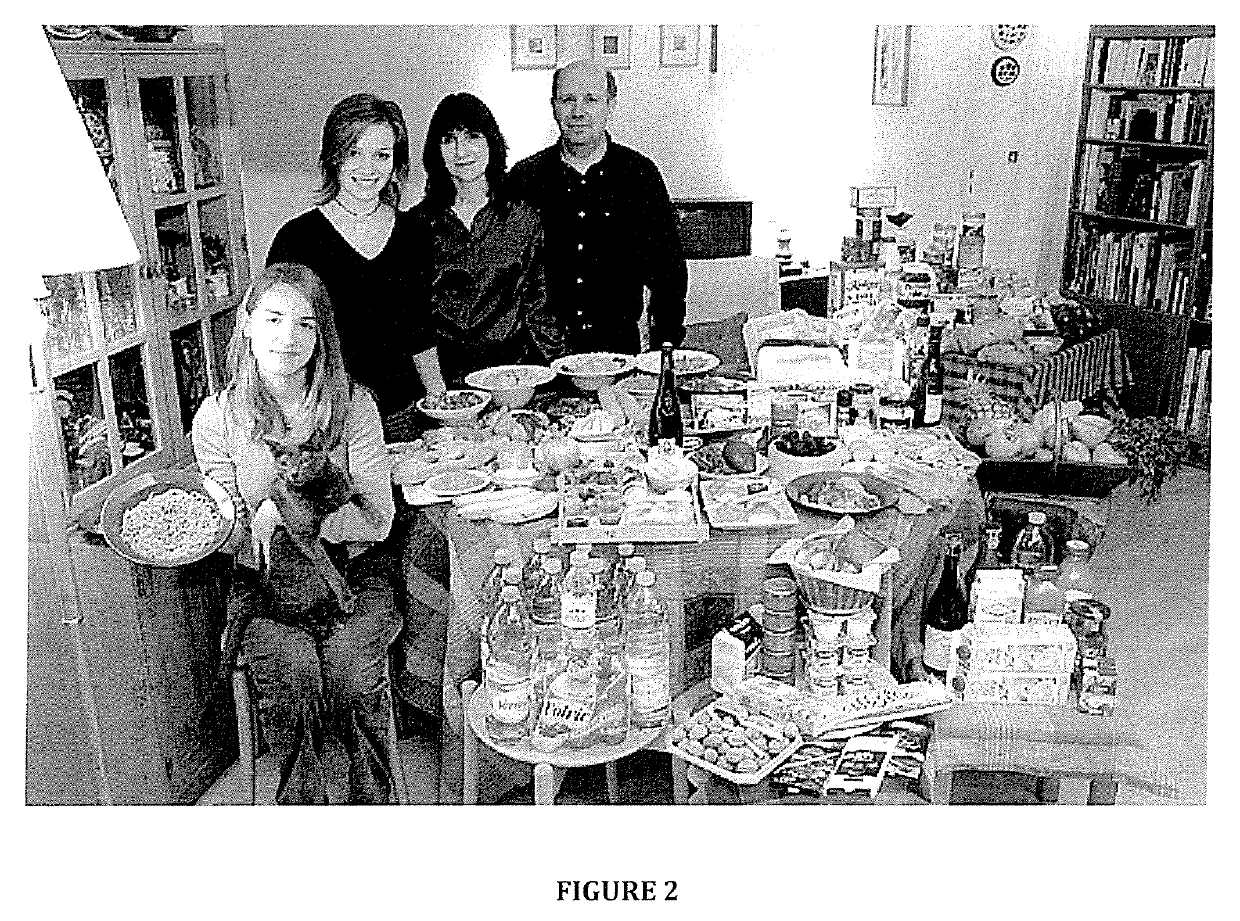
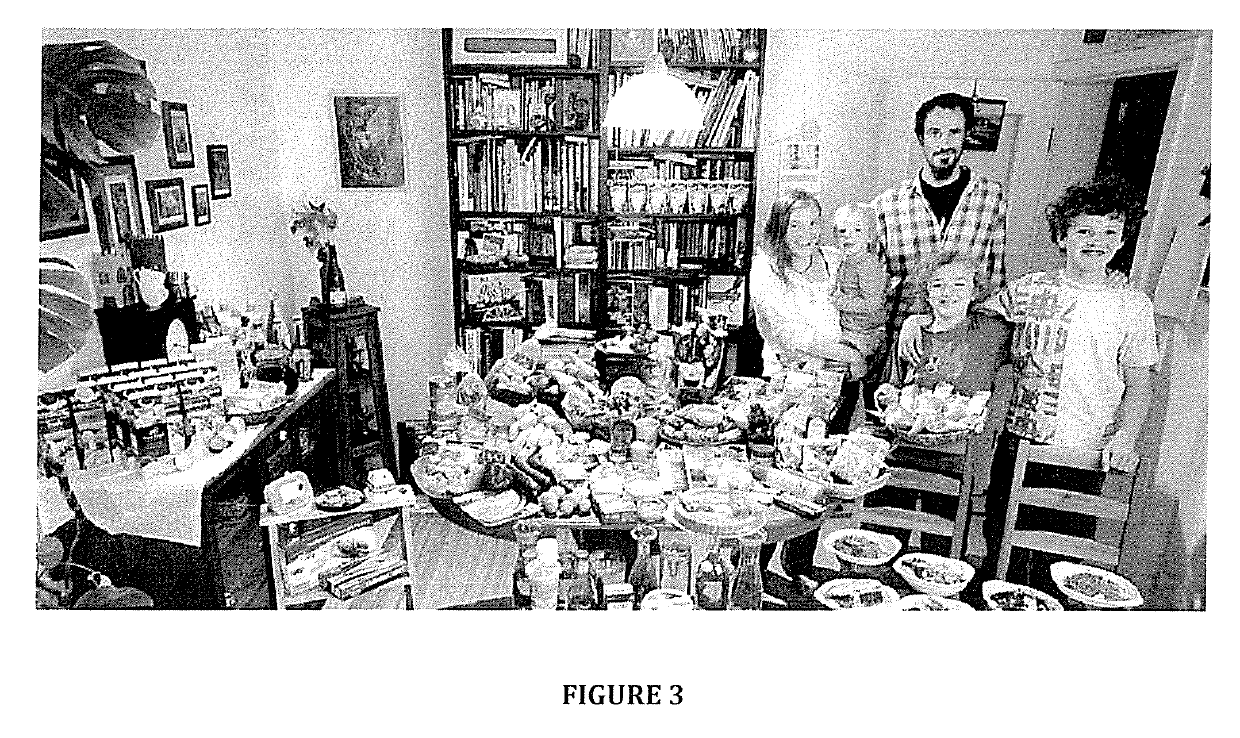
[0173]In order to provide any given user of the method with sufficient images to find a close match to their baseline and goal diets, these variations in both character and quality are represented by a suite of foods / drinks captured in a photograph. The ideal representation of, for instance, a “poor quality” vegetarian diet versus a “good quality” vegetarian diet is based on real-world reporting in die...

example 2

Closest Approximation of Baseline Diet

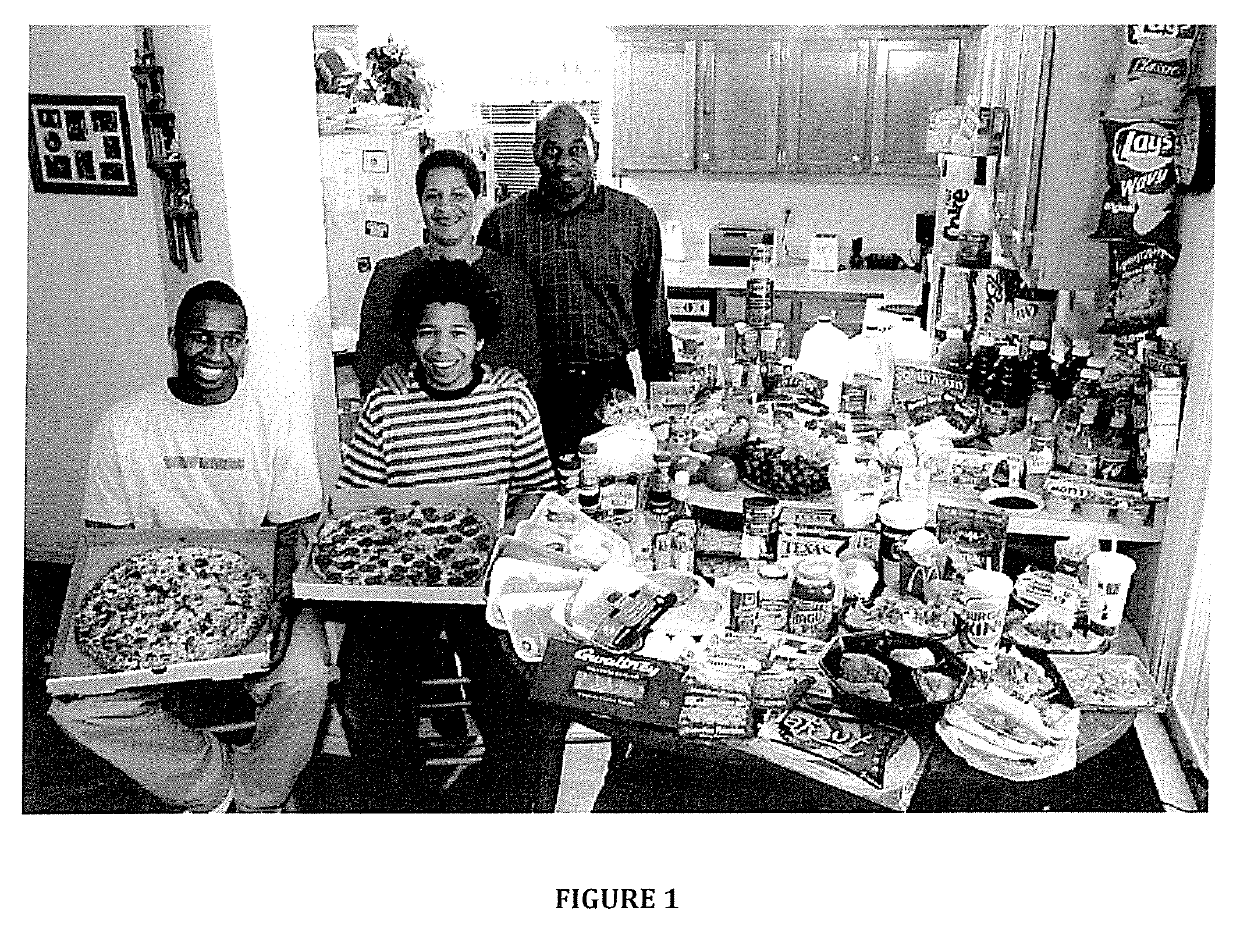
[0181]1) A subject is shown images from a photograph library and asked to choose the closest approximation of baseline diet for a period of time (i.e., one week); the images are VERY distinct. For example, the photograph library may include photographic representations of a ‘typical American diet,’ including meat, soda, and fast food; and an ‘optimal vegetarian diet’ showing no soda, no meat, no fast food, and in their place fresh vegetables, fruits, whole grains, a pitcher of water, etc.

[0182]2) Whichever image is chosen is then subjected to an EXPLODE function, in which N new food photographs, representing much more closely related variants of that dietary pattern are shown; and the subject is once again prompted to choose the closest approximation of baseline diet, in order to get an even closer fit. It is noted that N may be any number. In some embodiments, N is 2 or 3 or 4 or more. While there is no upper limit to N, too many photographs wo...

the structure of the environmentally friendly knitted fabric provided by the present invention; figure 2 Flow chart of the yarn wrapping machine for environmentally friendly knitted fabrics and storage devices; image 3 Is the parameter map of the yarn covering machine
Login to View More

PUM

No PUM Login to View More

Abstract

A fitness and education game and method of playing the same method for increasing health awareness. The game includes a plurality of unique photographic images, wherein each unique photographic image depicts a different objective level of diet quality for a different type of diet for a period of time and depicts representative types and quantities of foods and / or beverages consumed at the level of diet quality for the type of diet for the period of time. The game also a diet quality map comprising a grid of cells. Each unique photographic image corresponds to a cell in the grid of cells and each photographic image represents a dietary variant or pattern of a level of diet quality for a type of diet; and. The game also includes instructions for one or more players to navigate through the grid of cells from a BASELINE level of diet quality to a more optimal level of diet quality.

Description

FIELD OF THE INVENTION[0001]The present invention relates generally to a method for capturing baseline diet composition, goal (desired) diet composition, and providing step-by-step guidance from baseline to goal via a customized, preferred “route”—experienced by the user.BACKGROUND OF THE INVENTION[0002]Good diet quality is a major contributing factor to the health and well-being of individuals and families. However, in order to evaluate diet quality, it is necessary to obtain information regarding current dietary intake of the individual and / or household.[0003]Conventional dietary intake measures, including, for example, food frequency questionnaires, food diaries, dietary recall, are notoriously prone to inaccuracies despite being very labor-intensive. They are, in fact, labor intensive for both the “client” and the professionals (i.e., dietitians, nutrition researchers) who rely on them for data. Because they are tedious, cumbersome, and not user-friendly, they are ill-suited to ...

Claims

the structure of the environmentally friendly knitted fabric provided by the present invention; figure 2 Flow chart of the yarn wrapping machine for environmentally friendly knitted fabrics and storage devices; image 3 Is the parameter map of the yarn covering machine
Login to View More

Application Information

Patent Timeline
no application Login to View More
Patent Type & Authority Applications(United States)
IPC IPC(8): G09B19/00G09B29/00G16B45/00
CPCG09B29/00G09B19/0092
Inventor KATZ, DAVID L.
Owner DQPN LLC
Features
  • R&D
  • Intellectual Property
  • Life Sciences
  • Materials
  • Tech Scout
Why Patsnap Eureka
  • Unparalleled Data Quality
  • Higher Quality Content
  • 60% Fewer Hallucinations
Social media
Patsnap Eureka Blog
Learn More