

Method for nk cell transduction
- Summary
- Abstract
- Description
- Claims
- Application Information
AI Technical Summary
Benefits of technology
Problems solved by technology
Method used
Image

Examples
embodiments
[0127]In one embodiment of the invention a transgenic nucleic acid, e.g. a nucleic acid encoding for a chimeric antigen receptor is transferred into an activated NK cell with a retroviral vector particle, e.g. a lentiviral vector particle, that is pseudotyped with a modified baboon endogenous retrovirus (BaEV) envelope glycoprotein that is able of binding to and fusing with a hematopoietic cell membrane.
[0128]Said pseudotyped retroviral vector particle, e.g. lentiviral vector particle may comprise a chimeric envelope glycoprotein which comprises or consists in a fusion of the transmembrane and extracellular domain of a baboon endogenous retrovirus (BaEV) envelope glycoprotein and the cytoplasmic tail domain of a murine leukemia virus (MLV) envelope glycoprotein or a modified BaEV envelope glycoprotein wherein the cytoplasmic tail domain is devoid of the fusion inhibitory R peptide.
[0129]NK cells in a cell culture medium comprising NK cells are activated, e.g. by the addition of IL-2...
example 1
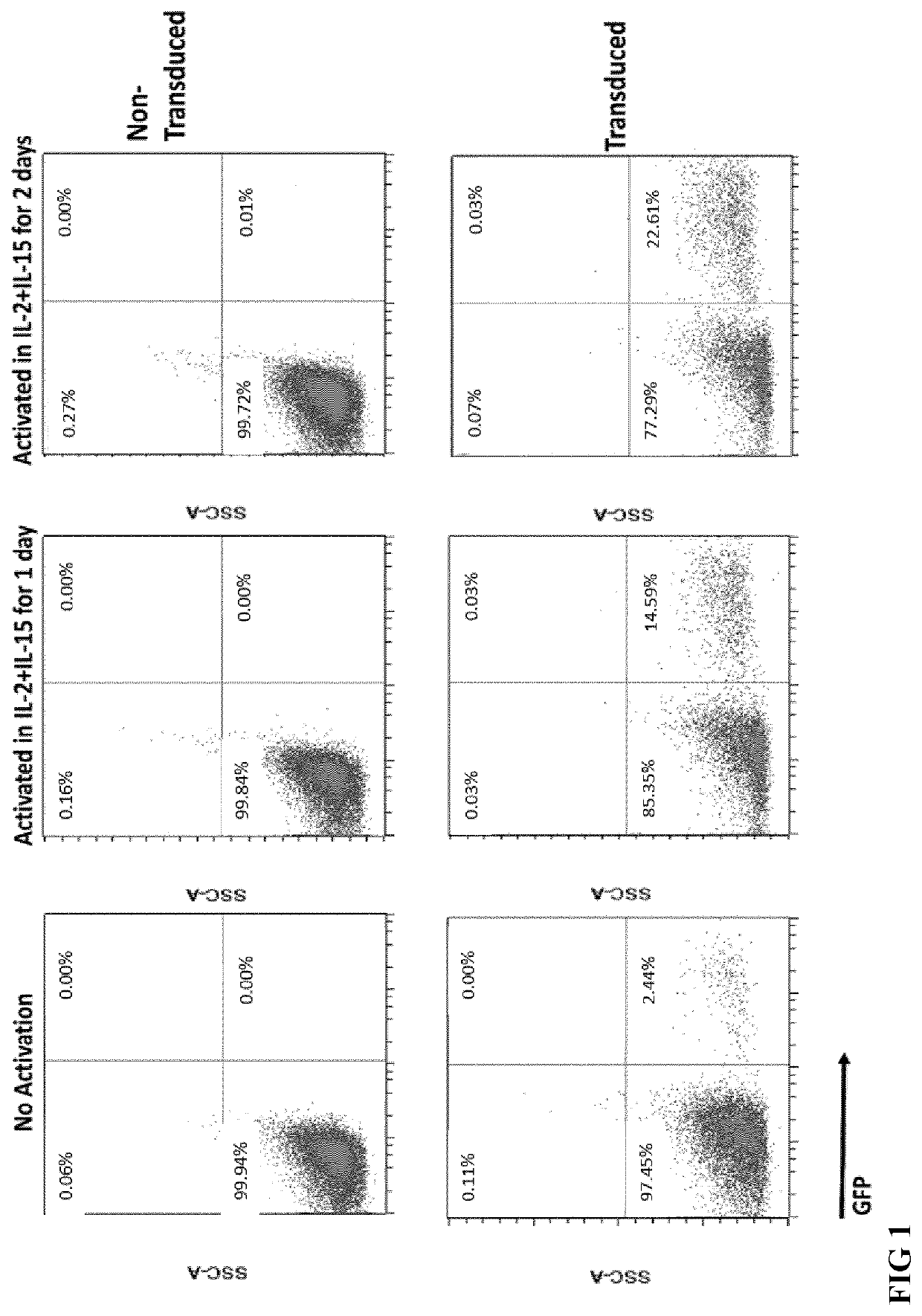
gly, Lentiviral Vector Pseudotyped with Baboon Envelope Glycoprotein (BaEV) Shows High Transduction Efficiency of Primary NK Cells when the NK Cells have been Pre-Activated
[0169]For NK cell isolation from buffy coats, peripheral blood mononuclear cell (PBMC) preparation was performed by standard density-gradient centrifugation using Ficoll-Paque PLUS (GE Healthcare). NK cell isolation kit human (Miltenyi Biotec) was applied for untouched enrichment of NK cells from PBMC. Isolated NK cells were divided in three groups, activated them for different durations and transduced with BaEV pseudotyped lentiviral vectors contained GFP. All transductions were performed with 10 ng / ml vectofusin (Miltenyi Biotec) and spinoculation following manufacturer protocol. First group of NK cells were transduced immediately after isolation (No activation). Second group of NK cells were cultured in NK MACS medium (Miltenyi Biotec) containing 5% AB serum, 500 U / ml IL-2 and 10 ng / ml IL-15 for 1 day (activate...
example 2
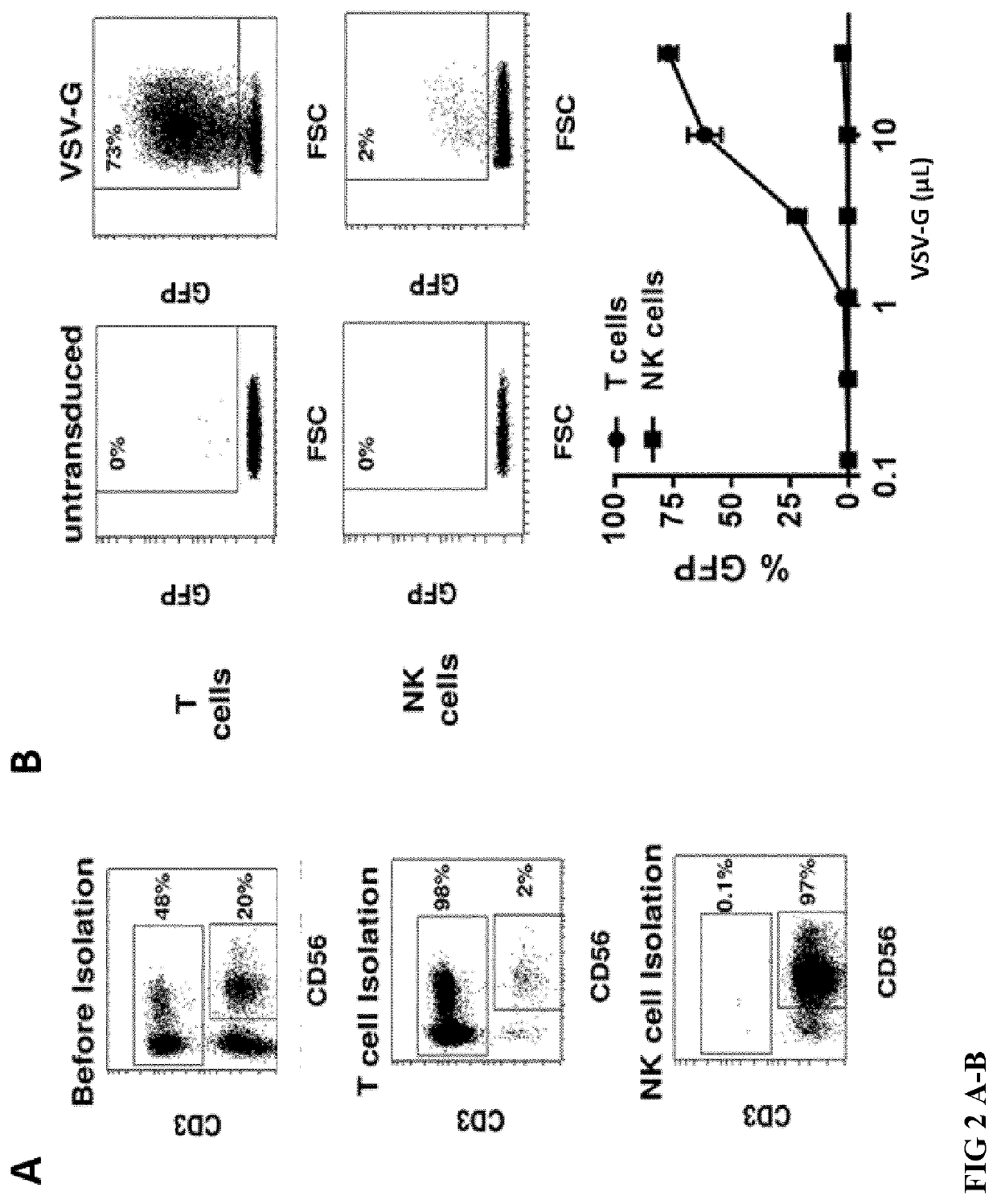
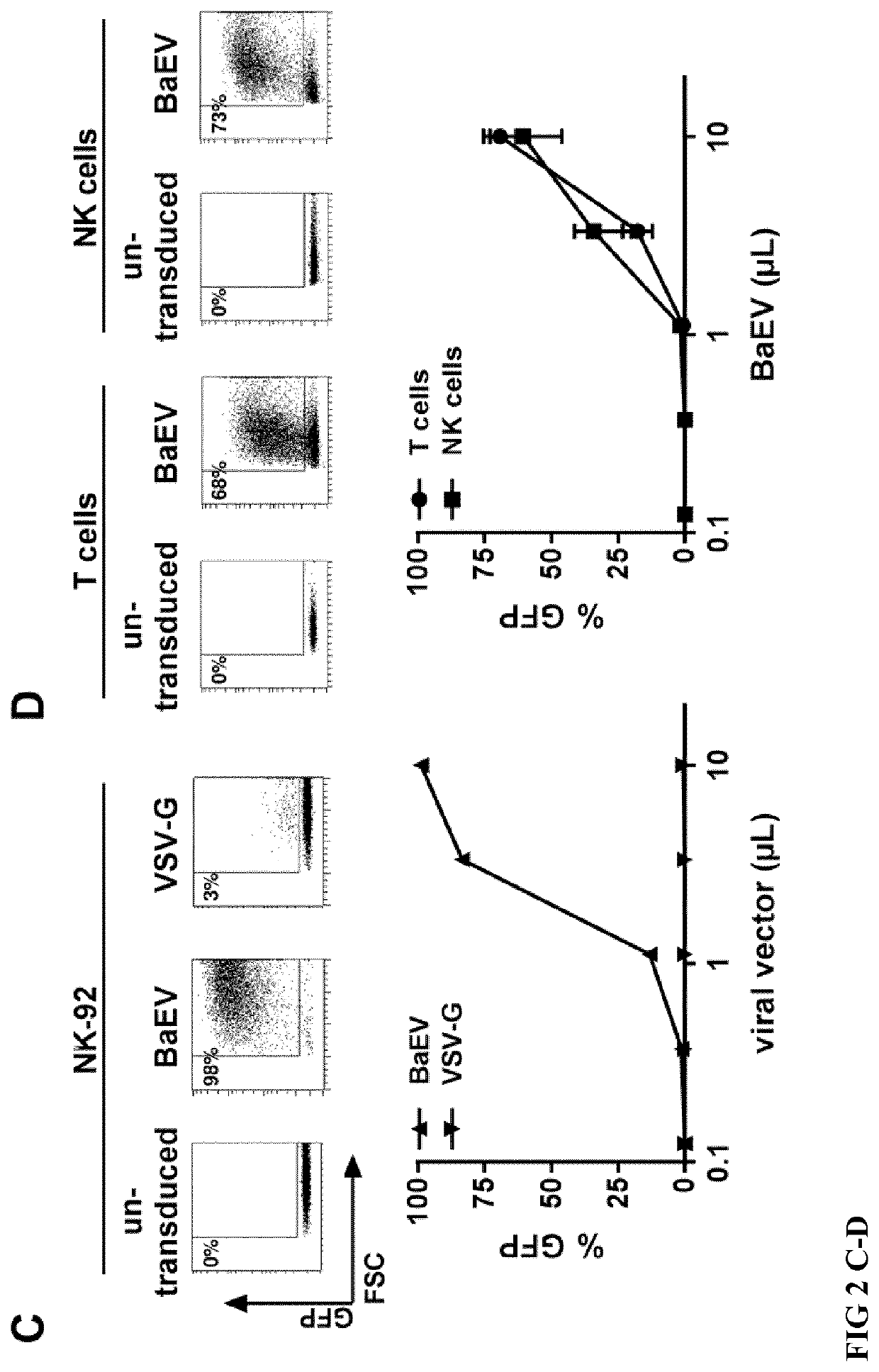
ion of Activated NK Cells with BaEV is Significantly Higher than with VSV-G, Stable Over Long Time, and does not Induce Cell Death
[0170]Primary NK cells were isolated as described in Example 1, resulting in pure CD3− and CD56+ NK cells (FIG. 2 A). T cells were isolated from the same blood samples using MicroBeads against CD4 and MicroBeads against CD8 from Miltenyi according to the user manual, resulting in pure CD3 positive T cells (FIG. 2 A) After isolation, NK cells were activated for 2 days in NK MACS medium with 5% AB serum, 10 ng / mL IL-15 and 500 U / mL IL-2. After isolation, T cells were activated for 2 days in TexMACS medium with 200 U / mL IL-2 and T Cell Transact human from Miltenyi, according to the user manual. Then, the activated primary T cells and NK cells, as well as NK-92 cell line, were transduced with supernatants containing lentiviral vectors coding for GFP expression, either pseudoyped with VSV-G envelope or pseudotyped with BaEV. Three days after transduction with ...
PUM
| Property | Measurement | Unit |
|---|---|---|
| Efficiency | aaaaa | aaaaa |
| Biological properties | aaaaa | aaaaa |
| Inhibition | aaaaa | aaaaa |
Abstract
Description
Claims
Application Information
 Login to View More