

Magnetic focusing immunosensor for the detection of pathogens
a biosensor and magnetic focusing technology, applied in the direction of optical radiation measurement, fluorescence/phosphorescence, spectrophotometry/monochromators, etc., can solve the problems of putting large segments of the population at risk, and affecting the detection efficiency of pathogens
- Summary
- Abstract
- Description
- Claims
- Application Information
AI Technical Summary
Problems solved by technology
Method used
Image

Examples
Embodiment Construction
)
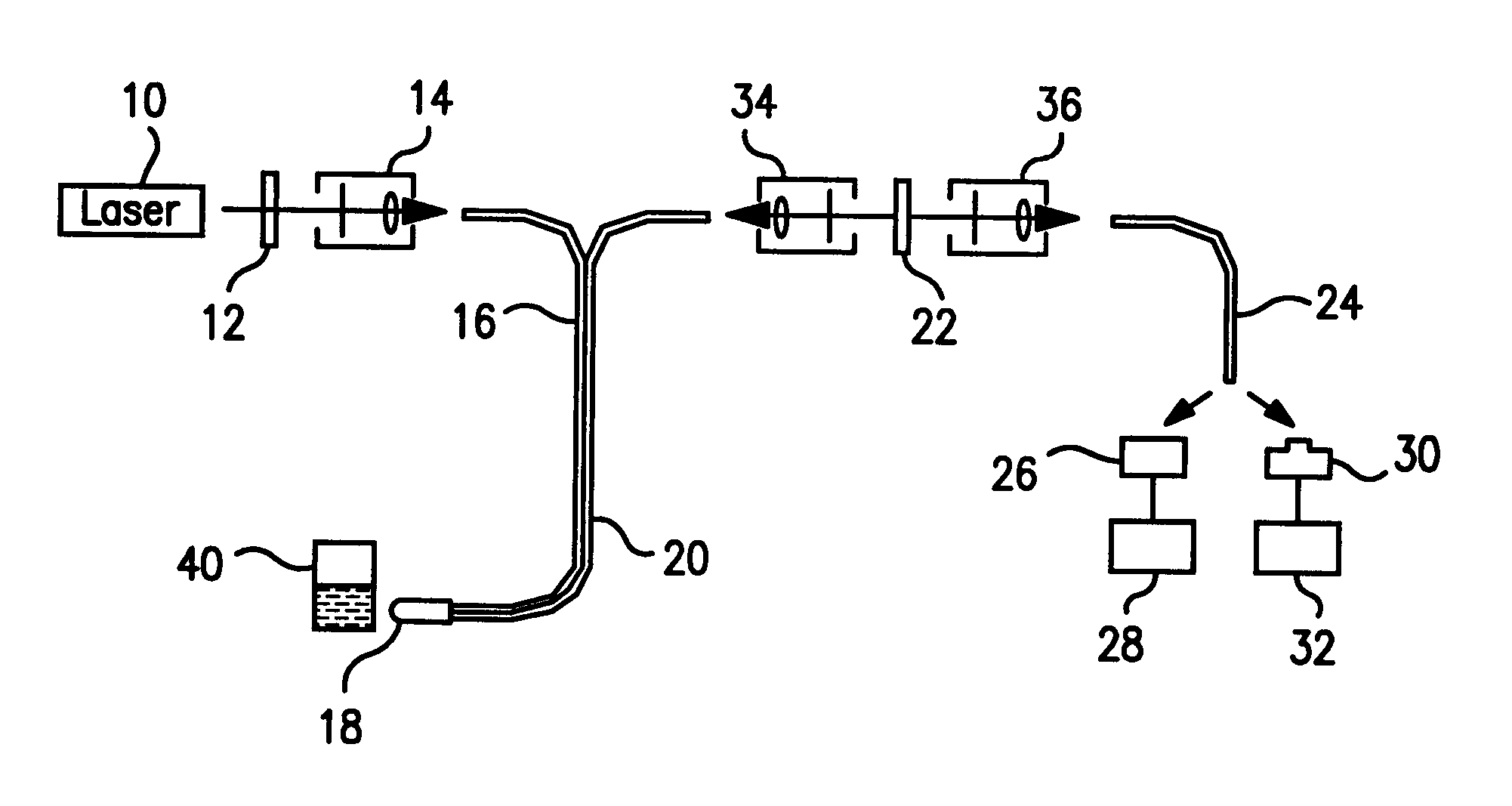
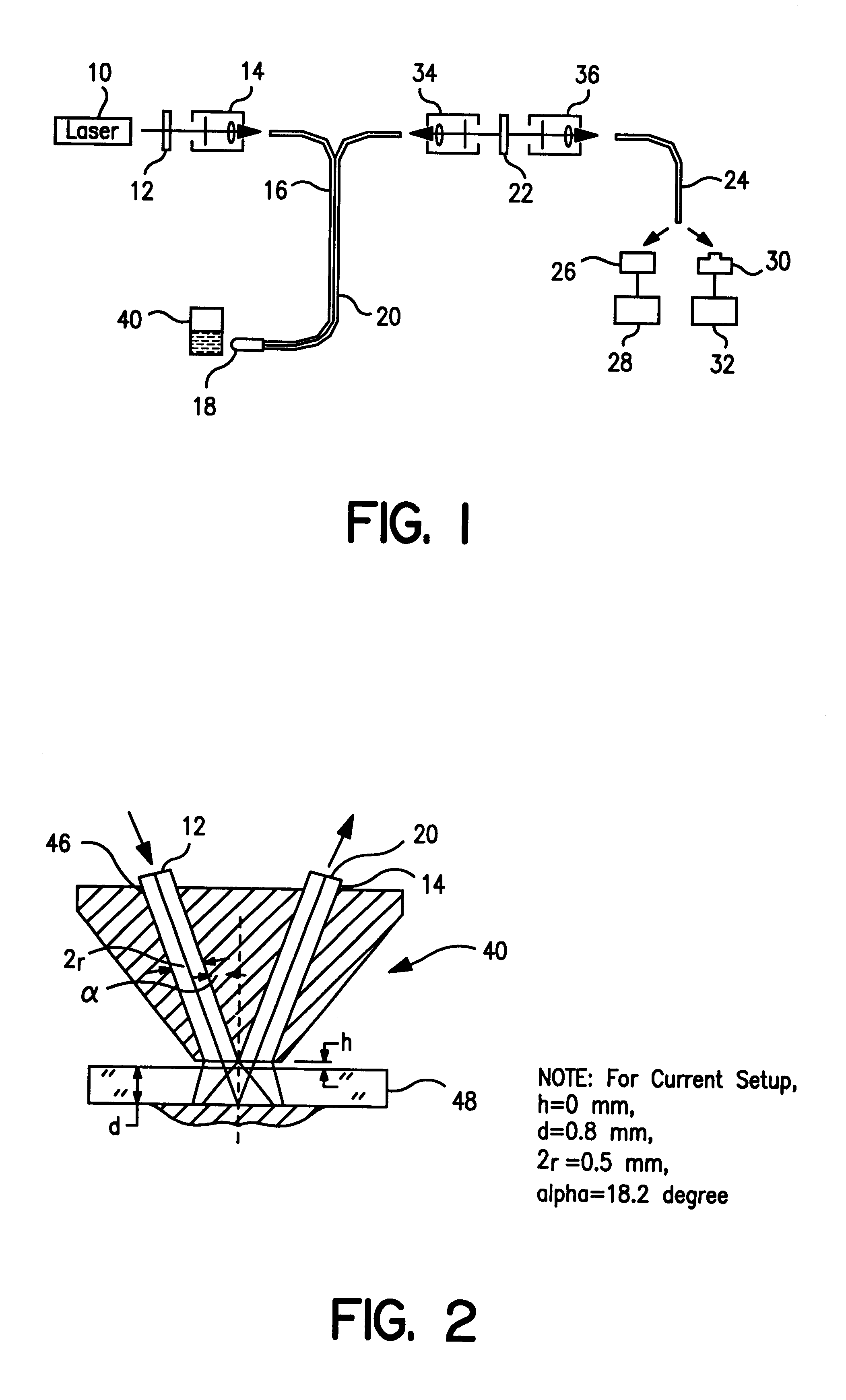
Referring to FIG. 1, a laser 10 having a 650 nm, 5-mW diode laser (Power Technology Corp.) is in communication with a line filter 12 (Omega Optical) which has its transmission maximum at 654 nm. The line filter 12 is in communication with a collimator 14 which is in communication with an exciting fiber 16. The exciting fiber 16 is in communication with a fiber optic magnetic focusing probe 18. The fiber magnetic focusing probe 18 is in communication with a collecting fiber 20. The collecting fiber 20 and the exciting fiber 16 are made from 500-micron (480-micron core) polymethyl methacrylate optical grade fibers. (ESKA brand).
The collecting fiber 20 is in communication with a collimator 34 which is in communication with a long pass filer 22. The long pass filter 22 has a cutoff of 670 nm and is made by Omega Optical. The long pass filter 22 is in communication with a transmission fiber 24 via collimator 36. The transmission fiber 24 is made of silica with a 400 micron core.
In the p...
PUM
| Property | Measurement | Unit |
|---|---|---|
| Angle | aaaaa | aaaaa |
| Diameter | aaaaa | aaaaa |
| Diameter | aaaaa | aaaaa |
Abstract
Description
Claims
Application Information
 Login to View More