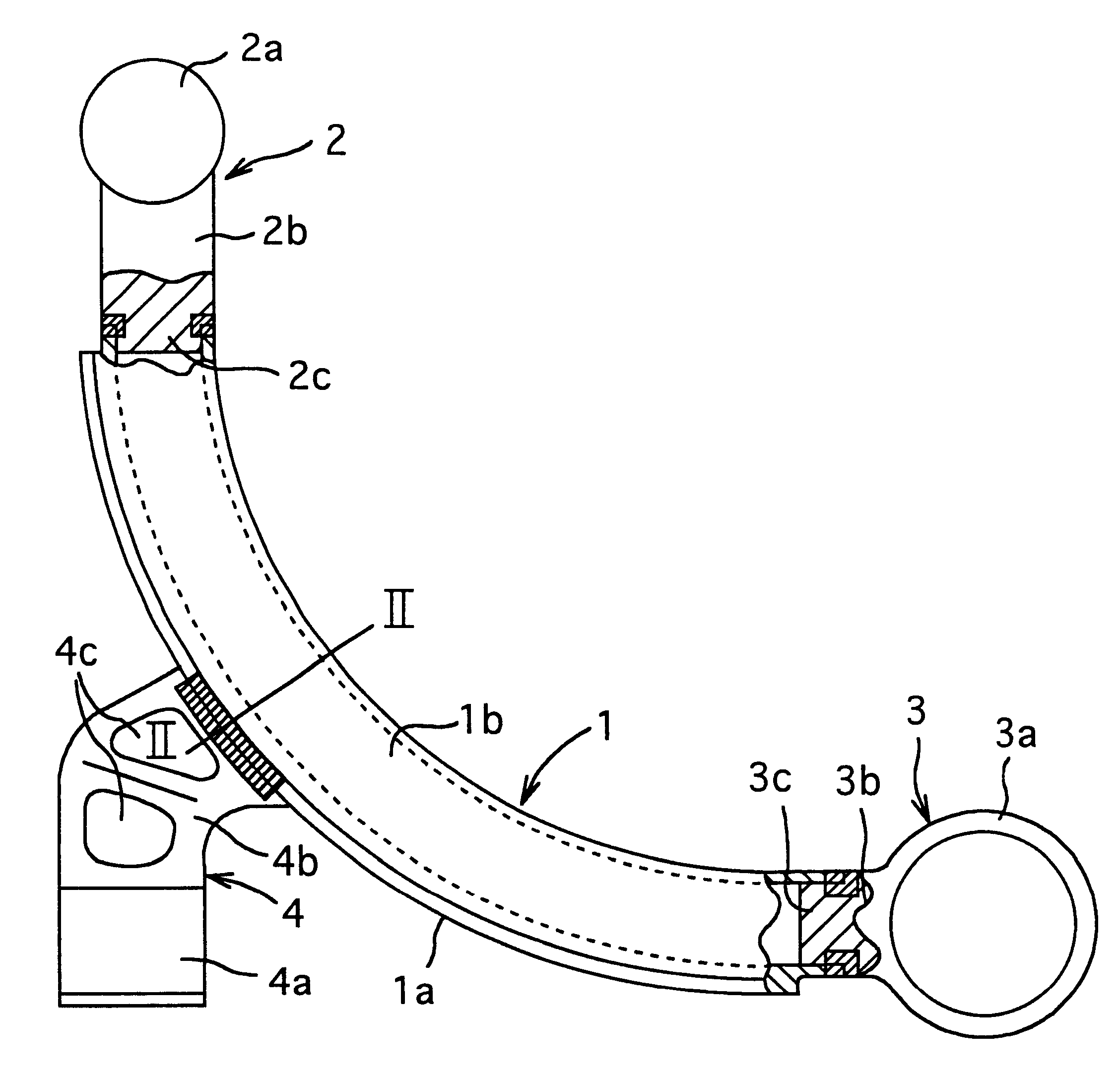
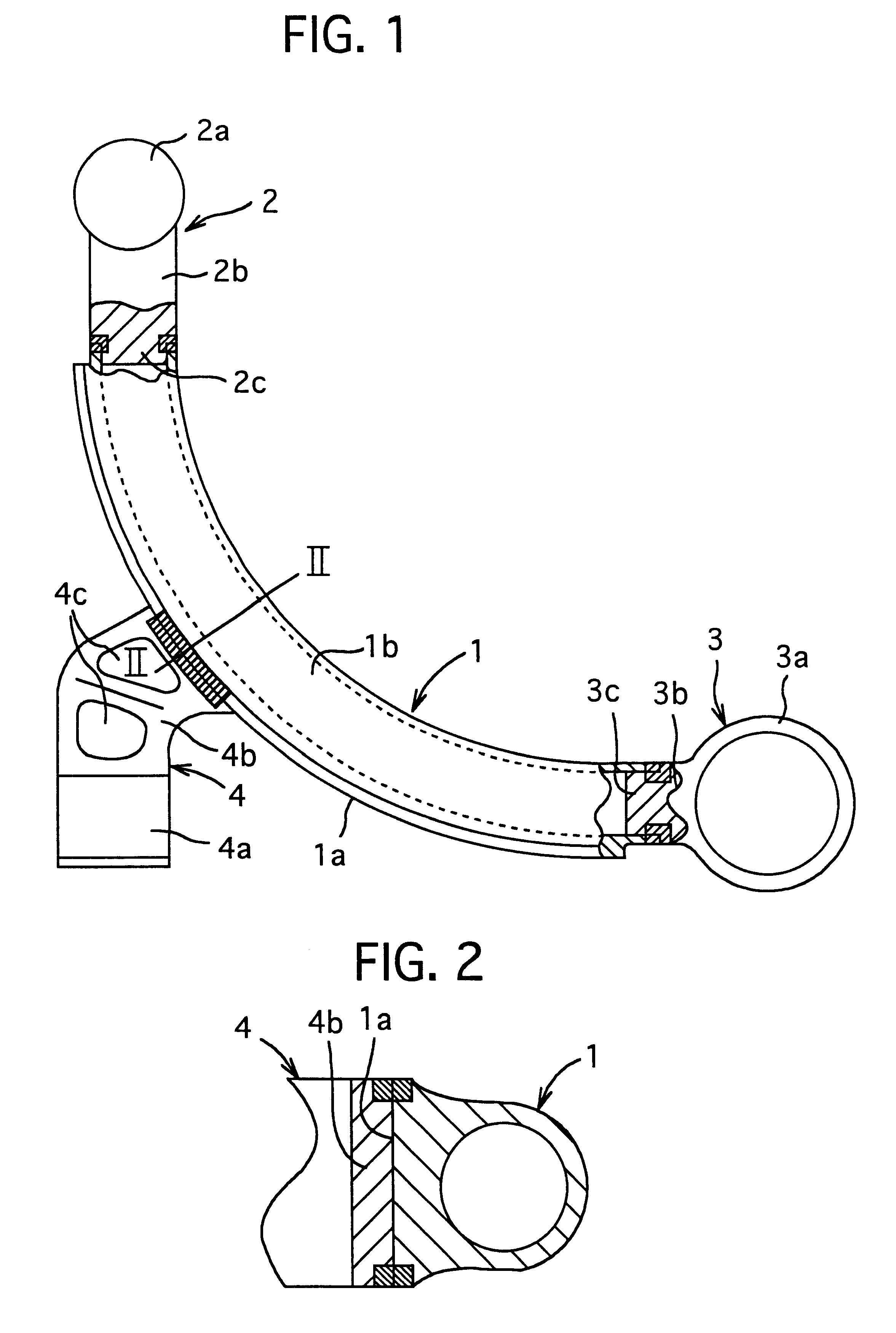
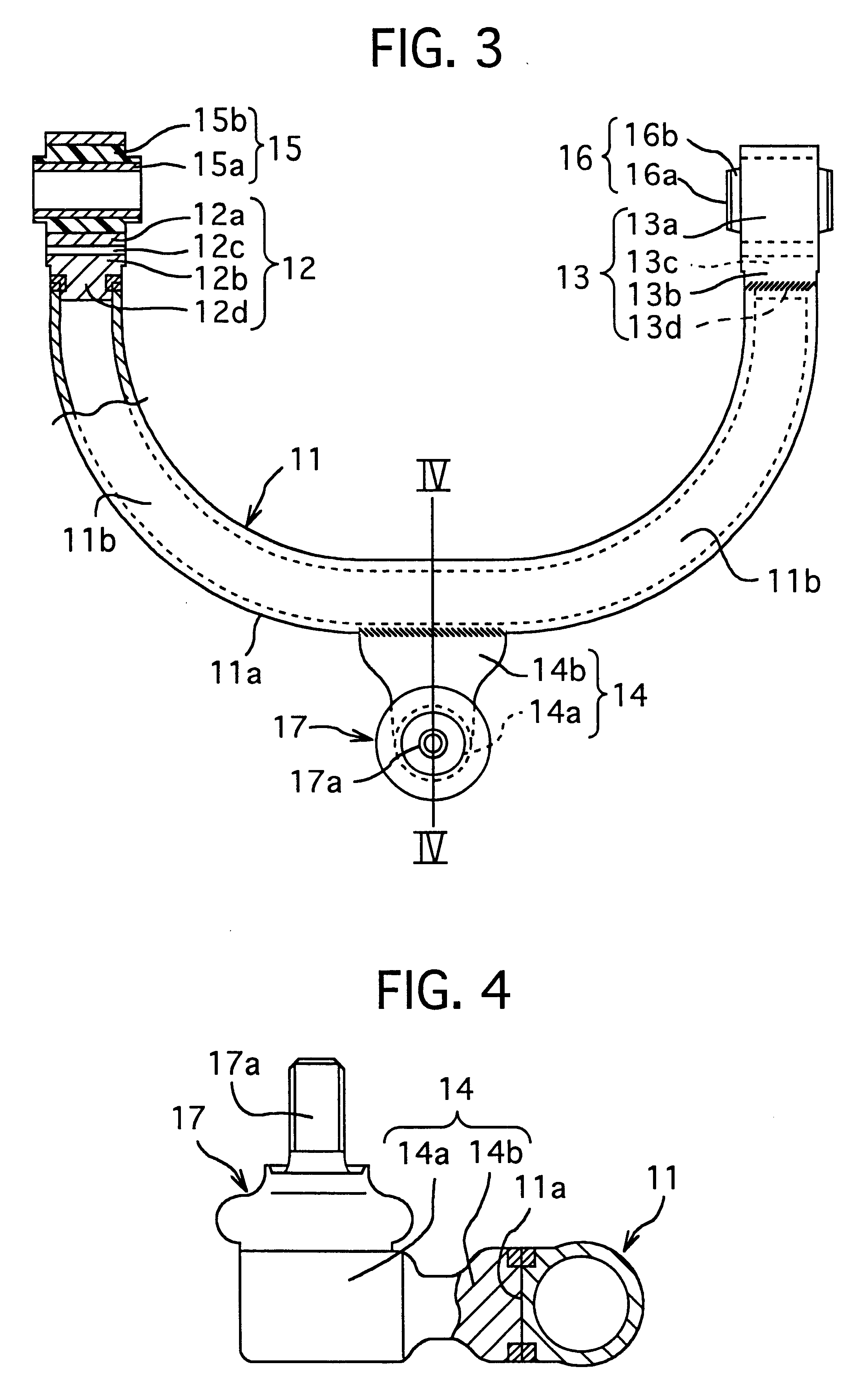
The arm member of this invention has at least a part thereof, a bent portion bent into the arch shape. This bent portion can be formed over the arm member such as a semi-circle or quater circle, or can be locally formed at a central portion of the arm member such as U-shape or V-shape. This bent portion is formed by bending the arm member by a known pressing apparatus easily, after the bearing members are attached to the both end of the arm member. As a result, the bearing members can be attached to the straight arm member easily.
In the invention recited in the claim 3, the arm member has a flat surface formed at a part of an outer
peripheral surface thereof in extruding and extending in the extruded direction. According to this invention, when the intermediate bearing member is joined to the arm member, the joined surface of the arm member is flat, not curved, at least in a cross-section perpendicular to the extruding direction, which can heighten the joining responsibility of the intermediate bearing member to the arm member. In addition, when the arm member is formed into the
pipe shape which has an inner
peripheral surface, due to formation of the flat surface at the part thereof, a modulus of section and a rigidity of the arm member can be increased, to thereby heighten the strength and durability of the arm member.
In the invention recited in the claims 4 to 6, the both end portions of the arm member, or the both bearing member at the both ends of the arm member are connected with each other by a connecting bar. According to this invention, a positional error occurred between the both ends of the arm member in bending the arm member can be corrected or absorbed when the connecting bar is attached between the both ends of the arm member or between the both bearing members. Thus, the dimensional accuracy of the shaft to shaft distance between the both bearing members attached to the both ends of the bent arm member can be increased. The connecting bar can be formed by a
rigid body such as a
metal, but is preferably formed by the
aluminium alloy, in view of the material (
aluminium alloy) of the arm member and the bearing members to which the connecting bar is connected, and lightening of the suspension arm including the connecting bar.
In the invention recited in the claim 7, the intermediate bearing member is joined to the flat surface of the arm member, which heighten the joining strength of the intermediate bearing member to the arm member. In the invention recited in the claim 6, the arm member has the semi-circular or quater circular shape, which can absorb the vivrations in various direction between the both ends and the intermediate portion of the arm member.
In the invention recited in the claims 9 and 10, a connecting members with vibration preventing fuction are attached to the bearing members at the both end of the arm member, or the intermediate bearing. According to this invention, on account of the connecting member with vibratio preventing function attached to the both bearing members or the intermediate bearing memer, the suspension arm can be connected to an another suspension arm or an attaching member easily. The connecting members with vibration preventing fuction are attached to the both bearing members or the intermediate bearing memer to connect this connecting member with another or adjacent connecting members with vibration preventing fuction. As the connecting member with vibration prevent, a vibration preventing
bushing provided with a rubber elastic body for absorbing the vibration, or a
ball joint provided with a joint shaft which has a cubic portion held contactingly slidably by a spherical contact with a
mating member and which slides to change an axis of the joint shaft far absorbing the vibration can be used.
According to this invention, the arm member of the aluminium alloy can be formed by the
pipe member of the hollow construction, so that the amount of the aluminium alloy material can be greatly decreased to lighten the suspension arm, and the rigidity is maintained. Also, no additional working for accurately positioning the paired bearing at the both ends of the arm member is necessary.


 Login to View More
  Login to View More