Method for the conversion of a Z-isomer into E-isomer

a technology of zisomer and eisomer, which is applied in the field of conversion of zisomer into eisomer, can solve the problems of low yield, low quality and use of expensive and hazardous reagents, and low product yield. achieve the effect of simple and effective process

a technology of zisomer and eisomer, which is applied in the field of conversion of zisomer into eisomer, can solve the problems of low yield, low quality and use of expensive and hazardous reagents, and low product yield. achieve the effect of simple and effective process

US6844471B2Inactive Publication Date: 2005-01-18ORCHID CHEM & PHARM LTD

Image

Smart Image Click on the blue labels to locate them in the text.
Viewing Examples
Smart Image
  • Method for the conversion of a Z-isomer into E-isomer
  • Method for the conversion of a Z-isomer into E-isomer
  • Method for the conversion of a Z-isomer into E-isomer

Examples

Experimental program
Comparison scheme
Effect test

example 1

Preparation of (E)-1-(4-(benzyloxy)phenyl)-2-(3,5-bis(benzyloxy)phenyl)ethene (I)

A mixture of Z- and E-isomers, (Z)-1-(4-(benzyloxy)phenyl)-2-(3,5-bis(benzyloxy)phenyl)ethene and (E)-1-(4-(benzyloxy)phenyl)-2-(3,5-bis(benzyloxy)phenyl)ethene (25 gm) in an approximate ratio of 45%:55%, respectively, was dissolved in chloroform (200 ml). To the clear solution, iodine (1 gm) was added at 28-33° C. and maintained at this temperature for 12 hours. After the reaction was over, the reaction mixture was quenched with sodium thiosulphate, extracted into chloroform and the organic layer concentrated under vacuum. Treatment of the resulting residue, with methanol followed by filtration afforded (E-1-(4-(benzyloxy)phenyl)-2-(3,5-bis(benzyloxy)phenyl)ethene in quantitative yield and in exclusive E-form. M. pt. 156-158° C.; 1H NMR (CDCl3, Bruker 400 MHz Avance): δ 5.09 (2, 4H), 5.11 (s, 2H), 6.56 (t, J=2.1 Hz), 6.77 (d, J=2.1 Hz, 2H), 6.91 (d, J=16.2 Hz, 1H), 6.99 (d, J=8.7 Hz, 2H), 7.04 (d, J=16...

example 2

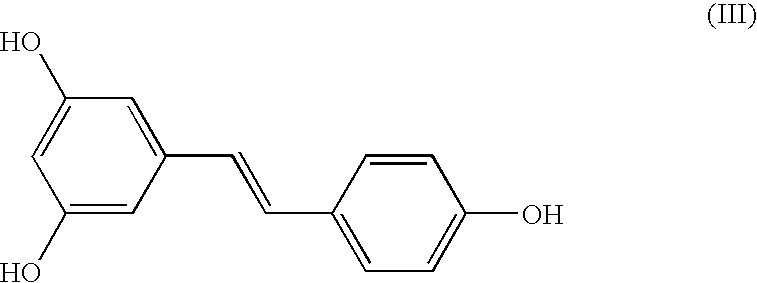
Preparation of (E)1-(3,5-dihydroxyphenyl)-2-(4-hydroxyphenyl)ethene of the formula (III):

Into a 3 lit. round-bottomed flask equipped with a thermometer were added aluminum chloride (390.35 gm) and N,N-dimethylaniline (413.10 gm) maintaining the temperature at 40-50° C. To this solution, a solution of (E)-1-(4-(benzyloxy)phenyl)-2-(3,5-bis(benzyloxy)phenyl)ethene (243 gm) prepared according to example 1 in dichloromethane was added and stirred well. After the reaction was over, the reaction mixture was acidified, extracted into ethyl acetate and concentrated to get pure (E)1-(3,5-dihydroxyphenyl)-2-(4-hydroxyphenyl)ethene (E-Resveratrol) in the exclusive E- form in 90% yield. 1H NMR (DMSO-d6, Bruker 400 MHz Avarice): δ 6.11 (t, J=1.8 Hz), 6.38 (d, J=1.8 Hz, 2H), 6.75 (d, J=8.5 Hz, 2H), 6.82 (d, J=16.3 Hz, 1H), 6.92 (d, J=16.3 Hz), 7.39 (d, J=8.4 Hz, 2H); Mass m / e: 228.2.

the structure of the environmentally friendly knitted fabric provided by the present invention; figure 2 Flow chart of the yarn wrapping machine for environmentally friendly knitted fabrics and storage devices; image 3 Is the parameter map of the yarn covering machine
Login to View More

PUM

PropertyMeasurementUnit
temperatureaaaaaaaaaa
Login to View More

Abstract

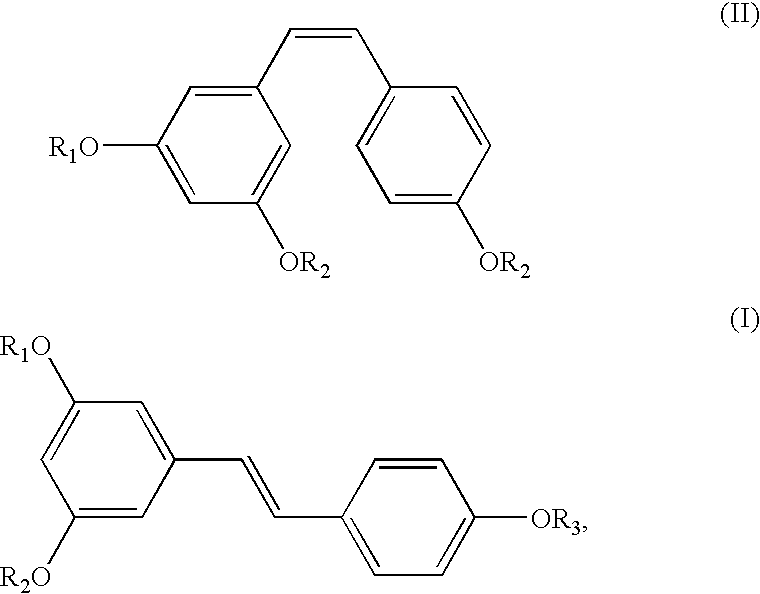
A method of converting (Z)-1-(3,5-disubstituted phenyl)-2-(4-substituted phenyl)ethene of general formula (II) to (E)-1-(3,5-disubstituted phenyl)-2-(4-substituted phenyl)ethene of general formula (I) wherein R1, R2, and R3 are the same or different and independently represent (C1-C4)alkyl, (C1-C4)alkoxy(C1-C4)alkyl, (C1-C4)alkoxy(C1-C4)alkoxy(C1-C4)alkyl, allyl, vinyl, silyl, formyl, acyl, aryl(C1-C4)alkyl or substituted aryl(C1-C4)alkyl group. The present invention also provides a process for the conversion of (E)-(3,5-disubstituted phenyl-2-(4-substituted phenyl)ethene of general formula (I) to E-resveratrol of formula (III).

Description

FIELD OF THE INVENTIONThe present invention relates to a method of converting (Z)-1-(3,5-disubstituted phenyl)-2-(4-substituted phenyl)ethene of general formula (II) to (E)-1-(3,5-disubstituted phenyl)-2-(4-substituted phenyl)ethene of general formula (I) wherein R1, R2 and R3 are same or different and independently represent (C1-C4)alkyl, (C1-C4)alkoxy(C1-C4)alkyl, (C1-C4)alkoxy(C1-C4)alkoxy(C1-C4)alkyl, allyl, vinyl, silyl, formyl, acyl, aryl(C1-C4)alkyl or substituted aryl(C1-C4)alkyl group.The compound of formula (I) is useful as a key intermediate in the preparation of E-resveratrol of the formula (III), without contamination of the corresponding Z-isomer, which is formed during the process of synthesis. E-resveratrol has broad-spectrum biological activity. Moreover, the preparation of E-resveratrol can be accomplished quite easily and inexpensively. BACKGROUND OF THE INVENTIONIn view of the vital biological activities of the polyhydroxylated trans-stilbenes, here have been a f...

Claims

the structure of the environmentally friendly knitted fabric provided by the present invention; figure 2 Flow chart of the yarn wrapping machine for environmentally friendly knitted fabrics and storage devices; image 3 Is the parameter map of the yarn covering machine
Login to View More

Application Information

Patent Timeline
18 Jan 2005
Publication
US6844471B2
IPC
C07C43/215; C07C37/00; C07C41/00; C07C43/00; C07C39/00; C07C39/21; C07C37/055; C07C41/32
CPC
C07C37/055; C07C41/32; C07C43/215; C07C39/21; C07B2200/09
Inventors
DESHPANDE, PANDURANG BALWANT; PALANISAMY, SENTHIL KUMAR UDAYAMPALAYAM