
Method and apparatus to automatically determine tissue cancellation parameters in X-ray dual energy imaging
- Summary
- Abstract
- Description
- Claims
- Application Information
AI Technical Summary
Benefits of technology
Problems solved by technology
Method used
Image

Examples
Embodiment Construction
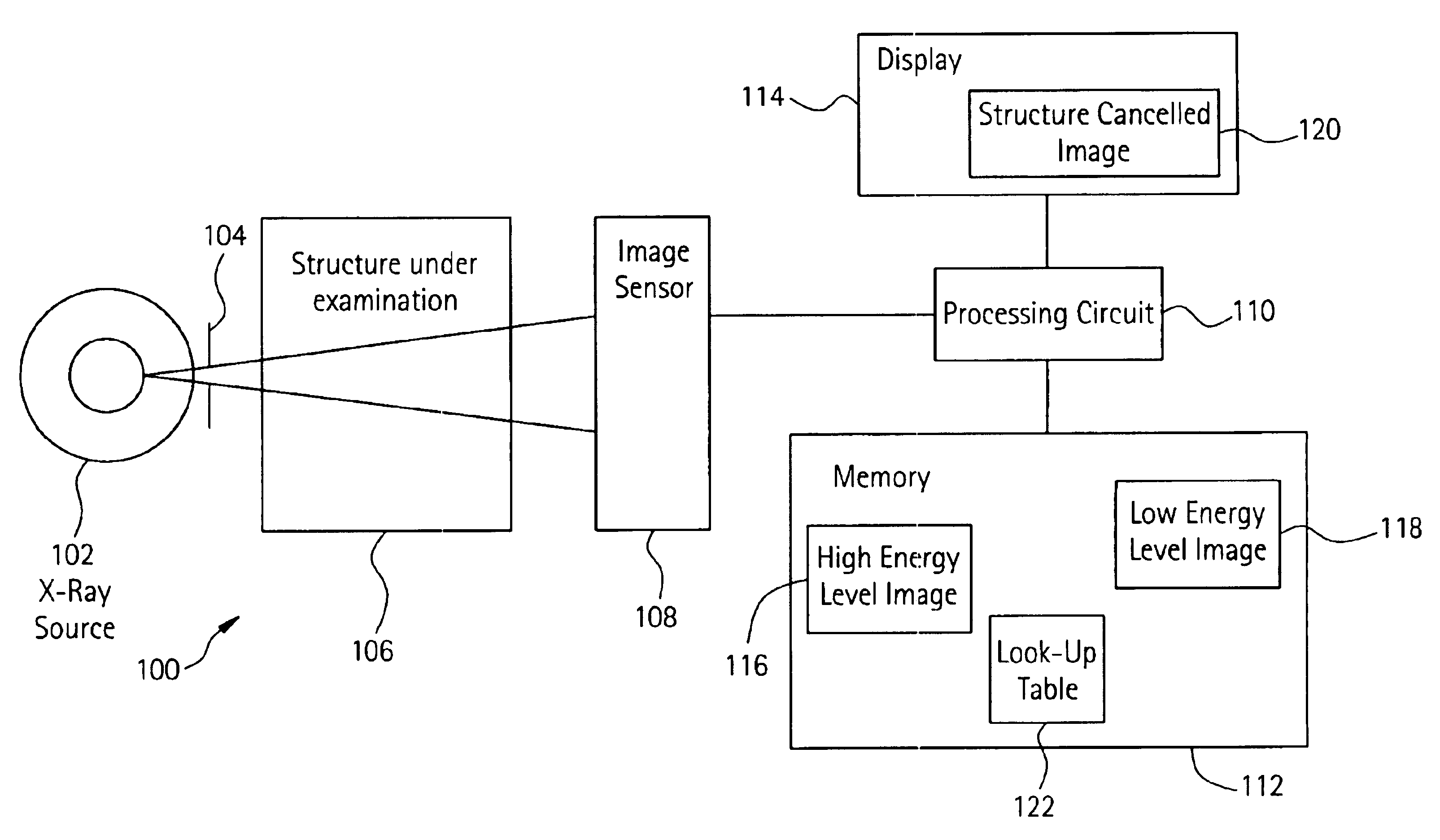
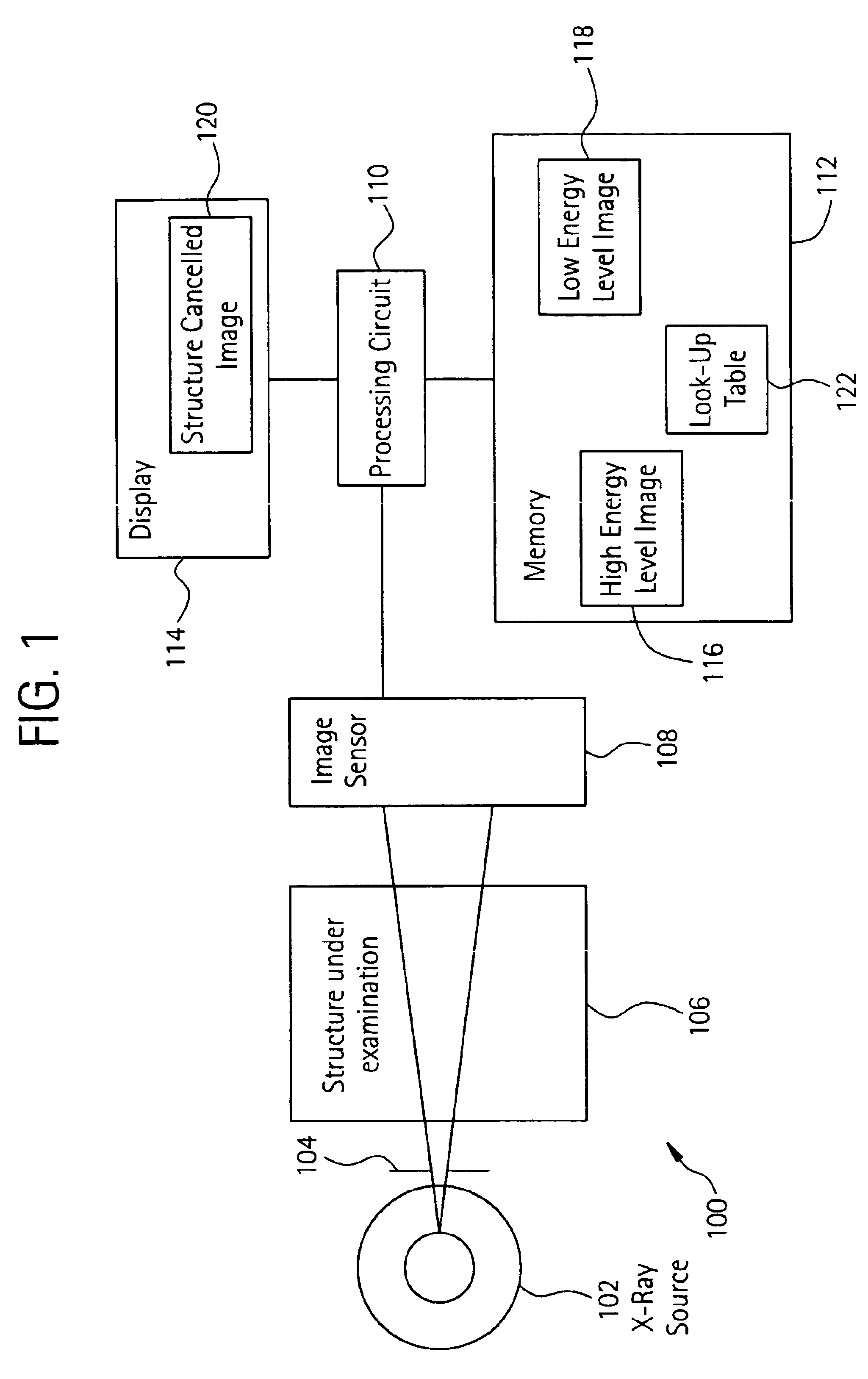
[0022]With initial reference to FIG. 1, the figure illustrates an X-ray imaging system 100. The imaging system 100 includes an X-ray source 102 and a collimator 104 which subject structure under examination 106 to X-ray photons. By way of example, the X-ray source 102 may be an X-ray tube, and the structure under examination 106 may be a human patient, test phantom or other inanimate object under test.
[0023]The X-ray imaging system 100 also includes an image sensor 108, such as a flat panel solid state detector, coupled to a processing circuit 110. The processing circuit 110 (e.g., a microcontroller, microprocessor, custom ASIC, or the like) couples to a memory 112 and a display 114. The memory 112 (e.g., including one or more of a hard disk, floppy disk, CDROM, EPROM, and the like) stores a high energy level image 116 (e.g., an image read out from the image sensor 108 after 110-140 kVp exposure) and a low energy level image 118 (e.g., an image read out after 60-90 kVp exposure). Th...
PUM
 Login to View More
 Abstract
Description
Claims
Application Information
 Login to View More