
Collagen/polysaccharide bilayer matrix
a polysaccharide and collagen technology, applied in the field of biodegradable matrices, can solve the problems of limited clinical indications for ha alone and its physical properties
- Summary
- Abstract
- Description
- Claims
- Application Information
AI Technical Summary
Benefits of technology
Problems solved by technology
Method used
Image

Examples
example 1
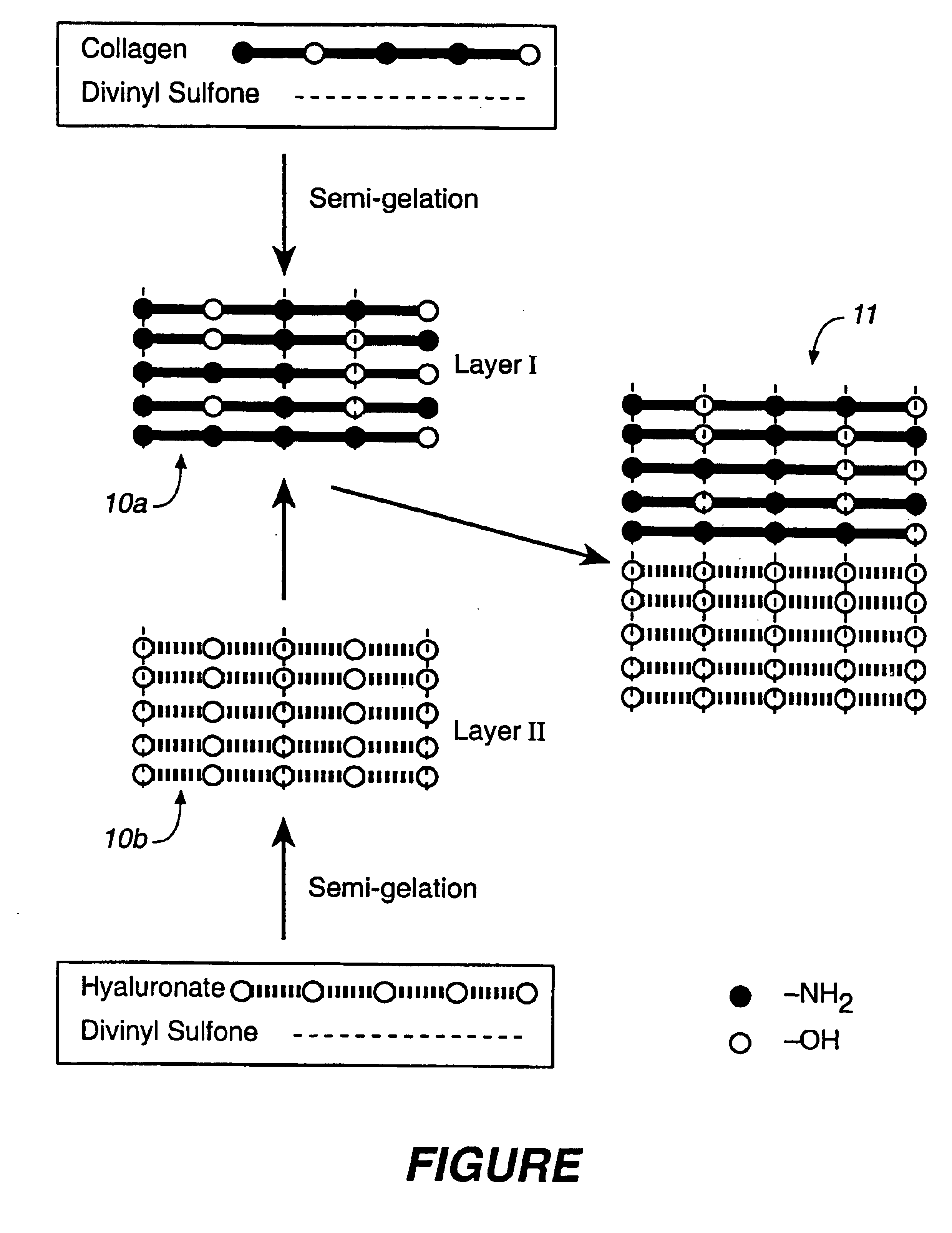
[0042]Preparation of a COL / HA bilayer matrix with 70% COL content in one layer and 100% HA content in another layer. This example illustrates how to cross-link a HA / DVS layer with a COL with HA gradient.
[0043]To 20 ml COL / HA suspension (560 mg of COL, Prep F fibers; 240 mg HA; 0.2N NaOH) added with 240 mg of DVS. The mixture was immediately blended using a heavy duty blender at low speed for 2×5 sec., and poured to a designed mold. After about 20 min. when the COL / HA slurry started to gel, 10 ml of HA / DVS viscose containing 400 mg HA and DVS was added onto the top of the COL / HA slurry. Since HA / DVS gels shortly after mixing, the viscose should be prepared only 4-5 min. before application by a vigorous vortexing. The mold with its content was allowed to sit on bench at room temperature for one hour to gel completely, then placed in 10% isopropyl alcohol solution for one hour. The matrix thus formed was washed with a large volume of D.I water with several changes for 48 hours, followe...
example 2
[0044]Preparation of a COL / HA bilayer matrix with 100% COL content in one layer and 100% HA content in another layer. This example illustrates how to cross-link a HA / DVS layer to a COL / Glutaraldehyde layer.
[0045]COL matrix was prepared by cross-linking pre-fabricated COL sponge with glutaraldyhyde in 30% isopropyl alcohol by a regular procedure adopted in-house. The matrix was soaked in 0.2 N NaOH for 5 min. and placed in an appropriate mold. HA / DVS viscose was prepared as described in Example 1 and poured on the top of the COL matrix. After sitting on bench at room temperature for one hour, the matrix was immersed in 10% isopropyl alcohol for one hour, then large volumes of D.I. H2O with several changes for 48 hours, followed by lyophilization.
example 3
[0046]Preparation of a COL / HA bilayer matrix with 100% COL content in one layer and 100% HA content in another layer. This example illustrates how to cross-link a HA / DVS layer to a COL / DVS layer.
[0047]COL matrix was prepared by blending COL fiber (4%, 0.2 N NaOH) with DVS using a heavy duty blender at the low speed for 2×5 sec. The COL / DVS slurry thus formed was poured into an appropriate mold and allowed to sit on bench at room temperature for 30 min. HA / DVS viscose was prepared as described in Example 1 and poured on the top of the COL / DVS gel. After sitting on bench at room temperature for an additional hour, the matrix was lyophilized. The dried matrix was immersed in 10% isopropyl alcohol for one hour, then large volume of D.I. H2O with several changes for 48 hours, followed by lyophilization.
PUM
| Property | Measurement | Unit |
|---|---|---|
| diameter | aaaaa | aaaaa |
| diameter | aaaaa | aaaaa |
| mass density | aaaaa | aaaaa |
Abstract
Description
Claims
Application Information
 Login to View More