The operator minimizes the amount of fluid that is circulated through the
drill string because too much fluid into the surrounding earth bore is undesirable.
If too much fluid is circulated through and around the
drill string, the fluid begins to wash out the sand,
dirt, and earth causing a
washout underneath the obstacle or structure, such as a highway or waterway, under which the bore hole is being drilled.
Structural problems will be created if a void is formed underneath a highway or some other structure.
First, once a thread begins to deform, further deformation is usually exponentially increased thereafter.
Second, once the thread has deteriorated, the entire
drill string must be disregarded since the length of the drill string has very limited variance.
Third, failure of the thread while the drill string is in the process of actually drilling a bore hole will cause substantial monetary damage.
Despite these designs, when a drill string member has a thread that is used in
multiple applications for the drilling of bore holes in the utility and pipeline industries, the
mating shoulders may become flared due to over torquing.
Also, the prior art designs result in the thread profile becoming deformed which in turn causes the external and internal thread design profiles to lose their make-up capability and results in
premature failure.
Once deformation begins, continued use exponentially increases
mating problems between cooperating tubular members.
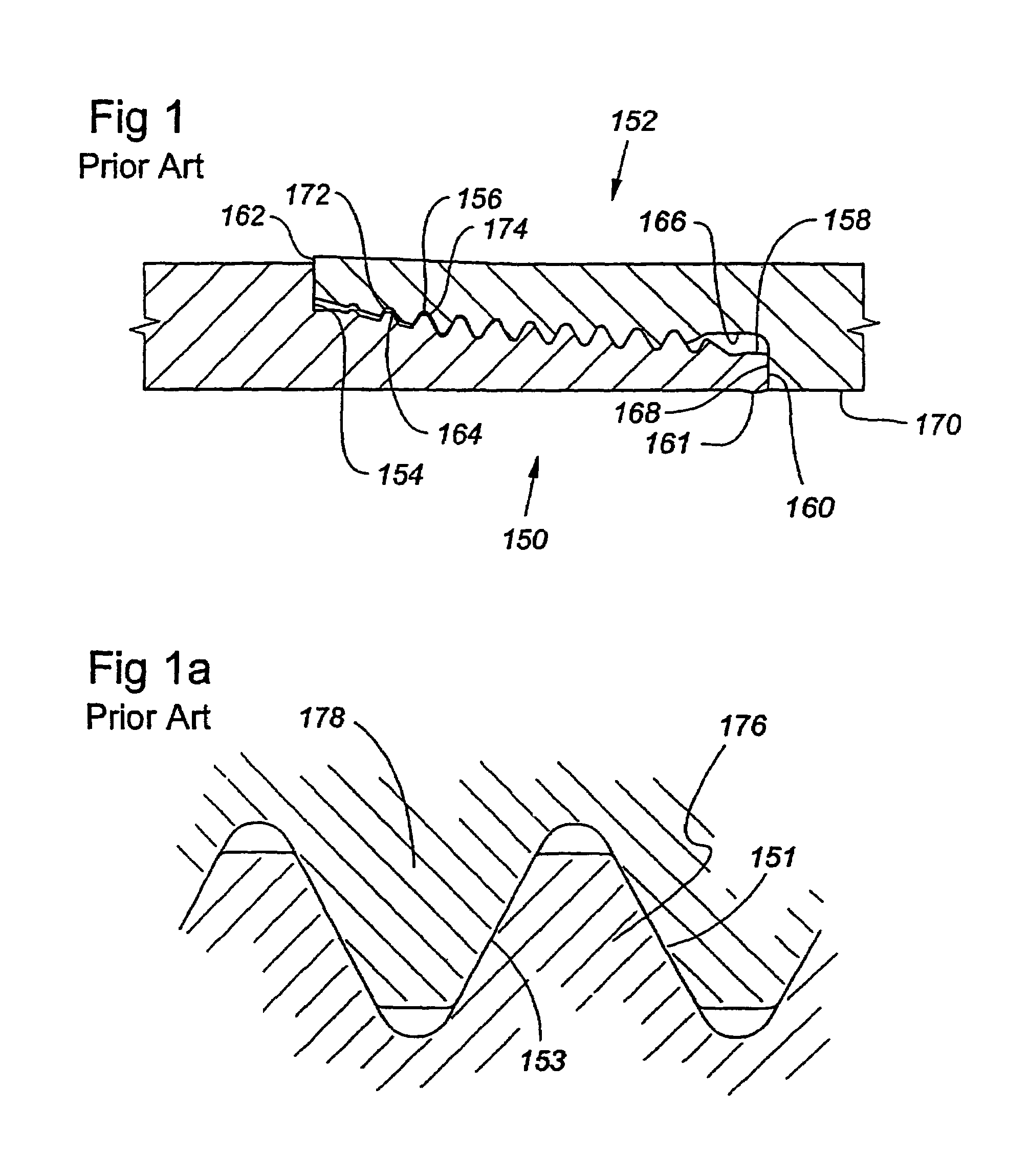
FIG. 1 illustrates a prior art connection and the inherent problem with multiple fastening and unfastening of prior art connections in the
utility industry due to over torquing and
cycling of the box and pin.
Thus, as the connection is placed under stress and incurs a
cycling motion, the connection fatigues and breaks.
The tubular members rocking on each other cause the connection to become loose.
The over torquing situation will also cause the thread profiles to no longer match properly.
However, the connection has very little compression capability.
However, many applications, such as deviated settings, produce several abrupt dog legs or kinks in the borehole due to the operator making abrupt changes in the direction of drilling.
Tortuosity substantially increases the cyclic bending, torque and drag on the drill string.
The smaller the
radius of the bend in the bore hole, the greater fatigue that will be placed on the pin.
The ramping of the threads cause yielding of the material and thus damage the connection.
Rocking causes fatigue and pin breakage.
As the
reamer engages obstacles in the drilling path, bends and torque are placed on the connections causing the threads to open and close.
These repetitive cycles with sliding shoulders provides a continuing fatigue at the mid-portion of the pin.
This causes substantial stress and causes the pin to break off at the connection.
During one half of the cycle the pin is bent one way and then during the other half of the cycle it is bent the other way causing it to fatigue and break.
This back and forth action causes tremendous fatigue.
All of these factors induce rapid fatigue in the connection.
Also, during the drilling process, a large amount of compressive force is placed on the drill string which tends to drive the terminal box end outwardly as the surfaces' slide.
However, the mid-portion of the threads remain tight.
Then at every cycle, the counter-stretching back and forth begins to fatigue the connection.
If the environment is very bad and if you have an inexperienced operator, the operator tends to over-compensate and steers too hard.
This causes a
tortuosity in the hole being drilled.
This places the drill string in a very serious bind as it is rotated through the bore hole.
Another of the problems of the prior art connection is its ability to withstand
high torque.
An extreme amount of torque is applied to the connection as compared to the small
diameter of the
pipe causing a large amount of torque to then be applied to a small
diameter drilling string.
Further, as the
pipe string passes through severe multiple bends, high
inertia torque is placed on the connections as the pipe string passes around obstacles and forms severe multiple bends.
In the
utility industry, often the operators are inexperienced and force the drill string to achieve a bore hole from point A to point B and do not drill a smooth bore hole.
Once the stretching exceeds the limit, then the connection begins to fatigue and will break.



 Login to View More
  Login to View More