
Method for the alkylation of salicylic acid
a technology of salicylic acid and alkylation method, which is applied in the preparation of carboxylic compounds, drug compositions, transportation and packaging, etc., can solve the problems of not all long-chain alkylphenols are readily carboxylated, use of sulfuric acid as catalyst, and difficulty in removing salicylic acid. , to achieve the effect of easy removal and recycling
Patent Information
- Authority / Receiving Office
- US · United States
- Patent Type
- Patents(United States)
- Current Assignee / Owner
- Publication Date
- 2006-05-16
Smart Images
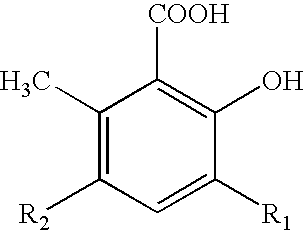
Figure 1 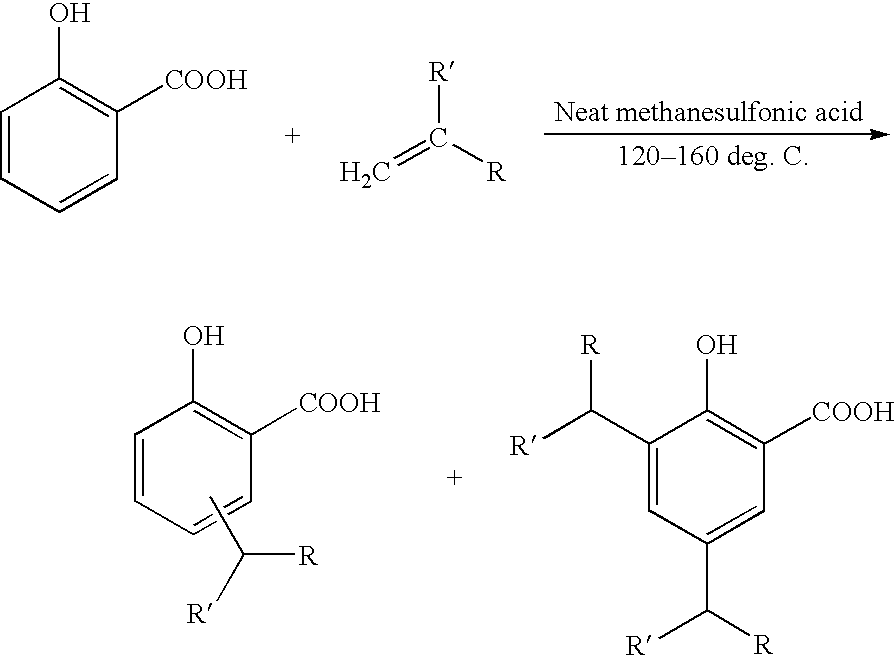
Figure 2
Abstract
Description
[0001] I claim the benefit under Title 35, United States Code, § 120 to U.S. Provisional Application No. 60 / 422,492, filed Oct. 31, 2002, entitled METHOD FOR THE ALKYLATION OF SALICYLIC ACID.BACKGROUND OF THE INVENTION
[0002] 1. Field of the Invention
[0003] The present invention relates to the alkylation of salicylic acid with long-chain olefins. These alkylated salicylic acids can be overbased to form useful lubricating oil additives.
[0004] 2. Description of Related Art
[0005] It is known to use alkaline earth metal salts of organic carboxylic acids as additives for lubricating oil compositions. These salts have a dispersant property that helps ensure that the insides of engine cylinders remain clean and that deposition of carbonaceous products on pistons and in piston grooves is counteracted, thus preventing piston-ring sticking.
[0006] It is also known to prepare basic (or overbased) alkaline earth metal salts of such acids. The overbasing provides an alkaline reserve which, when applied ...
Examples
example 1
[0065]Salicylic acid (215.0 grams) is added to a 3 liter glass vessel equipped with a stirrer, a thermometer, and a heating mantle. A mixed C14–C18 olefin (367.7 grams) is added next, followed by an alkylation catalyst, preferably 45.1 grams of methanesulfonic acid. The mixture is heated to 120° C. and kept at that temperature for 24 hours. Next, some light naphtha, such as VM&P naphtha, (582.6 grams) is introduced and the clear solution is allowed to settle to remove the spent catalyst. The product recovered is a clear yellowish naphtha diluted alkyl salicylic acid suitable for direct overbasing or for reaction with previously overbased detergent.
example 2
Salicylic Acid Monoalkylated with a 16.4:47.9:35.6 Wt / Wt % Mixture of C14, C16, C18 α-olefins
[0066]A three liter resin kettle was charged with salicylic acid powder (828.96 grams, 6.0 moles). The kettle was fitted with five-hole lid, mechanical stirrer (PTFE bearing, polished glass shaft, PTFE axial and radial turbines), reflux condenser (attached to a nitrogen line and mineral oil bubbler for positive pressure) and mantle, Therm-O-Watch®, thermocouple. The kettle was charged with a commercial mixture of C14 / C16 / C18 α-olefins (1414.12 grams, 6.30 moles, assuming an average molecular weight of the alkene mixture of 228.11, composition in wt %: 16.4% 1-tetradecene, 47.9% 1-hexadecene, an 35.6% 1-octadecene) and then stirring at about 250–300 rpm was started. Anhydrous methanesulfonic acid (173.47 grams, 1.8 moles, 30 mole % relative to the salicylic acid) was added all at once to the resulting white suspension. The suspension was then heated under nitrogen and stirred to a target pot ...
example a
Comparative Example
Salicylic Acid Monoalkylated with 80 V / V Aq. Sulfuric Acid with Propylene Tetramer
[0068]A two liter resin kettle was charged with salicylic acid (138.39 grams, 1.00 mole) and 890 mL (25.6 moles) of an 80% v / v aqueous sulfuric acid solution. The suspension was stirred under a nitrogen positive pressure at 43° C., and then propylene tetramer (185.24 grams, 1.1 moles) was added dropwise over about 0.5 hour. During the addition, the reaction temperature cooled slightly to 41° C. Then, the reaction mixture was warmed to a target temperature of 60° C.; however, there was an exotherm to 75° C. The reaction was kept at about 60° C. for a total of three hours. The deep reddish reaction product was diluted with 600 mL of water and an exotherm, owing to the dilution of the sulfuric acid, occurred. The diluted product separated into two phases, which were treated with 200 mL of n-heptane in a separatory funnel. The upper organic phase was kept and the lower aqueous phase extr...