High pressure cleaning and decontamination system

a cleaning and decontamination system technology, applied in the field of high pressure cleaning and decontamination methods and systems, can solve the problems of rigidity and brittleness of thermoplastic braided hoses

US7140954B2Inactive Publication Date: 2006-11-28KURION INC
7 Cites 44 Cited by

Patent Information

Authority / Receiving Office
US · United States
Patent Type
Patents(United States)
Current Assignee / Owner
Publication Date
2006-11-28
Estimated Expiration
Not applicable · inactive patent

Smart Images

  • Figure 1
    Figure 1
  • Figure 2
    Figure 2
  • Figure 3
    Figure 3
Patent Text Reader

Abstract

Abrasive cleaning and decontamination methods and systems are disclosed. The methods and systems use a high pressure liquefied gas, such as carbon dioxide, which produces insignificant quantities of secondary waste. These principles of the invention exploit the properties of the relatively high triple point of CO2 in order to first pressurize it to 35,000 to 60,000 PSI from a pressurized liquid. In the pressurized state, such a fluid can be at or above room temperature, allowing for transport over long distances in a flexible high pressure hose. At a point of use, a heat exchanger may subsequently chill the liquid, so that after expansion through a small high pressure orifice, a significant fraction of the liquid is converted to solid phase crystals exiting at high velocity to effectively clean and decontaminate. For more aggressive cleaning, abrasive particles and / or small diameter solid CO2 pellets can be entrained into the high pressure CO2 slipstream.
Need to check novelty before this filing date? Find Prior Art

Description

FIELD OF THE INVENTION

[0001] The present invention is directed to high pressure cleaning and decontamination methods and systems, and, more particularly, to non-cryogenic cleaning and decontamination methods and systems.BACKGROUND OF THE INVENTION

[0002] Many types of surfaces require cleaning and decontamination of coatings and residues without significant impact to the base surface. It is desirable to aggressively clean a variety of coatings and contaminants without leaving behind additional cleaning residues, such as chemical solvents, water, grit media, etc. This is particularly problematic in the field of nuclear radioactive facility clean-out and decontamination, as any cleaning substance will likewise become radiologically contaminated. Disposing of large volumes of cleaning materials becomes costly, dangerous, and time consuming. What is therefore desired is a cleaning media imparting high kinetic momentum transfer to relatively hard particles which impact the surface to be cle...

Examples

Embodiment Construction

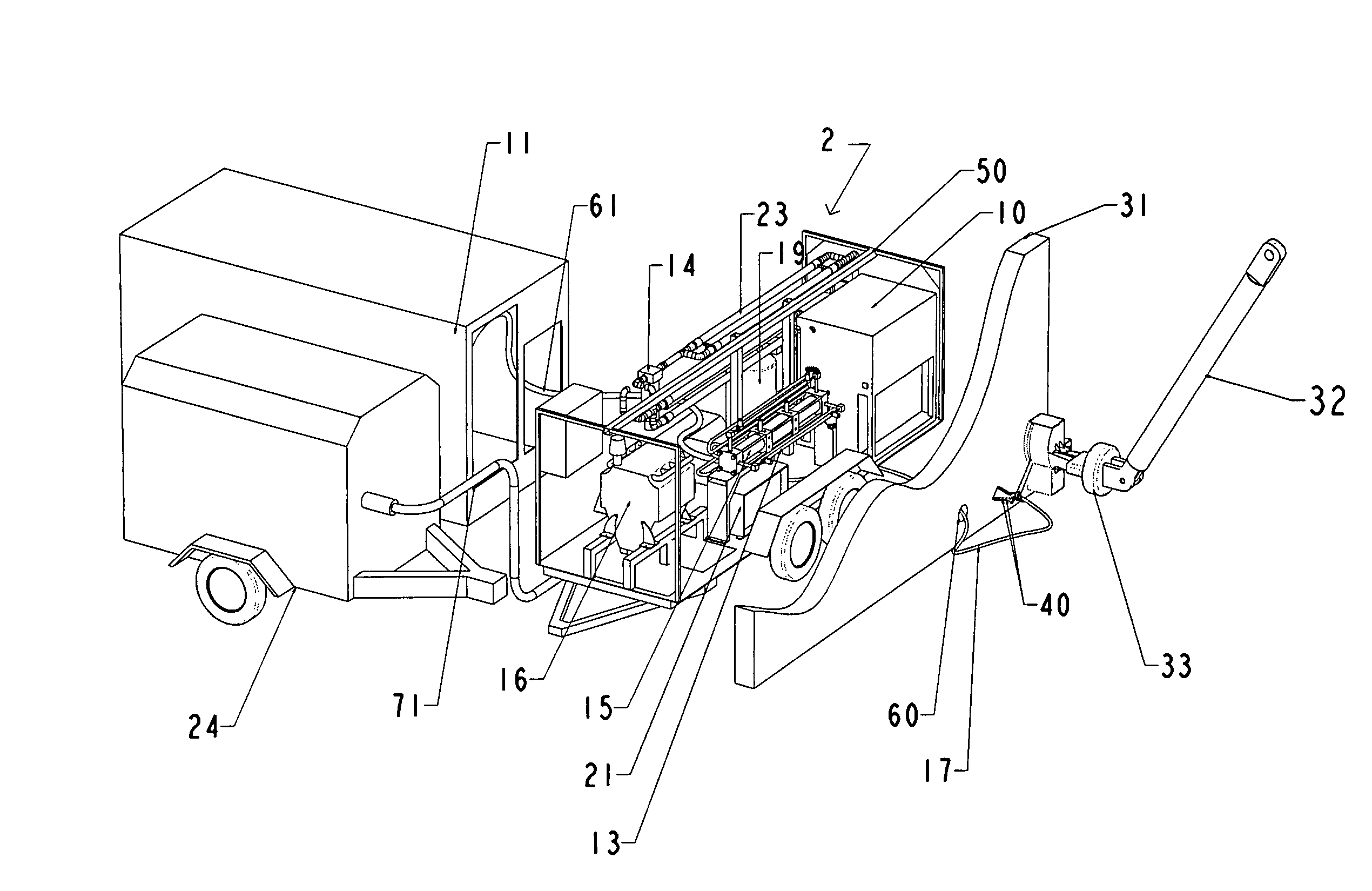
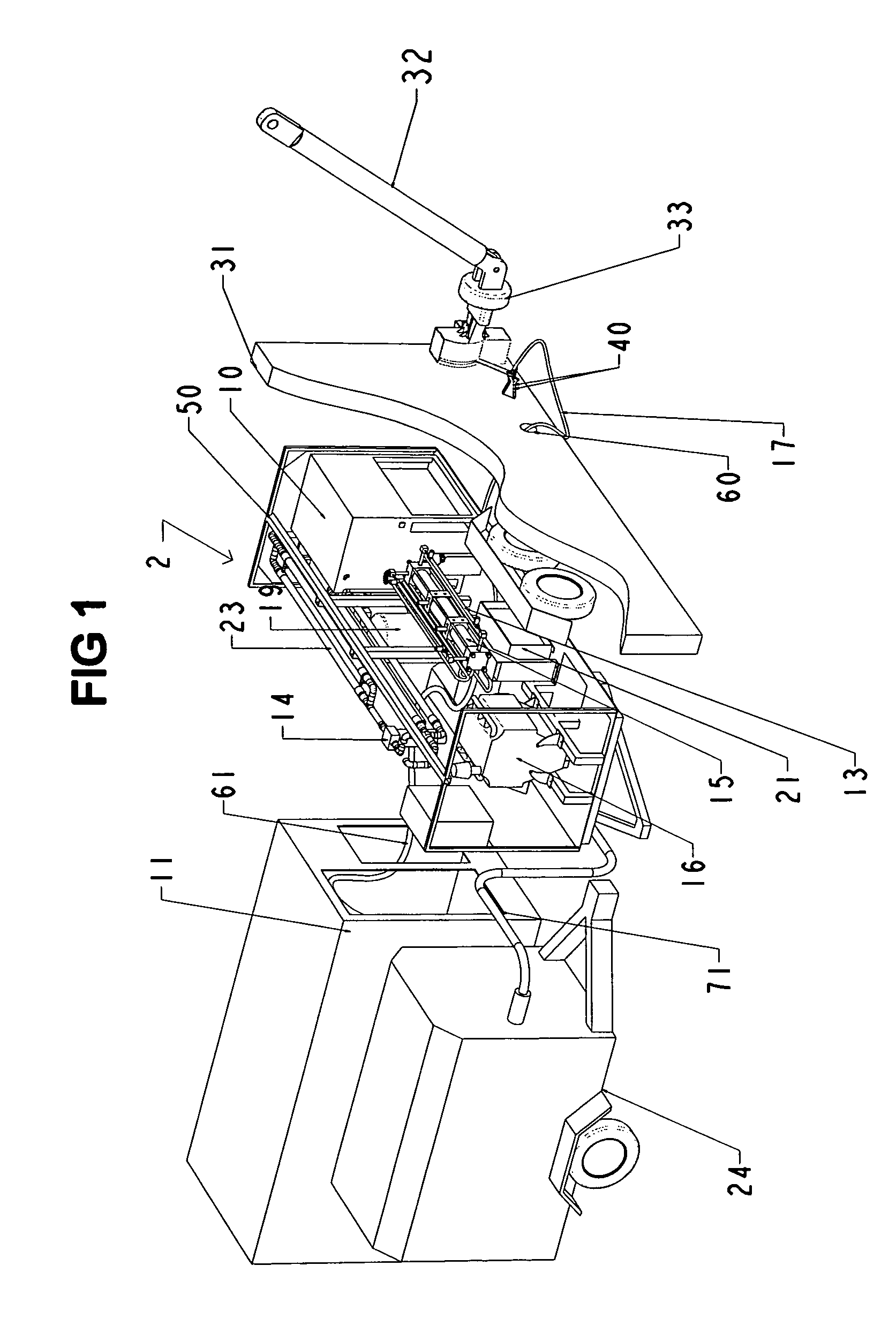
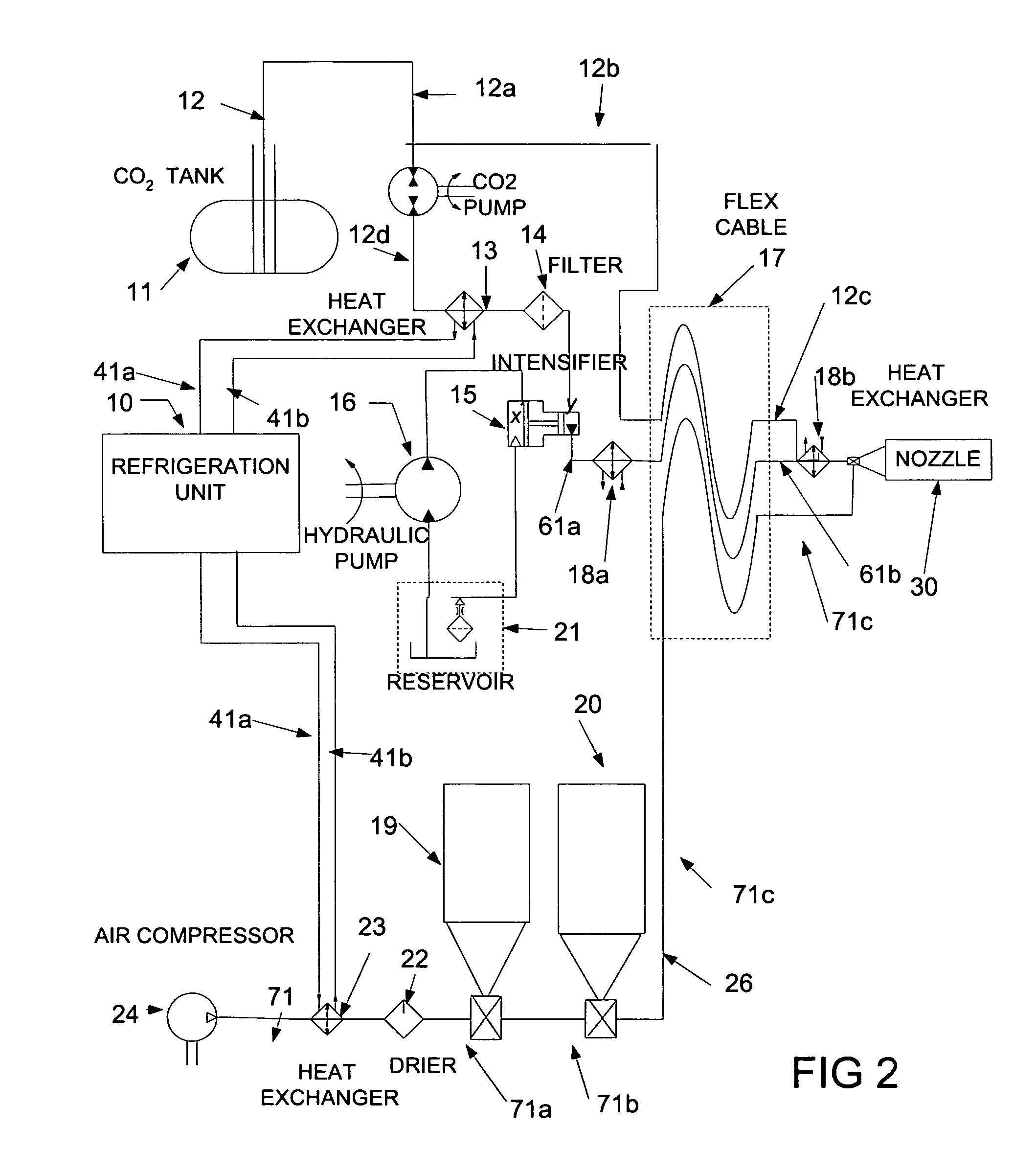
[0024]Referring now to the drawings, FIG. 1 illustrates a non-cryogenic cleaning system 2 constructed in accordance with principals of the present invention. The term “non-cryogenic” as used throughout the specification, including the claims, refers to a class of fluids that are gasses under atmospheric conditions, but may be pressurized to liquid states at temperatures that are at least high enough to allow elastomeric hoses to remain flexible. Non-cryogenic fluids thus include, but are not limited to: carbon dioxide, sulfur dioxide, and ammonia. However, non-cryogenic fluids according to principles of the present invention are preferably inert or benign. The non-cryogenic cleaning system 2 is shown in relation to a contaminated cell 31. The contaminated cell 31 may be sealed and house articles or equipment in need of cleaning and / or decontamination. The contaminated cell 31 may comprise any area, room, enclosure, or interior of a larger piece of equipment. For purposes of discussi...