
Optical information reproducing method and apparatus for performing reproduction compensation
a technology of optical information and reproduction compensation, applied in the direction of digital signal error detection/correction, instruments, recording signal processing, etc., can solve the problems of large possibility of bit droppage, and cannot treat the waveform deviation of a reproduced signal, so as to correctly reproduce recording information
- Summary
- Abstract
- Description
- Claims
- Application Information
AI Technical Summary
Benefits of technology
Problems solved by technology
Method used
Image

Examples
embodiment 1
(Embodiment 1)
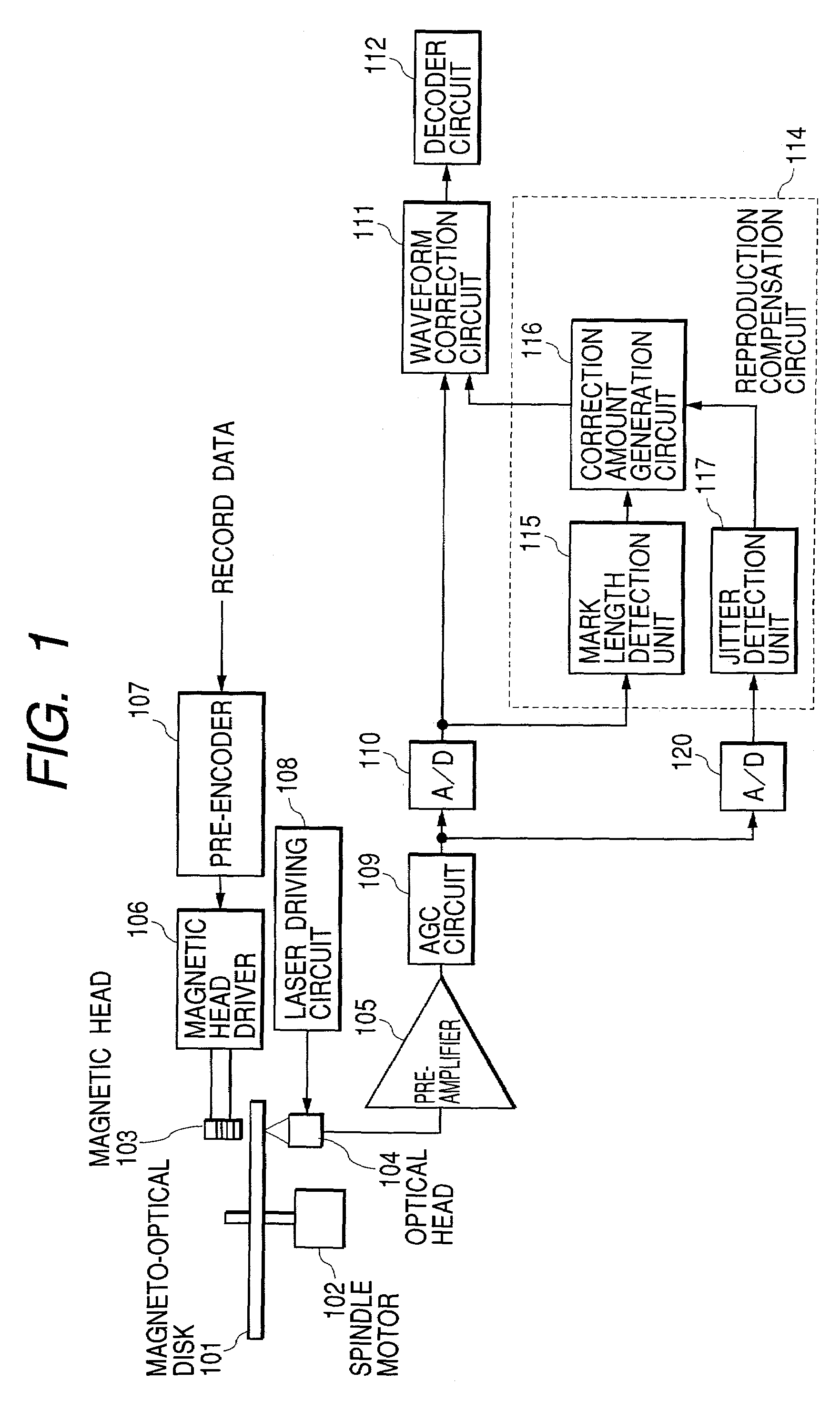
[0057]FIG. 1 is a block diagram showing the configuration of a first embodiment of a magneto-optical reproducing apparatus according to the present invention. In FIG. 1, numeral 101 denotes a magneto-optical disk as an information-recording medium, and numeral 102 denotes a spindle motor for rotating the magneto-optical disk 101 at a predetermined speed. A magnetic head 103 for generating a magnetic field modulated according to a record signal is arranged above the top face of the magneto-optical disk 101, and an optical head 104 is arranged below the bottom face of the disk with opposing the magnetic head 103.
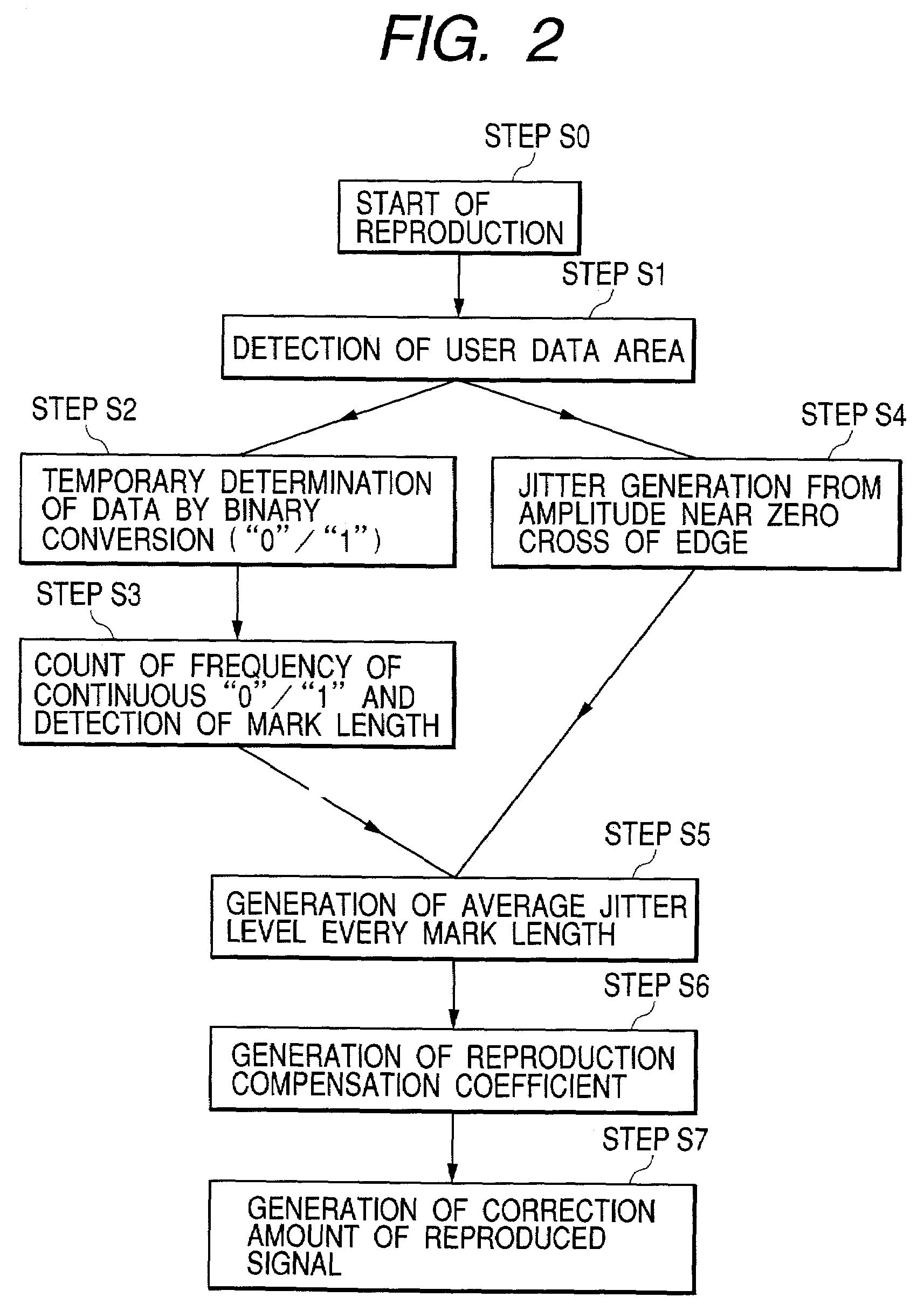
[0058]The optical head 104 radiates a light beam for recording, and records information, or radiates the light beam for reproduction, detects the reflected light from the medium, and reproduces recorded information. At this time, a semiconductor laser (not shown in the drawings) that is a light source for recording and reproduction, and a photosensor (not shown i...
embodiment 2
(Embodiment 2)
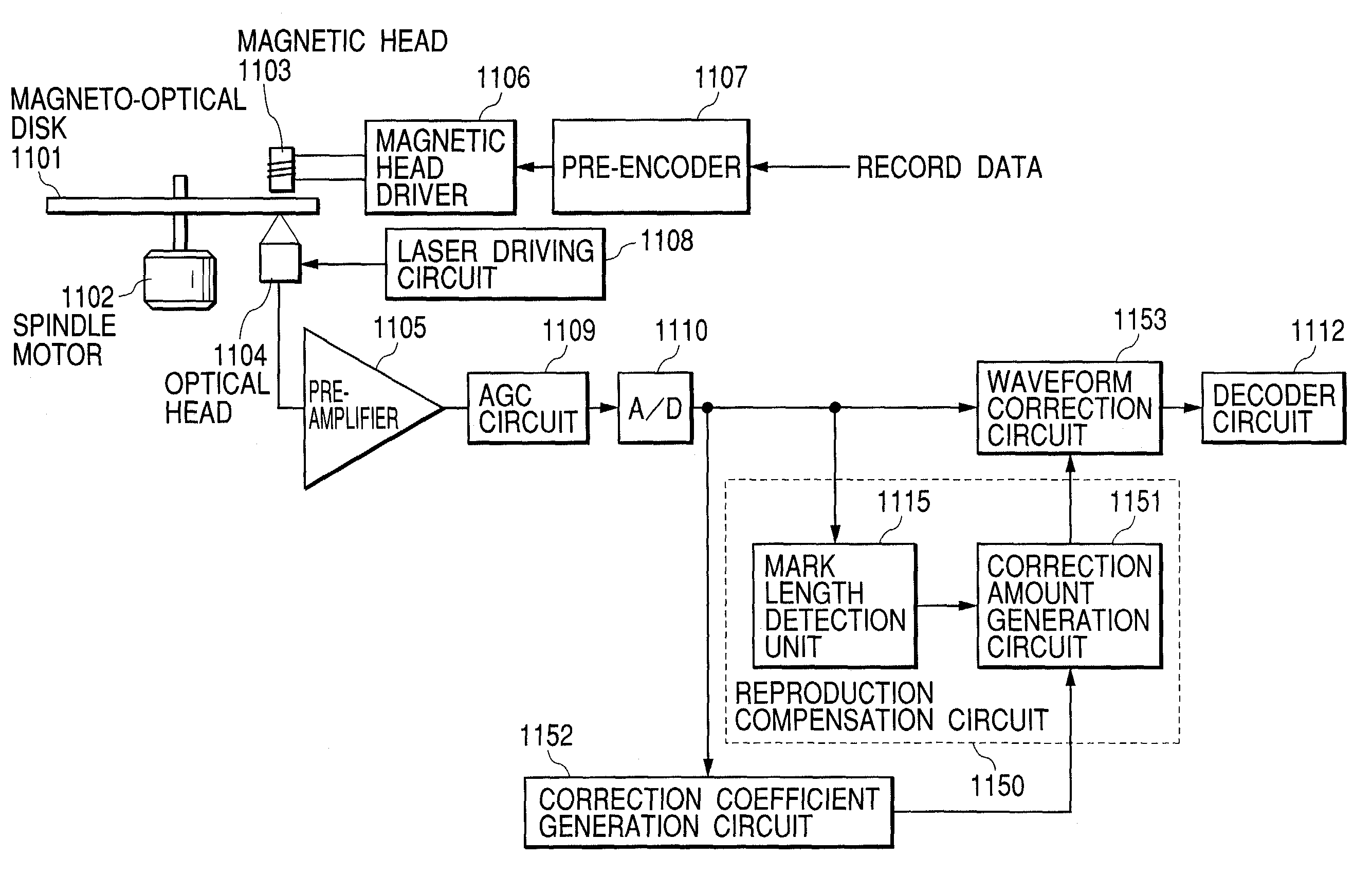
[0113]Next, a second embodiment of the present invention will be explained. The second embodiment is characterized in the generation of a correction coefficient, the generation method of a correction amount, and a correction method in comparison with the above-mentioned embodiment.
[0114]FIG. 10 is a block diagram showing a second embodiment of the present invention. Similar portions as those in FIG. 1 have been assigned the same numerals, consequently, explanations of such portions have been omitted.
[0115]A mark length detection unit 130 in FIG. 10 temporarily determines a reproduced signal that is sampled by PR detection. A jitter detection unit 131 performs PR (1, −1) processing of a sampled RF digital signal 5, and detects a jitter in an edge section. A correction amount generation circuit 132 generates a correction amount of a reproduced signal based on the mark length and jitter. A waveform correction circuit 133 corrects sampled data near an edge of the RF digita...
embodiment 3
(Embodiment 3)
[0135]Next, a third embodiment of the present invention will be explained. This embodiment is different from the second embodiment in a generation method of a correction amount in the correction amount generation circuit 132 in FIG. 10.
[0136]As described above, the size of a stray magnetic field changes with an interval between a magnetic domain wall formed immediately before and a magnetic domain wall which is going to be formed next, i.e., the record mark length to be formed, and the mark length located in front of it. Hence, the edge shift by a waveform deviation is influenced by the record mark length that is going to be formed, and the mark length located ahead of it.
[0137]Then, a correction amount J is generated with the following formula from the kth and (k+1)th mark lengths.
J=−A·n(k)+B·n(k+1) (8)
Here, n(k) is the kth mark length, and n(k+1) is the (k+1)th mark length.
[0138]Coefficients A and B in Formula (8) are computed by a method of least squares, etc. on t...
PUM
| Property | Measurement | Unit |
|---|---|---|
| length | aaaaa | aaaaa |
| magnetic | aaaaa | aaaaa |
| optical information reproducing method | aaaaa | aaaaa |
Abstract
Description
Claims
Application Information
 Login to View More