Magnetic field angle sensor with GMR or MTJ elements
a technology gmr or mtj, which is applied in the field of magnetic field angle sensor, can solve the problems of increasing manufacturing cost, increasing angle detection error, and no prior art method, and achieves the effect of eliminating the proportionality constant and being readily computabl
- Summary
- Abstract
- Description
- Claims
- Application Information
AI Technical Summary
Benefits of technology
Problems solved by technology
Method used
Image

Examples
Embodiment Construction
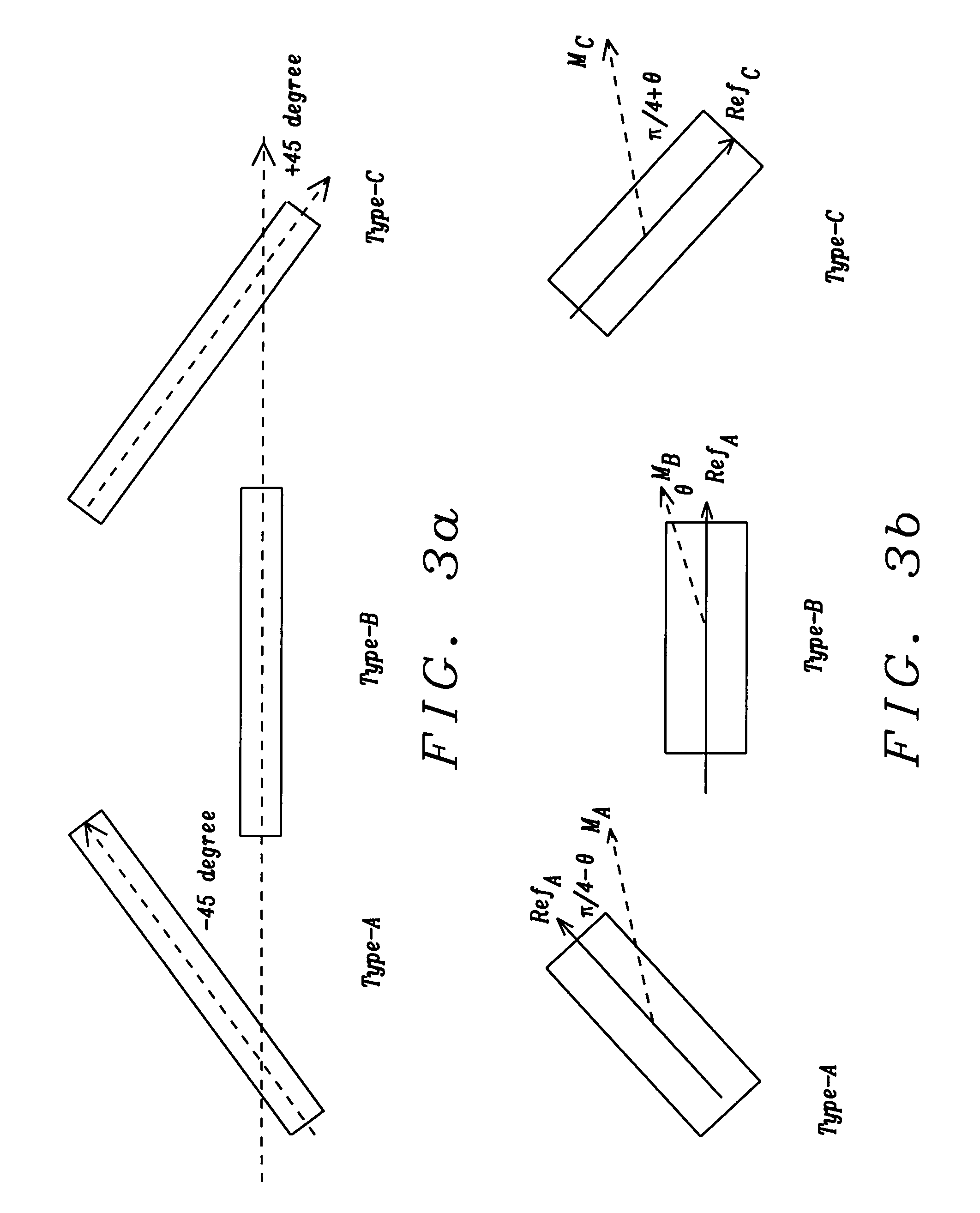
[0026]One class of anti-ferromagnetic materials includes the ordered tetragonal (fct) alloys such as PtMn, PtPdMn, NiMn, etc. The as-deposited state of these materials is a non-magnetic fcc structure and the ferromagnetic sub-layer has no exchange bias (pinning) with similar coercivity to that of a pure ferromagnetic layer. For all types of GMR stripes, in order to set pinning directions of synthetic anti-parallel layers along their own longitudinal axes, the magnetic moment of sub-layer AP2 is designed to be higher than that of the reference sub-layer AP1, resulting in a non-zero net magnetic moment of the synthetic anti-parallel pinned layer.
[0027]Once deposited, the GMR film is patterned into rectangular stripes that have a very large aspect ratio, whereby each stripe has a large shape anisotropy generated by the net magnetic moment along its longitudinal axis. Before thermal annealing is initiated, a large magnetic field is applied along the −x direction yjat is sufficient to al...
PUM
 Login to View More
 Abstract
Description
Claims
Application Information
 Login to View More