Chronic performance control system for rotodynamic blood pumps

a technology of rotodynamic blood pump and control circuit, which is applied in the field of medical arts, can solve the problems of increasing the risk of complications and unnecessary strain on the heart, and achieves the effects of improving system reliability and effectiveness, simple control circuitry, and enhancing control flexibility and precision

US7645225B2Inactive Publication Date: 2010-01-12MEDVEDEV ALEXANDER +2
20 Cites 192 Cited by

Patent Information

Authority / Receiving Office
US · United States
Patent Type
Patents(United States)
Current Assignee / Owner
Publication Date
2010-01-12
Estimated Expiration
Not applicable · inactive patent

Smart Images

  • Figure 1
    Figure 1
  • Figure 2
    Figure 2
  • Figure 3
    Figure 3
Patent Text Reader

Abstract

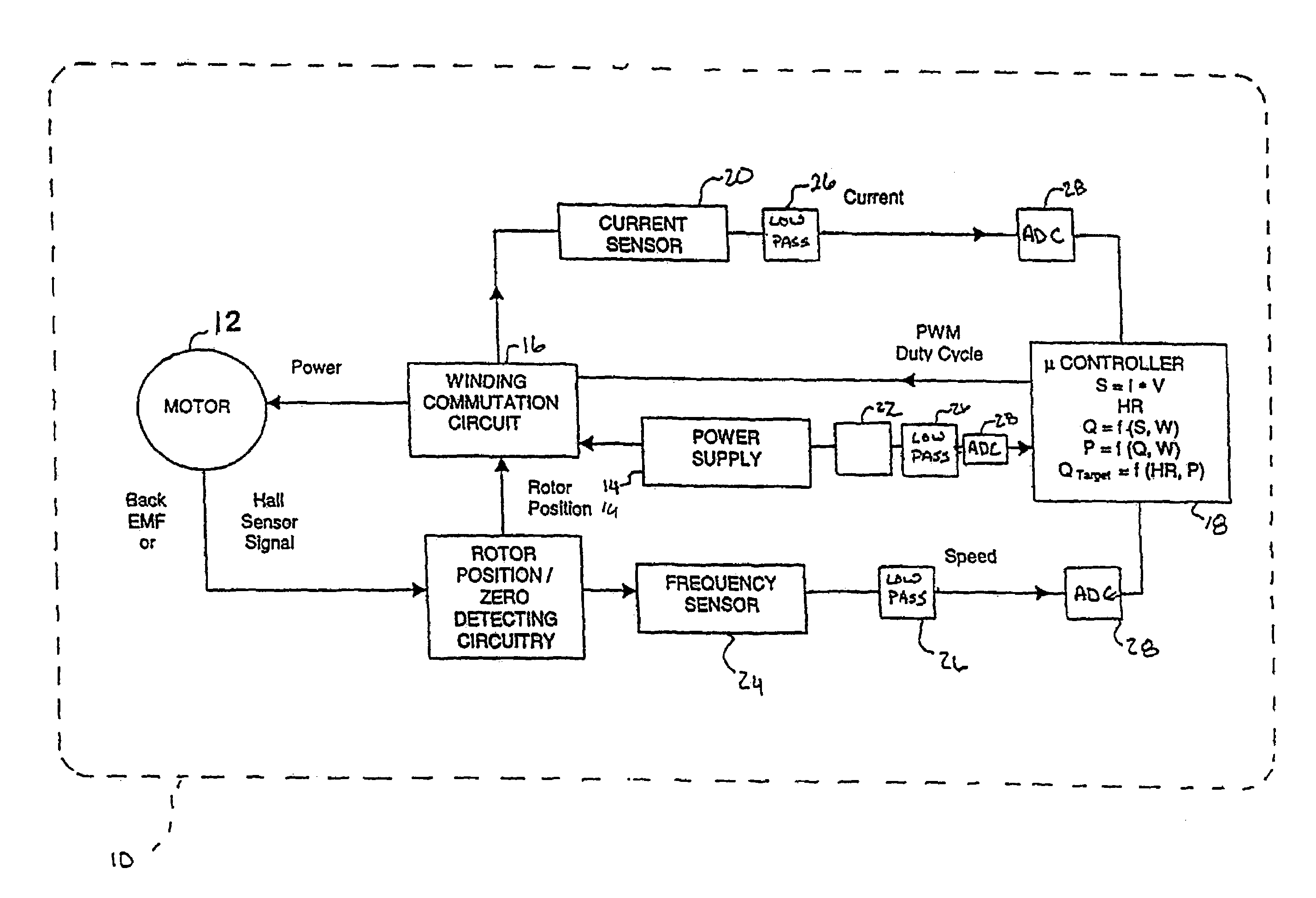
In a left ventricular assist device (LVAD) a rotodynamic blood pump (10) is powered by a brushless DC motor (12). A power supply (14) supplies power to the motor (12). Three feedback channels, one for each of voltage, current, and motor speed lead to a microcontroller or microprocessor (18). The three feedback waveforms are analyzed, and from these waveforms, motor input power, patient heart rate, current pump flow rate, and systemic pressure are determined. The microprocessor (18) then calculates a desired flow rate proportional to the patient heart rate. The microprocessor communicates a new power output to a commutation circuit (16), which regulates power to the motor (12). The pump (10) also includes safety checks that are prioritized over desired pump flow. These include prevention of ventricular suction, low pulsatility, minimum and maximum pump speed, minimum speed-relative pump flow, minimum absolute pump flow, minimum and maximum motor input power.
Need to check novelty before this filing date? Find Prior Art

Description

CROSS REFERENCE TO RELATED APPLICATION

[0001] This is a U.S. National Phase Application of PCT / US01 / 08776, filed Mar. 19, 2001, which claims the benefit of U.S. Provisional Application No. 60 / 192,221, filed Mar. 27, 2000.FEDERAL RESEARCH STATEMENT

[0002] The U.S. Government may have certain rights in this invention pursuant to contract number N01-HV-58159 awarded by the U.S. National Heart, Lung and Blood Institute of the National Institutes of HealthBACKGROUND OF THE INVENTION

[0003] The present invention relates to the medical arts. It finds particular application in cardiac assist technologies using, for example, rotodynamic blood pumps, also known as left ventricular assist devices (LVAD) in assisting patients with failing hearts and will be described with particular reference to a centrifugal blood pump. It is to be appreciated that the present invention is also applicable to other types of pumps, such as axial flow pumps, and is not limited to the aforementioned application.

[0004] El...

Examples

Embodiment Construction

[0026]There are several possible approaches to setting a required pump performance level matched to patient individual needs. A simple one employs a few levels of fixed pump speed / flows (i.e., low, medium, high) that are set according to patient activity (i.e., sleeping, sitting, walking). Another more flexible approach uses cardiac pacing technology where a separate pacemaker type device controls the pump performance. The present invention, though, proposes methods that employ patient systemic pressure and / or heart rate to define the required pump flow while using no pressure or ECG type sensors (so-called “sensorless” approach).

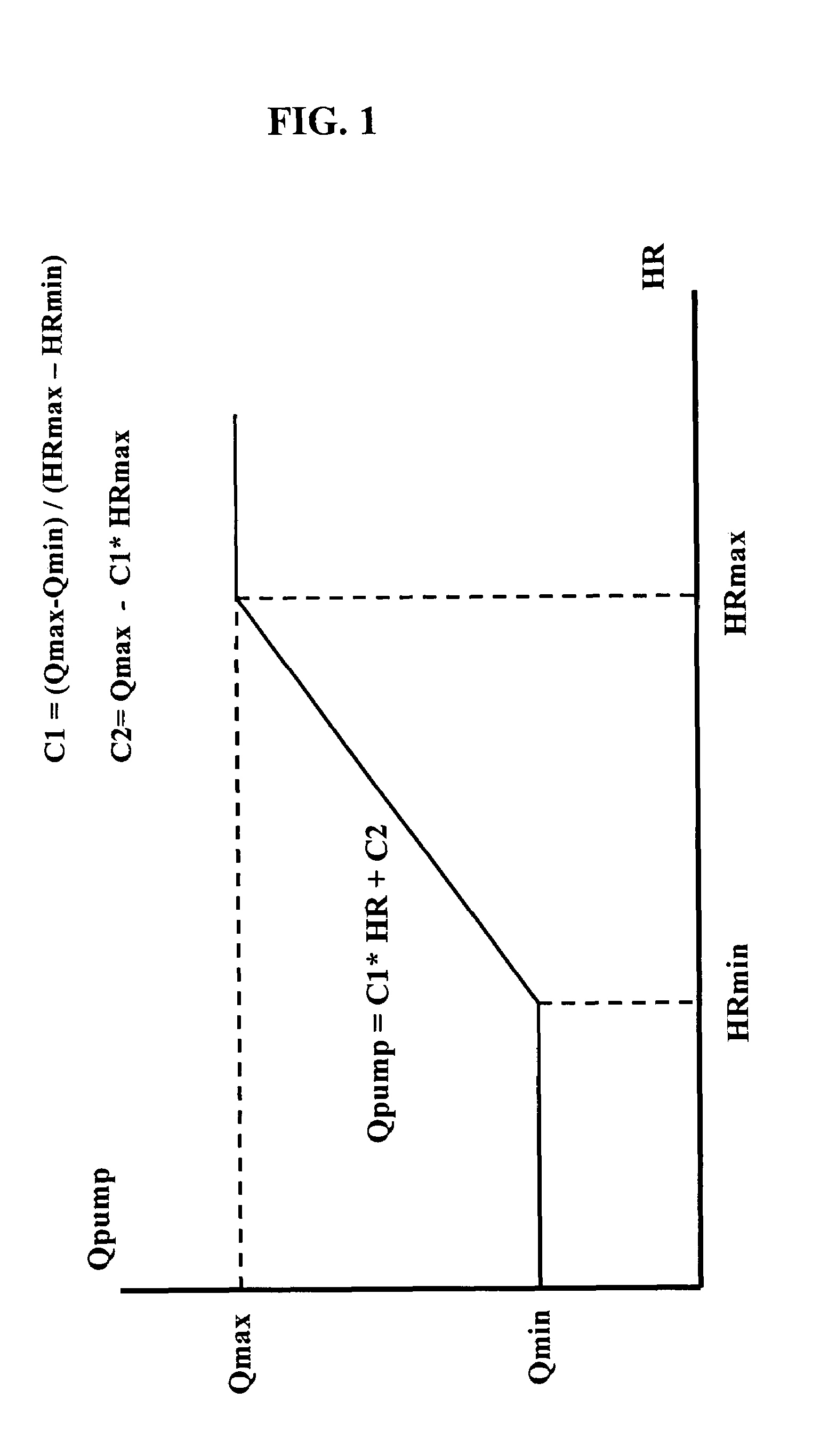
[0027]Studies have shown that there is an almost linear dependence between healthy human heart rate and cardiac output for different age groups and various activity levels. Therefore, maintaining an appropriate pump flow (Qtarget) depending on the patient heart rate (HR) is a reasonable objective for the heart assist control algorithm.

[0028]It is important ...