In practice, however, the
signal strength of the signal received by the positioning receiver may be so attenuated, particularly indoors, that detection of the signal is difficult, and positioning cannot always be performed.
This interference signal is
wideband to the degree that the
noise level of the frequency range used in the positioning rises.
Other noises that are disturbing in view of the
GPS positioning receiver include e.g. such interference frequencies caused by a
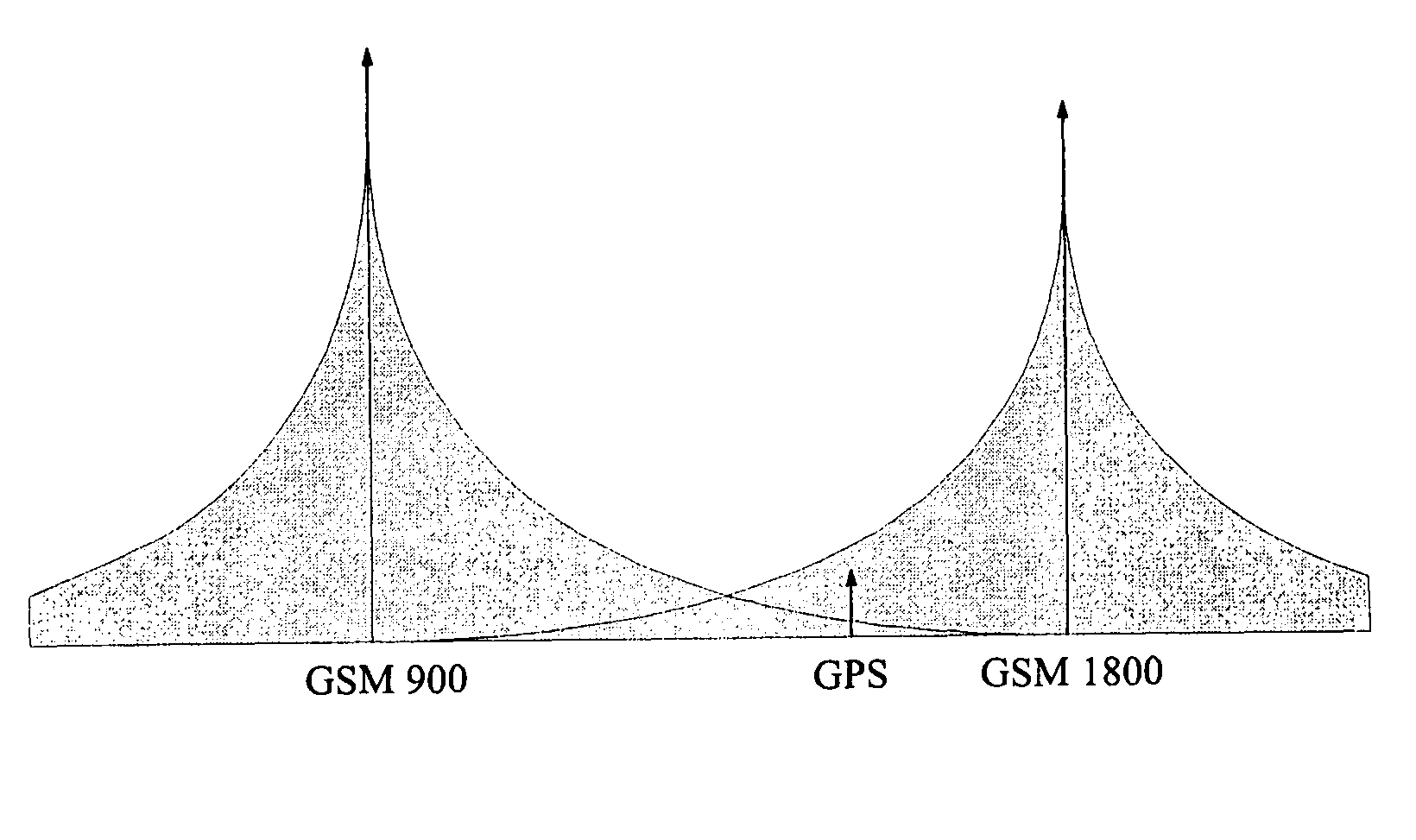
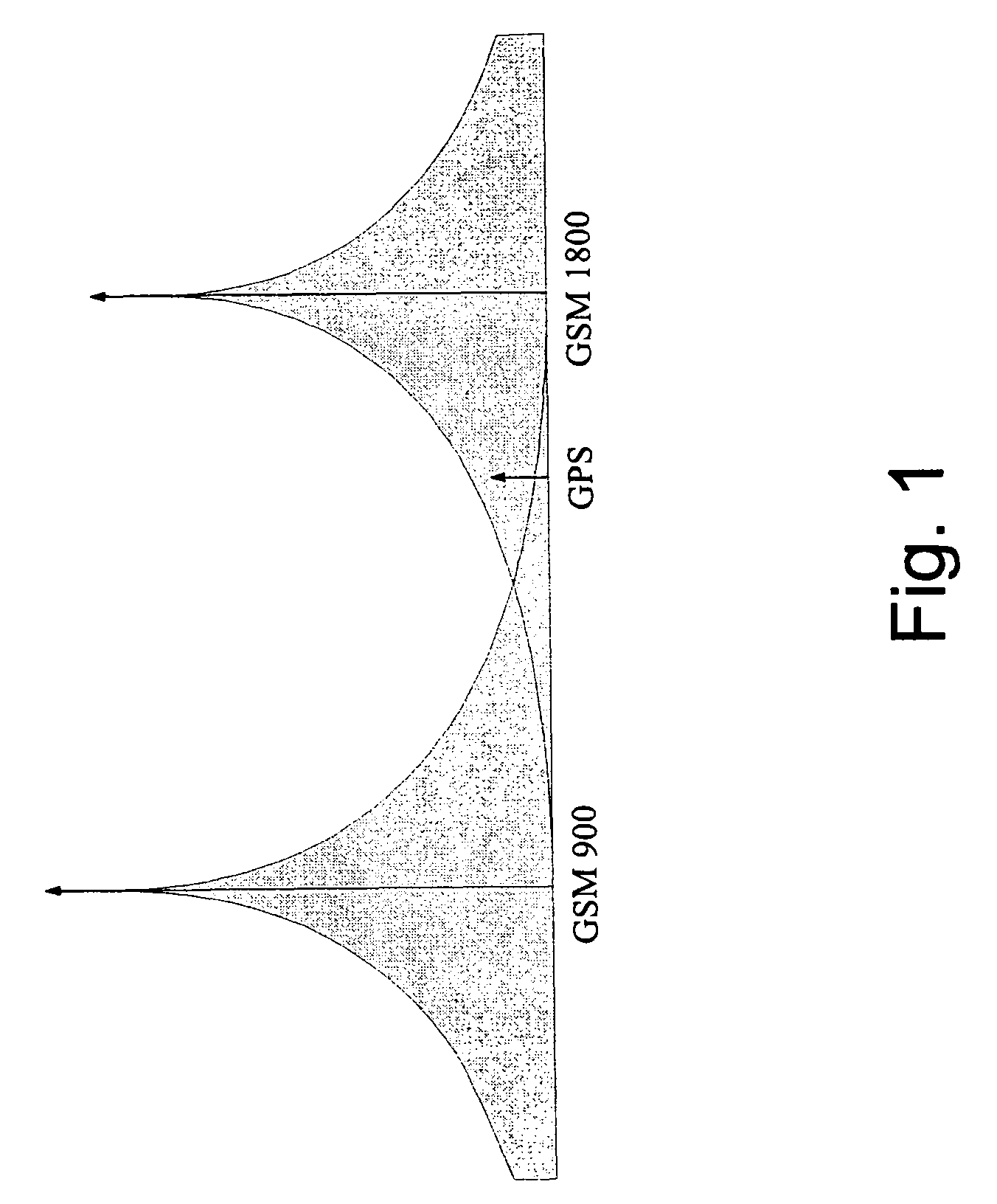
GSM transmission that occur in the GPS band.
Even if an aim has been to implement the structure of the device in a manner that such interference signals would not spread into the surrounding space, the device may radiate interference signals to some extent also right next to the device.
Aftenuating such interference signals inside the device itself is also troublesome.
Thus, in a prior art device the interference
radiation reaches the positioning receiver, in which case the positioning receiver is not necessarily capable of detecting weak signals transmitted by satellites, and the positioning fails.
Sufficient attenuation of interference
radiation is difficult with different
radiation shields and grounding arrangements inside the device itself, and in many cases it would require increasing the size of the device.
This is cumbersome in practical use, because the user must turn off the mobile
communication device in order to perform positioning.
Since the positioning often takes a long time, even several minutes, because of particularly
weak signal intensity, the
usability of such a device is not particularly good.
However, in mobile communication devices functioning according to these types of orders, interferences may still occur, which are very harmful from the point of view of a positioning receiver functioning close to a mobile
communication device.
Thus, even a small additional interference may prevent the function of a positioning receiver.
Thus, the
time duration of the interference was relatively short in view of total time.
Thus, the interference affects the function of the positioning receiver practically throughout the entire call, or in the case of a
data call whenever the mobile communication device transmits data.
Also, in many systems based on code division technique (CDMA,
Code Division Multiple Access; WCDMA,
Wideband CDMA), the mobile communication device transmits a signal, in practice, continuously throughout the entire call, which may cause the
noise level to rise in the positioning receiver.
Especially in the case of a burst interference, the adjustment of the positioning receiver is difficult to perform in such a manner that the effect of disturbances is as small as possible.
This is, however, not always possible in practice, because, for example, additional suppressors cannot be implemented in a mobile communication device e.g. because of lack of space.
Also, this type of additional suppressors cannot be easily assembled in mobile communication devices already manufactured and in use.
This presumes that a switch and a
control signal are arranged between the mobile communication device and the positioning receiver, which is not always possible, especially if these are implemented as separate devices.
With the arrangement it is not possible to solve the attenuation of interference caused by other mobile communication device possibly close to the positioning receiver either.
In addition, the
system suits poorly for such mobile communication devices, wherein the
transmitter transmits either continuously during a call, or the amount of transmitting time periods reserved for the
transmitter from all the available time periods is relatively large.
Thus in practice, positioning cannot be performed during a call.
This system cannot take into account the interferences caused by other mobile communication devices either.
In this case, the mobile communication device cannot be switched off while performing positioning.
In practice this means that in connection with an emergency call, positioning in prior art systems is aimed to be performed by using a
mobile communication network, which, as mentioned, is not always possible.


 Login to View More
  Login to View More