

Encoder and decoder by LDPC coding
a technology applied in the field of encoder and encoder of low density parity check, can solve the problems of increasing circuit scale, reducing processing scale, and not being realistic for mobile bodies, and achieving the effect of reducing processing scale, high speed and efficiency, and increasing circuit scal
- Summary
- Abstract
- Description
- Claims
- Application Information
AI Technical Summary
Benefits of technology
Problems solved by technology
Method used
Image

Examples
example
Multivariable Polynomial
[0282][Equation114]{v(r,x)≡∑b,dvb,d·r0b0·r1b1·∏j=14xjdj=0.8·r1·x12+0.1·r1·x28+0.2·r0·x33·x43+0.1·r0·x32·x43+0.3·r1·x5μ(x)≡∑dμd·∏j=1nexjdj=0.8·x12·x2·x3+0.3·x43·x5(40)
[0283]An implemented socket model is shown in FIG. 2; a test matrix in FIG. 3; and a correspondence table in FIG. 4.
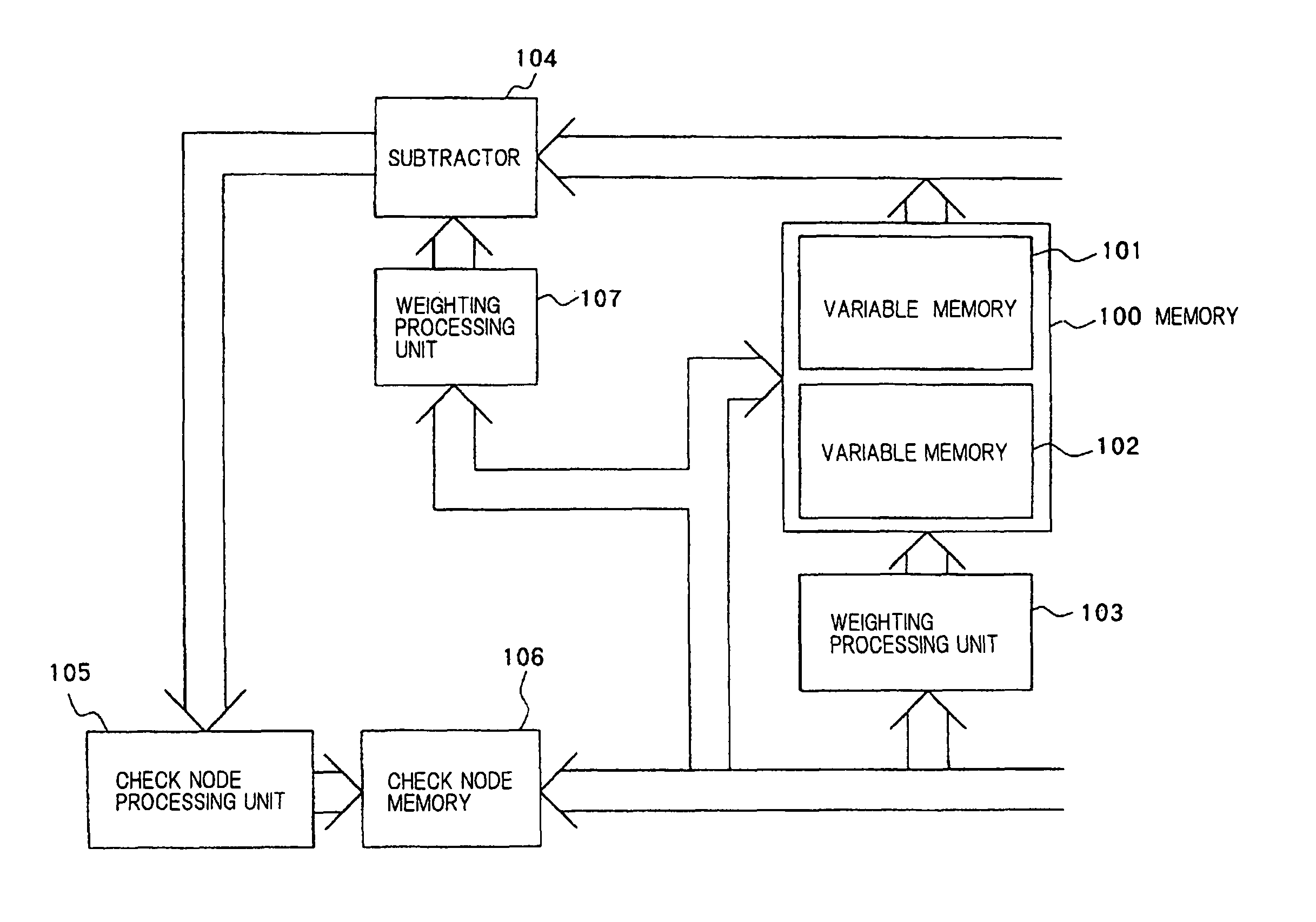
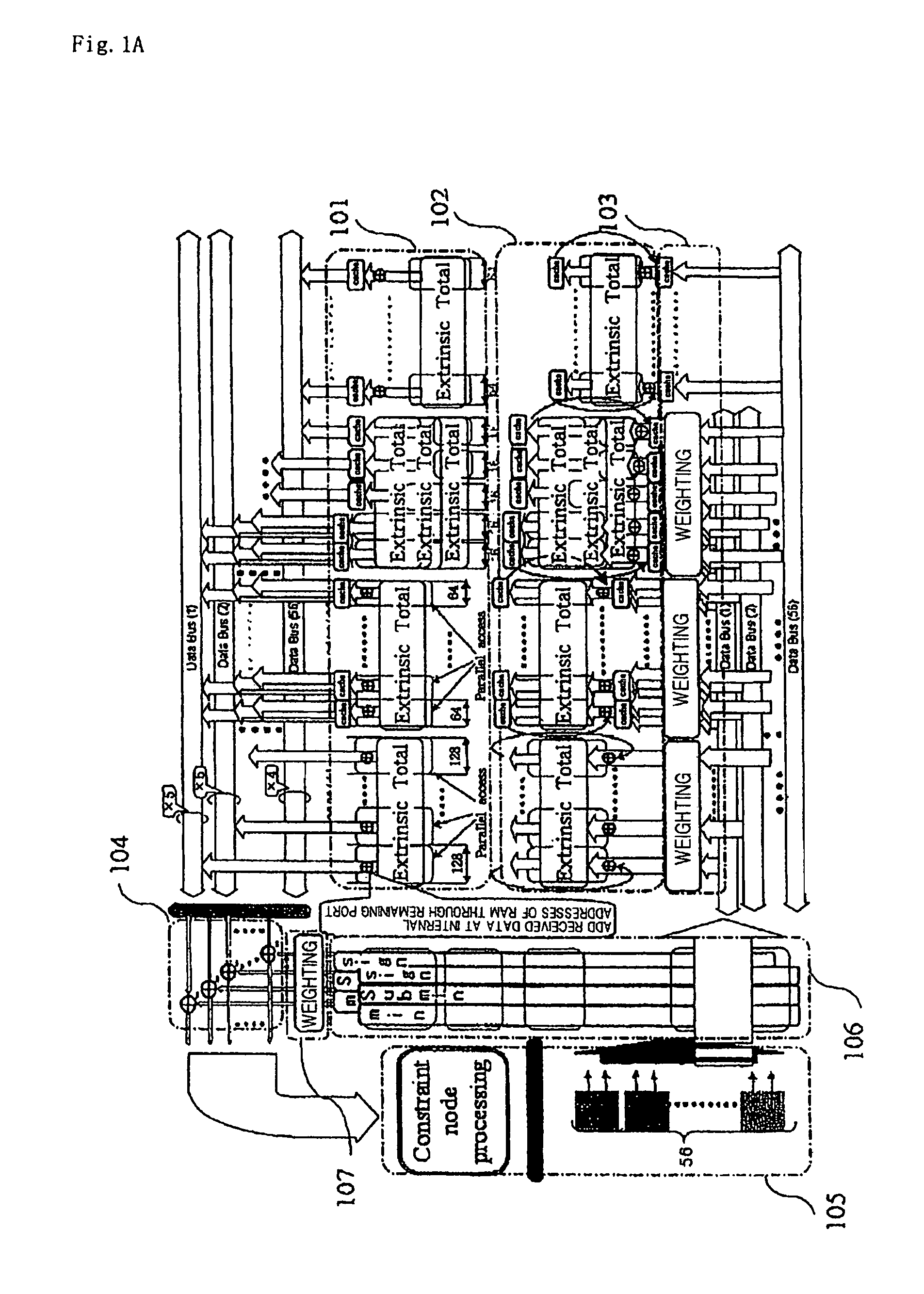
[0284]This example is called “Multi-Type,” where categories are provided for each Type. It is understood from the polynomial of the aforementioned Equation (40), the socket model in FIGS. 2 to 4, and the like that it is a single row weight having a row weight of four. Optimal weighting is searched by the GA in the Tanner graph in which this example is classified into categories including non-linear processing resulting from the aforementioned MaxLog approximation (or also called the “minSum algorithm”). Locations corresponding to the weighting are indicated in a block diagram as in FIG. 1. Specifically, this is configured such that each different category is independently ...
PUM
 Login to View More
 Abstract
Description
Claims
Application Information
 Login to View More