

Organic photoelectric conversion material and organic thin-film photoelectric conversion device
a conversion device and organic technology, applied in the field of organic photoelectric conversion material and organic thin-film photoelectric conversion device, can solve the problems of insufficient photoelectric conversion performance of conventional organic photoelectric conversion device to that of silicon photoelectric conversion device, insufficient use of long wavelength range (near infrared range) and insufficient use of long wavelength range (near infrared range). to achieve good photoelectric conversion performan
- Summary
- Abstract
- Description
- Claims
- Application Information
AI Technical Summary
Benefits of technology
Problems solved by technology
Method used
Image

Examples
example 1
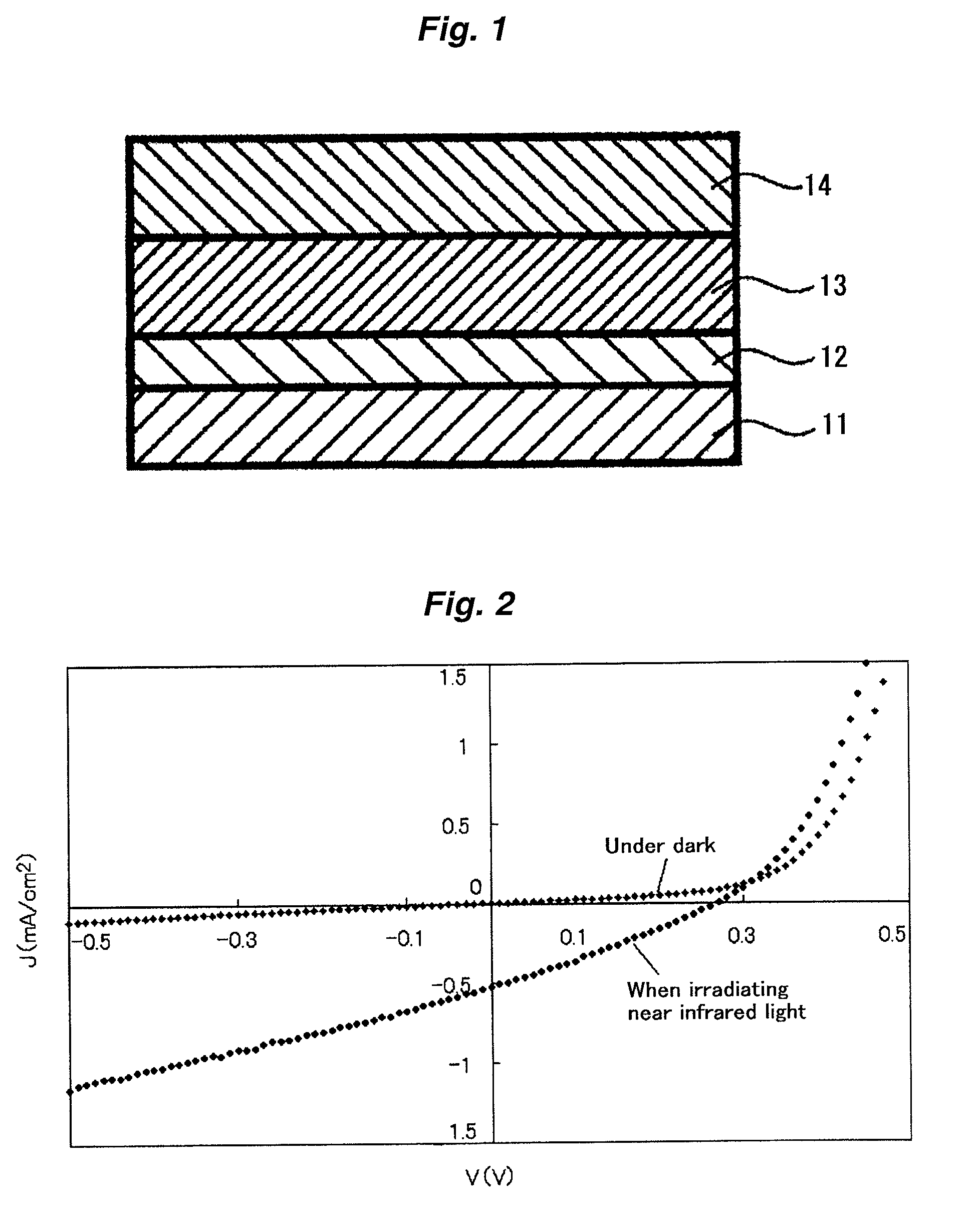
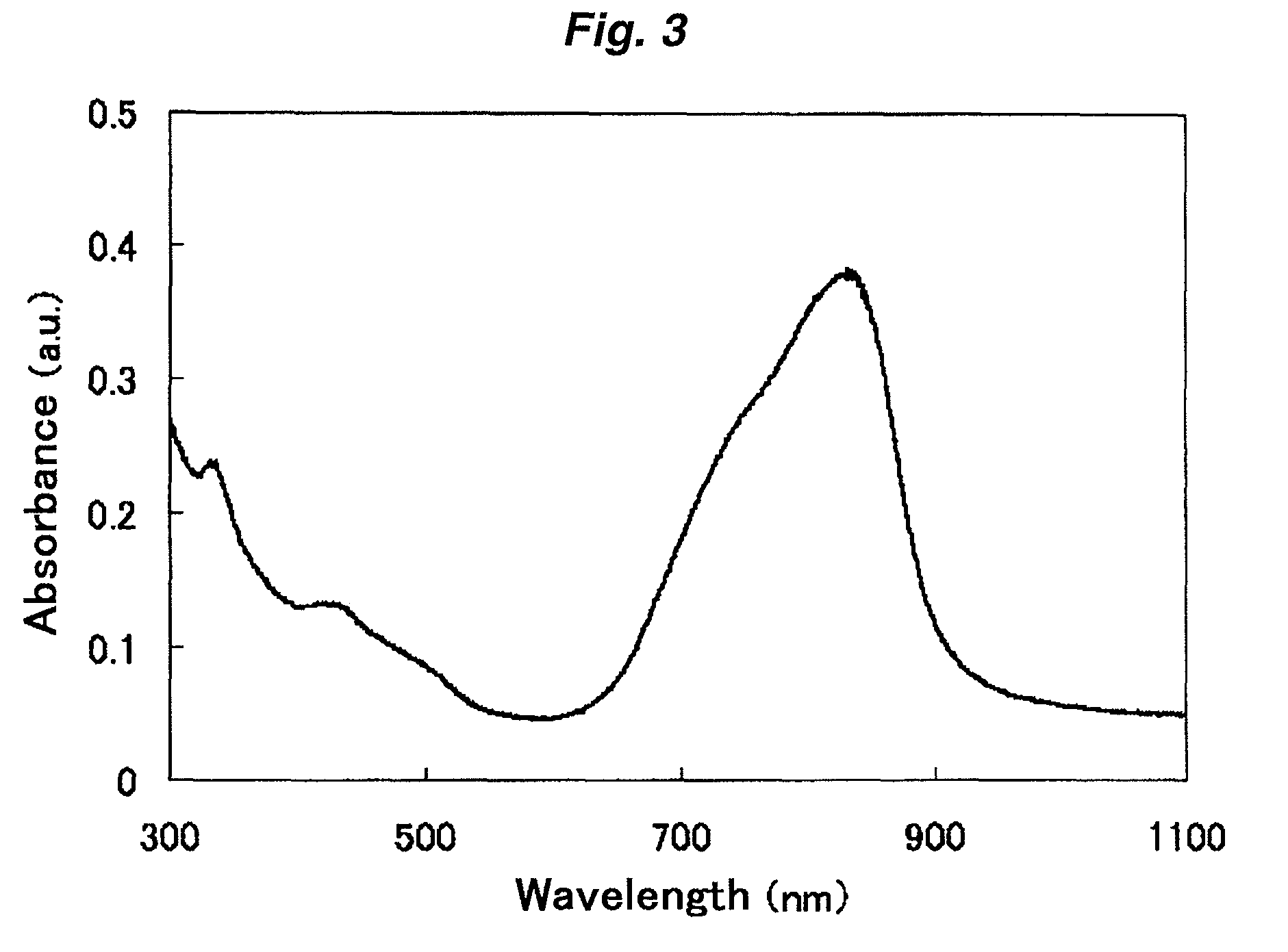
[0126]A glass substrate (2.5 cm×2.5 cm) with a patterning of ITO electrode was washed in isopropyl alcohol using ultrasonic, and then dried. Thereafter, a UV ozone treatment was performed for 30 minutes in order to remove organic contaminants on the surface of ITO substrate. Subsequently, an aqueous solution containing PEDOT (poly (3,4-ethylenedioxythiophene)) / PSS (polystyrene sulfonic acid) (Baytron P standard good) was spin coated on the ITO substrate at 4000 rpm for 60 seconds, and then dried at 120° C. for 10 minutes. Thereby, a 50 nm film-thick buffer layer was formed. The film thickness was measured using a film thickness meter by a stylus method (DEKTAK6M (trade name) manufactured by ULVAC, Inc.). Hereinafter, the same measuring method is applied to the film thickness. Subsequently, after dissolving 10 mg of the exemplified compound 1 and 10 mg of PCBM in 1 ml of 1,2-dichlorobenzene (HPLC grade) in a glove box (nitrogen atmosphere), ultrasonic was irradiated to the above mixt...
example 2
[0129]Devices manufactured exactly in the same manner as Example 1 except that each of the exemplified compounds 5, 9, 16, and 18 was used in place of the exemplified compound 1 respectively exhibited high photoelectric conversion performance equivalent to the device of Example 1 at the near infrared range. The results of short circuit-current, open voltage, and absorption λ max of the photoelectric conversion layer of each of the devices are shown in Table 1.
PUM
 Login to View More
 Abstract
Description
Claims
Application Information
 Login to View More