
Method and system for processing echo signals
a technology of echo signal and processing method, applied in the field of processing echo signal, can solve the problems of unreliable and inaccurate level measurement, relevant parameters which are difficult or impossible to measure and apply to the signal processing algorithm in real time, and cannot be reliable and accura
- Summary
- Abstract
- Description
- Claims
- Application Information
AI Technical Summary
Benefits of technology
Problems solved by technology
Method used
Image

Examples
Embodiment Construction
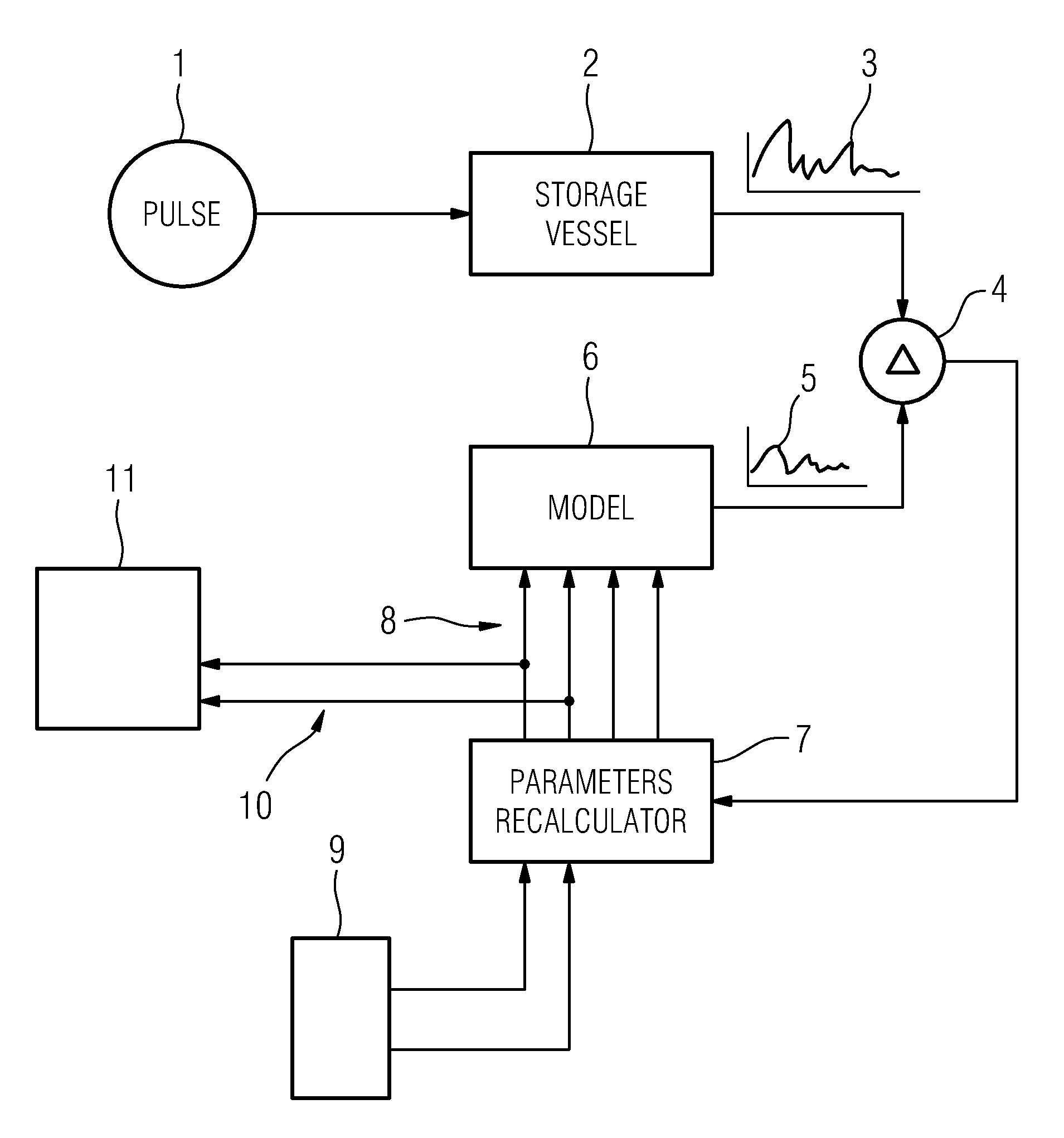
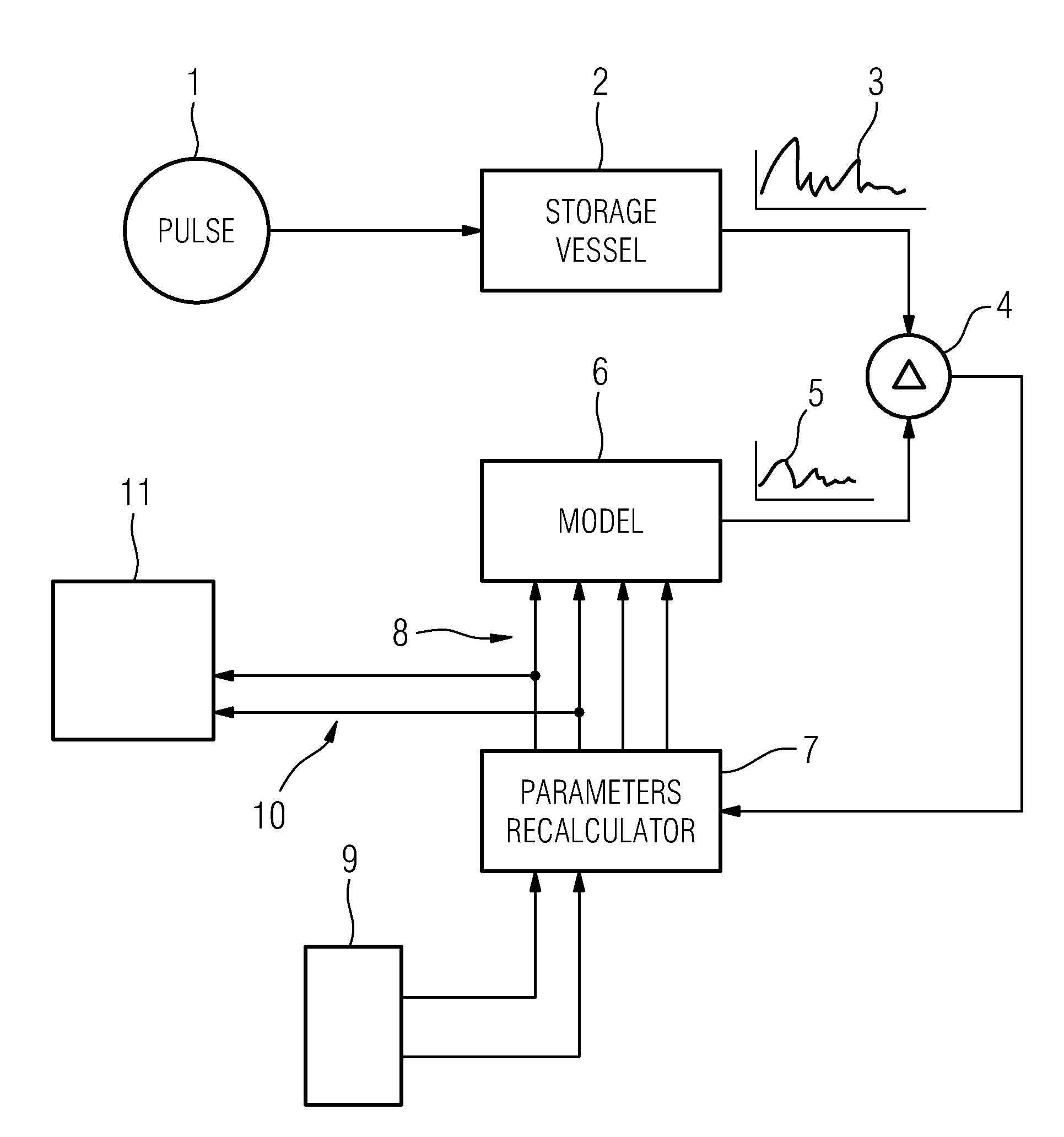
[0015]Referring to FIG. 1, a radar or ultrasonic transducer 1 transmits an interrogating pulse into a storage vessel 2. A captured echo signal 3 is applied to a difference calculator 4 where the signal 3 is compared with a calculated signal 5.
[0016]The calculated signal 5 is produced by a simulated model 6 of the storage tank 2. The model 6, as discussed in more detail below, contains a number of parameters such as:[0017]Rate of change of level[0018]Material particle size[0019]Surface turbulence[0020]Angle of repose[0021]Froth height[0022]Froth density[0023]Material absorption of interrogating signal[0024]False reflections[0025]Environmental noise
all of which are difficult or impossible to measure directly. The output of the difference calculator 5 is applied to a parameter recalculator 7 which modifies the parameters 8 used in the model 6 in a manner to reduce the difference.
[0026]Any one or more of the parameters 8 may be used, as required, as a final output 10 from the system, an...
PUM
 Login to View More
 Abstract
Description
Claims
Application Information
 Login to View More