
Macrocyclic indoles as hepatitis C virus inhibitors
a technology of hepatitis c virus and macrocyclic indoles, which is applied in the field of macrocyclic indoles, can solve the problems of persistent infection, high rate of chronic infection, and existing infections that will continue to present serious medical and economic burden
- Summary
- Abstract
- Description
- Claims
- Application Information
AI Technical Summary
Benefits of technology
Problems solved by technology
Method used
Image

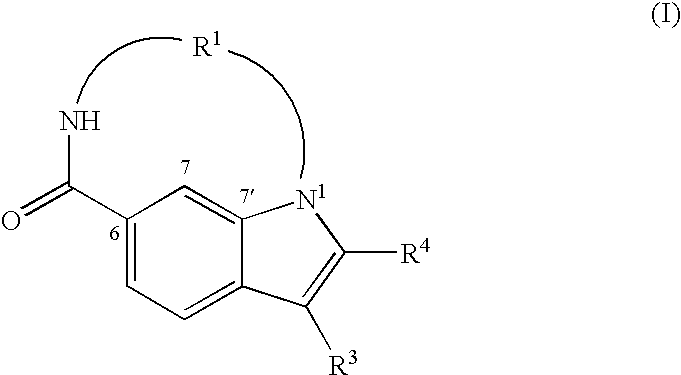
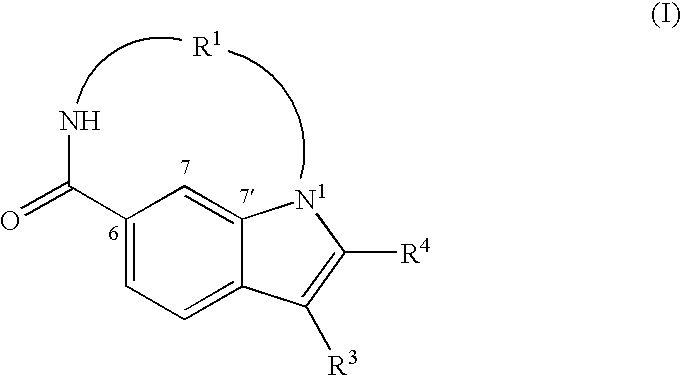
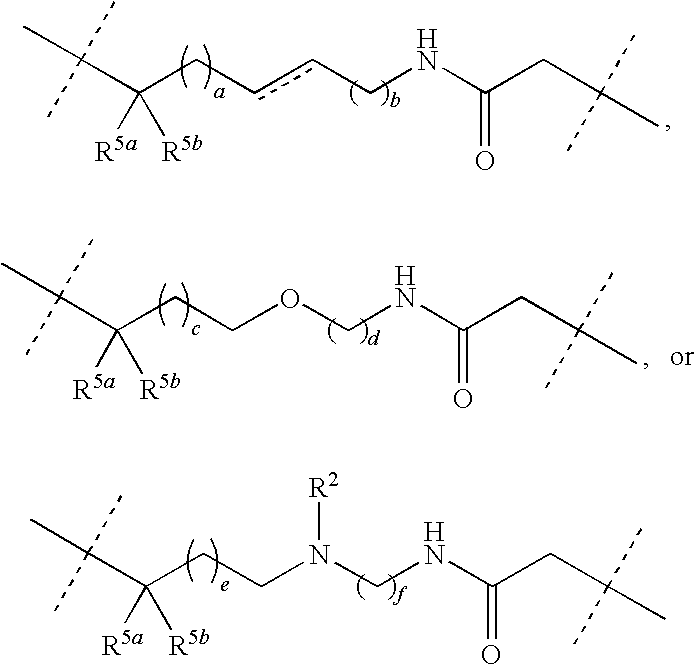
Examples
example 1
Synthesis of 17-cyclohexyl-18-(furan-3-yl)-1,4,11-triaza-tricyclo-[11.5.2.016,19]icosa-7,13(20),14,16(19),17-pentaene-3,12-dione (1)
[0335]
Step A.
[0336]
[0337]Cyclohexanone (18.2 g, 186 mmol) was added to a solution of indole-6-carboxylic acid 1-1 (10.0 g, 62.0 mmol) in methanol (100 mL). Then, a solution of sodium methoxide (20.4 g, 378.5 mmol) in methanol (50 mL) was added dropwise. The resulting solution was heated to reflux. After 5 days, the reaction mixture was evaporated and ice-cold water (250 mL) was added. The precipitate was filtered off, washed with water and dried under vacuum to give 12.0 g (80.1%) of the target compound 1-2: m / z=242 (M+H)+.
Step B.
[0338]
[0339]A mixture of 1-2 (14.0 g, 58 mmol) and 20% Pd(OH)2 / C (600 mg) in methanol (50 mL) and THF (50 mL) was shaken in a hydrogenation apparatus under 55 psi pressure at room temperature for 3 h. The catalyst was removed by filtration and washed with methanol. The filtrate was concentrated to dryness. The residue was tritu...
example 2
17-Cyclohexyl-18-(furan-3-yl)-1,4,11-triaza-tricyclo[11.5.2.016,19]icosa-13(20),14,16(19),17-tetraene-3,12-dione (2)
[0354]
[0355]A mixture of 1 (30 mg, 0.067 mmol) and 10% Pd / C (20 mg) in methanol (10 mL) and THF (10 mL) was shaken in a hydrogenation apparatus under 55 psi pressure at room temperature for 1 h. The catalyst was removed by filtration and washed with methanol. The filtrate was concentrated to dryness. Filtration on silica gel afforded 24 mg (80%) of the target product 2: m / z=448 (M+H)+.
example 3
Preparation of 17-cyclohexyl-18-[4-[2-(4-methanesulfonylpiperazin-1-yl)-5-nitrobenzyloxy]phenyl]-1,4,11-triazatricyclo[11.5.2.016,19]icosa-7,13(20),14,16(19),17-pentaene-3,12-dione (3)
[0356]
Step A.
[0357]
[0358]A solution of 2-chloro-5-nitrobenzoic acid 3-1 (101 mg, 0.503 mmol), N-methylsulfonylpiperazine 3-2 (110 mg, 0.673 mmol) and cesium carbonate (335 mg, 1.03 mmol) in DMF (5 mL) was heated at 100° C. under nitrogen. After 12 h, the reaction mixture was successively cooled down at room temperature and acidified to pH 5 with an aqueous 6 N solution of HCl. The precipitate was collected by filtration to give 75 mg (45.3%) of the target product 3-3: m / z=330 (M+H)+. On larger scale (4.53 g of 31) the target product 3-3 was obtained with a yield of 87.1%.
Step B.
[0359]
[0360]A solution of acid 3-3 (508 mg, 1.54 mmol), methyliodide (120 μL, 1.93 mmol) and NaHCO3 (220 mg, 2.61 mmol) in dry DMF (10 mL) was stirred at room temperature for 12 h. Then, the reaction mixture was diluted with wat...
PUM
| Property | Measurement | Unit |
|---|---|---|
| pressure | aaaaa | aaaaa |
| temperature | aaaaa | aaaaa |
| temperature | aaaaa | aaaaa |
Abstract
Description
Claims
Application Information
 Login to View More