
Process for the preparation of a propenal intermediate and derivatives thereof
a technology applied in the field of process for the preparation of propenal intermediate and derivative thereof, can solve the problems of non-satisfactory product yield, process that is not cost effective for large-scale industrial production, and often contains significant amounts of impurities, so as to achieve cost-effectiveness, sacrificing yield and quality of the product
- Summary
- Abstract
- Description
- Claims
- Application Information
AI Technical Summary
Benefits of technology
Problems solved by technology
Method used
Image

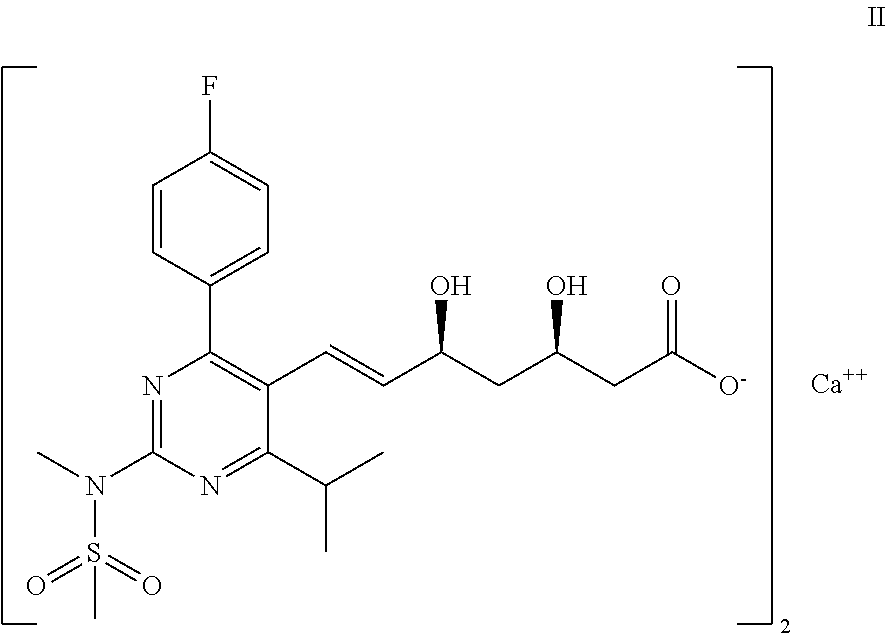
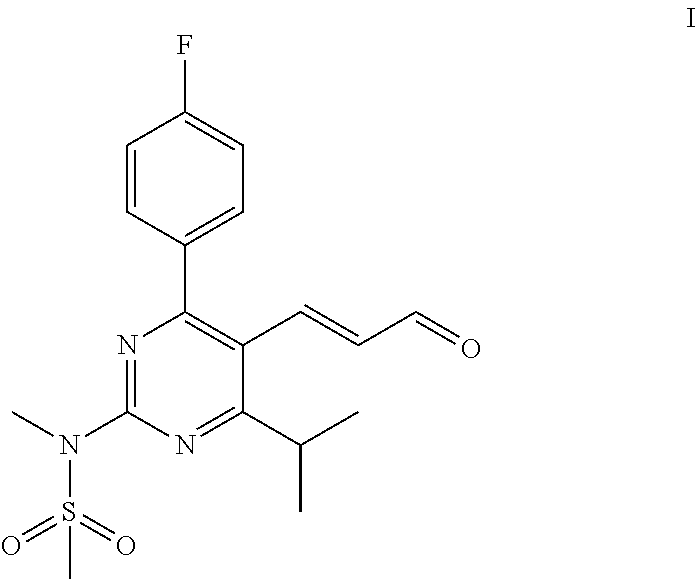
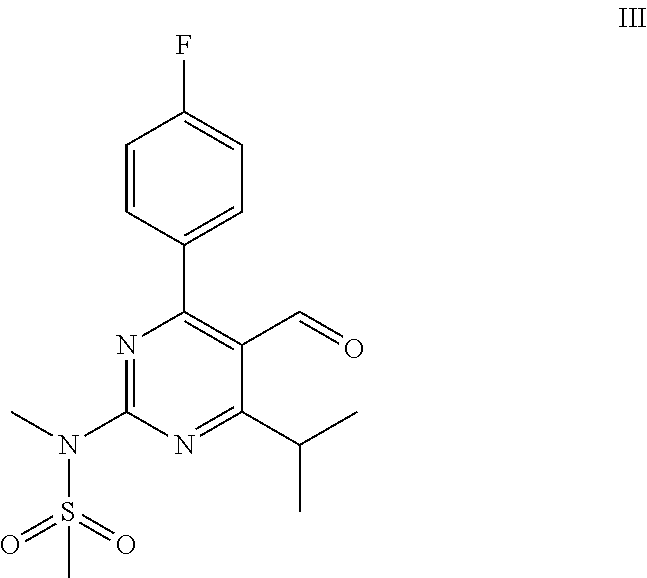
Examples
example 1
[0069]Magnesium (13.8 g, 570 mmol) is charged into a 3-neck round-bottom flask and dried under heat and vacuum. Then the flask is purged with Argon. A solution of allylbromide (24.8 mL, 285 mmol) in 560 mL diethylether is added dropwise. The reaction mixture is stirred for 30 min after the completion of the addition. The reaction mixture is left to settle and the supernatant is added to a solution of N-[4-(4-fluorophenyl)-5-formyl-6-isopropylpyrimidin-2-yl]-N-methylmethanesulfonamide (40 g, 114 mmol) in 1120 mL THF at −5° C. to 5° C. under stirring. Reaction is monitored by TLC.
[0070]Upon completion of the reaction, 100 mL 1N HCl is charged into the reaction mass and stirred for 30 min. Layers are separated and the aqueous layer is extracted with 500 mL ethyl acetate twice. Organic layers are combined and washed with 100 mL DM water and 100 mL brine, subsequently. Organic layer is dried over 10 g of anhydrous Na2SO4. The solution is filtered and the filtrate is evaporated till dry. ...
example 2
[0072]A 50 mL round-bottom flask equipped with a stirring bar is dried under heat and vacuum followed by purged with Argon and charged with 1 g (2.85 mmol) of N-[4-(4-fluorophenyl)-5-formyl-6-isopropylpyrimidin-2-yl]-N-methylmethanesulfonamide and 28 mL of dry THF. The solution is cooled in an ice bath and 900 mg (2.85 mmol) solid TBAF.3H2O are added in two equal portions in the space of 5 min. The reaction mixture is stirred at 0° C. for 1 hour and at 20° C.-25° C. for 12 hours. It is then treated with 10 mL aqueous 1N HCl and extracted with ethyl acetate (2×50 mL).
[0073]The organic layers are combined and washed with DM water (10 mL) and brine (10 mL) followed by drying over 500 mg of anhydrous Na2SO4. The mass is filtered and the filtrate is concentrated under vacuum. The residue is purified through silica gel column chromatography eluting with 30% ethylacetate:cyclohexane to provide 560 mg (50%) of the desired N-[4-(4-fluorophenyl)-5-(1-hydroxybut-3-enyl)-6-isopropylpyrimidin-2-...
example 3
[0074]To a solution of N-[4-(4-fluorophenyl)-5-(1-hydroxybut-3-enyl)-6-isopropyl-pyrimidin-2-yl]-N-methylmethanesulfonamide (2 g, 5.08 mmol) in a mixture of 30 mL methanol and 4 mL buffer solution (pH=7), sodium periodate (3.2 g, 15.2 mmol) and osmium tetroxide (0.3 mL, 4% wt. in water, 13 mg) are added at room temperature. The reaction mass is stirred and the progress of the reaction is monitored by TLC. Upon completion of the reaction, the reaction mixture is filtered through celite bed (1 g) and washed with ethyl acetate (2×10 mL). The filtrate is distilled under reduced pressure until solvents are removed. To the residue, ethyl acetate (200 mL) is added and washed with DM water (50 mL) and brine (50 mL), subsequently. The solvent is distilled off under reduced pressure to afford 2.1 g crude product. Part of the residue (200 mg) is purified through silica gel column chromatography eluting with (20%-30%) ethylacetate:cyclohexane to obtain 60 mg pure N-(4-(4-fluorophenyl)-5-(1-hydr...
PUM
| Property | Measurement | Unit |
|---|---|---|
| reaction time | aaaaa | aaaaa |
| reaction time | aaaaa | aaaaa |
| reaction time | aaaaa | aaaaa |
Abstract
Description
Claims
Application Information
 Login to View More