Method and system for lossy compression and decompression of computed tomography data
a computed tomography and data compression technology, applied in the field of medical diagnostic imaging and baggage imaging, can solve the problems of lossy compression techniques, data loss, and harm to the human being being scanned, and achieve the effects of reducing the quality of compressed data, combining the output of entropy encoded data, and high quality
- Summary
- Abstract
- Description
- Claims
- Application Information
AI Technical Summary
Benefits of technology
Problems solved by technology
Method used
Image



Examples
Embodiment Construction
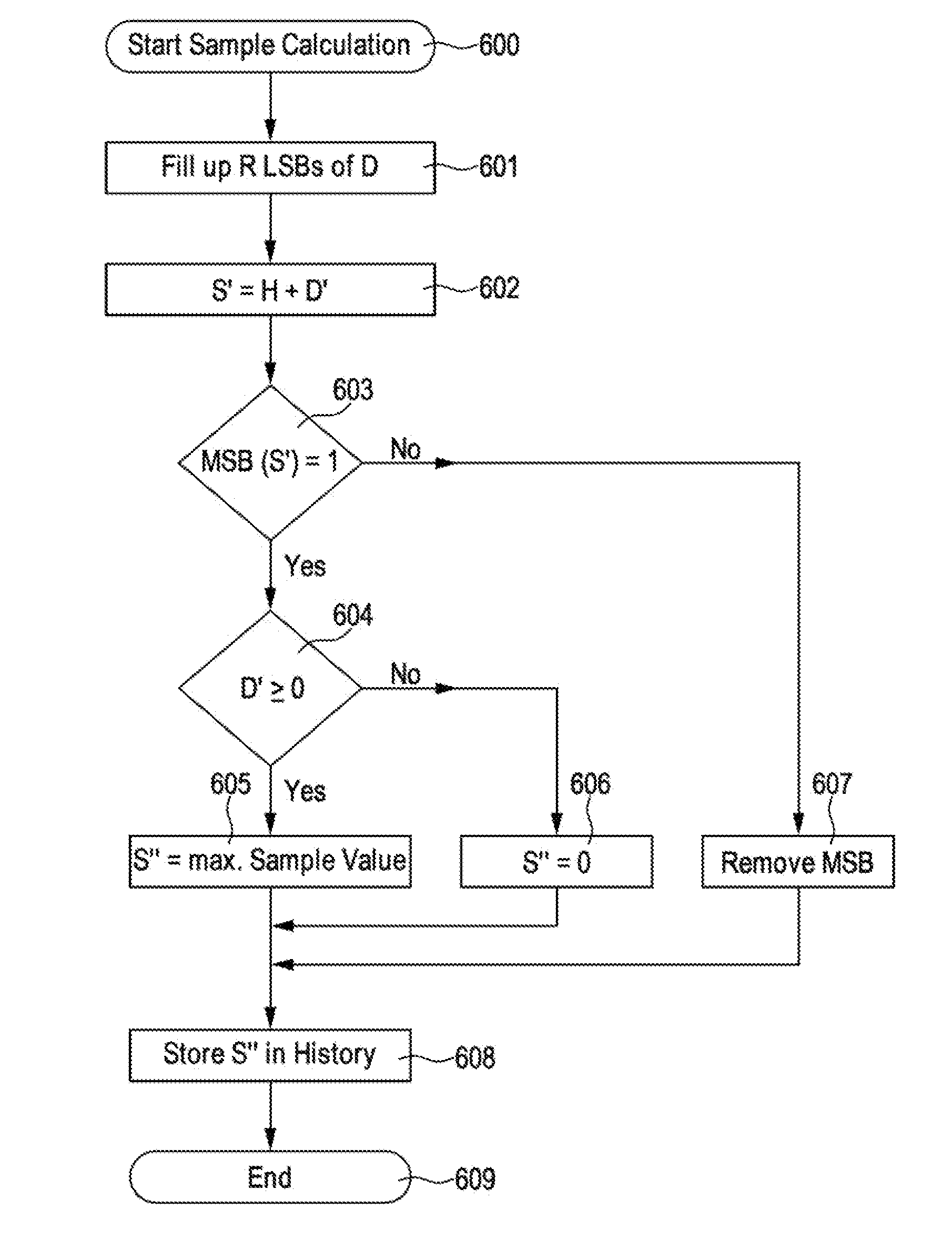
[0080]FIG. 1 shows a basic compression algorithm. The compression starts this step 100. In step 101 data is input from the data source like a CT scanner. Preferably a block of N input samples, wherein N is an integer number, is input and further processed together. In the following step 102, an appropriate mod for predicting the data is selected. The selection may be based on history like previously input data, preferably data which has been stored in history memory in step 111. With the selected model in step 103 the differences between the received data of input step 101 and the model D=S−H are calculated. If a required compression cannot be reached by the algorithm, an optional reduction of differences is performed in step 104. This step, calculating the reduced differences DR from the differences, D, may be called a difference reducer. By using these reduced differences, decompressed values are calculated in steps 108-110. First in step 108 reconstructed differences D′ are calcu...
PUM
 Login to View More
 Abstract
Description
Claims
Application Information
 Login to View More