Check patentability & draft patents in minutes with Patsnap Eureka AI!

Method of enzyme inactivation

a technology of inactivation method and enzyme, which is applied in the preparation of detergent mixture composition, chemical treatment enzyme inactivation, and detergent compounding agent. it can solve the problems of contaminating and potentially degrading foodstuffs, preventing their commercial use, and changing the taste of foodstuffs

Active Publication Date: 2018-06-05
ECOLAB USA INC
View PDF6 Cites 0 Cited by
  • Summary
  • Abstract
  • Description
  • Claims
  • Application Information

AI Technical Summary

Benefits of technology

The present invention provides a method for inactivating enzymes using a composition containing a sulfonated peroxycarboxylic acid. The composition may further include an oxidizing reagent, such as hydrogen peroxide, and may be used after a cleaning step using an enzyme-based cleaning product. The method may be carried out at a temperature between 10°C and 70°C. The technical effect is the inactivation of enzymes that may be present in equipment or membranes, which can be useful in various industries such as food and pharmaceutical manufacturing.

Problems solved by technology

A problem associated with the use of enzymes in the cleaning-in-place of food processing equipment is that they might contaminate and potentially degrade the foodstuff, if they are not completely inactivated after the cleaning step.
This might change the taste of the foodstuff and potentially prevent its commercial use.
Similarly, residual enzymes in laundry-cleaning applications might degrade laundry components, especially if the laundry material is a textile of biological origin, e.g. wool, resulting in degradation products that have an unpleasant odour.
However, this method of inactivation is potentially damaging to the equipment that is to be cleaned.
For example, an acid treatment might have a corrosive effect on the surfaces of process equipment and on filtration membranes used therein.
Also, the rather high temperature required entails an increase in energy costs.

Method used

the structure of the environmentally friendly knitted fabric provided by the present invention; figure 2 Flow chart of the yarn wrapping machine for environmentally friendly knitted fabrics and storage devices; image 3 Is the parameter map of the yarn covering machine
View more

Image

Smart Image Click on the blue labels to locate them in the text.
Viewing Examples
Smart Image
  • Method of enzyme inactivation
  • Method of enzyme inactivation
  • Method of enzyme inactivation

Examples

Experimental program
Comparison scheme
Effect test

examples

[0054]Inactivation of Lipases on Microfiltration Membranes

[0055]Tests of lipase inactivation were conducted on a DDS M38 flat sheet MF / UF lab test plant. Microfiltration membranes of type Alfa Laval GRM 0.2 were incubated for 30 minutes to 60 minutes at 50° C. by circulating an aqueous solution containing 0.2% of an enzyme composition at pH 9. The enzyme composition contained 5% to 10% by weight of Rizolipase (a lipase from Rhizopus arrhizus) and 5% to 10% by weight of Subtilisin. Subsequently, the membranes were subjected to one of the cleaning and inactivation procedures described below. Immediately before and after the cleaning and inactivation procedures, samples of the membranes were frozen and stored frozen until the analysis of lipase concentration and activity. Analysis of lipase concentration and activity was performed by enzyme-linked immunosorbent assays (ELISA) by Novozymes A / S. Lipase concentration is reported as μg of lipase per g of membrane, the specific lipase activ...

the structure of the environmentally friendly knitted fabric provided by the present invention; figure 2 Flow chart of the yarn wrapping machine for environmentally friendly knitted fabrics and storage devices; image 3 Is the parameter map of the yarn covering machine
Login to View More

PUM

PropertyMeasurementUnit
temperatureaaaaaaaaaa
pHaaaaaaaaaa
temperatureaaaaaaaaaa
Login to View More

Abstract

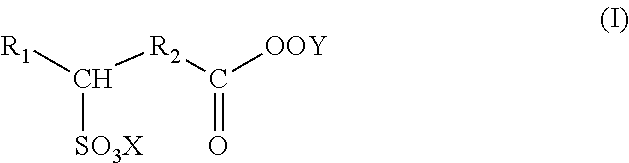
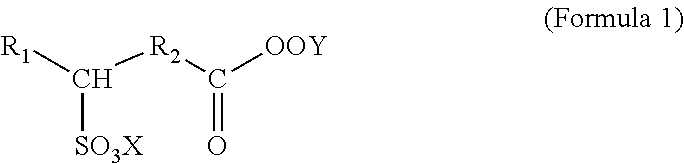
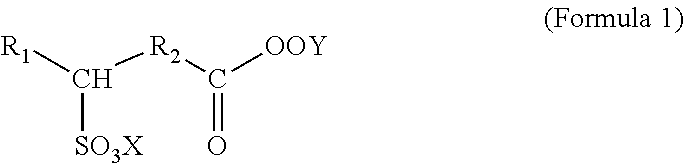
The present invention relates to a method for the inactivation of enzymes with a composition comprising a sulfonated peroxycarboxylic acid according to formula (I) wherein: R1 is hydrogen, or a substituted or unsubstituted Cm alkyl group; R2 is a substituted or unsubstituted Cn alkyl group; X is a hydrogen atom, a cationic group, or an ester forming moiety; Y is a hydrogen atom, a cationic group, or an ester forming moiety; n is 1 to 10; m is 1 to 10; and n+m is less than or equal to 18, wherein the composition is contacted with the enzyme.

Description

FIELD OF THE INVENTION[0001]The present invention relates to a chemical method of inactivating enzymes, in particular hydrolytic enzymes used in cleaning applications.BACKGROUND[0002]The use of enzymes, for example proteases and lipases, offers considerable advantages in cleaning applications. For example, WO 97 / 02753 A1 discloses that enzymes can be used to remove protein- and lipid-containing soils at low temperatures and without the need for additional chemicals. Thereby, the use of enzymes in cleaning applications increases the material compatibility, decreases the energy costs, reduces water consumption, and reduces the health and environmental risks that would result from the use of chemicals.[0003]Enzyme-based cleaning products are used for example in the food industry, in particular for the cleaning-in-place of equipment used to process food or beverages. Here, cleaning-in-place refers to the cleaning of process equipment by circulating a cleaning solution through the equipm...

Claims

the structure of the environmentally friendly knitted fabric provided by the present invention; figure 2 Flow chart of the yarn wrapping machine for environmentally friendly knitted fabrics and storage devices; image 3 Is the parameter map of the yarn covering machine
Login to View More

Application Information

Patent Timeline
no application Login to View More
Patent Type & Authority Patents(United States)
IPC IPC(8): C12N9/99C11D3/386C11D3/39C11D11/00B01D65/02
CPCC12N9/99B01D65/02C11D3/386C11D11/0017C11D11/0023C12Y301/01C11D3/3945B01D2321/166C11D2111/14C11D2111/12
Inventor PATTEN, ANJANOLDE, CHRISTOFVOGT, PETRA
Owner ECOLAB USA INC
Features
  • R&D
  • Intellectual Property
  • Life Sciences
  • Materials
  • Tech Scout
Why Patsnap Eureka
  • Unparalleled Data Quality
  • Higher Quality Content
  • 60% Fewer Hallucinations
Social media
Patsnap Eureka Blog
Learn More