
Filtering material of thermal stability and the purpose thereof
A filter material and heat-resistant technology, applied in the fields of filtration and separation, chemical instruments and methods, separation methods, etc., can solve the problems of difficult use of inorganic fibers and low number of curls of heat-resistant organic fibers.
- Summary
- Abstract
- Description
- Claims
- Application Information
AI Technical Summary
Problems solved by technology
Method used
Image

Examples
Embodiment 1
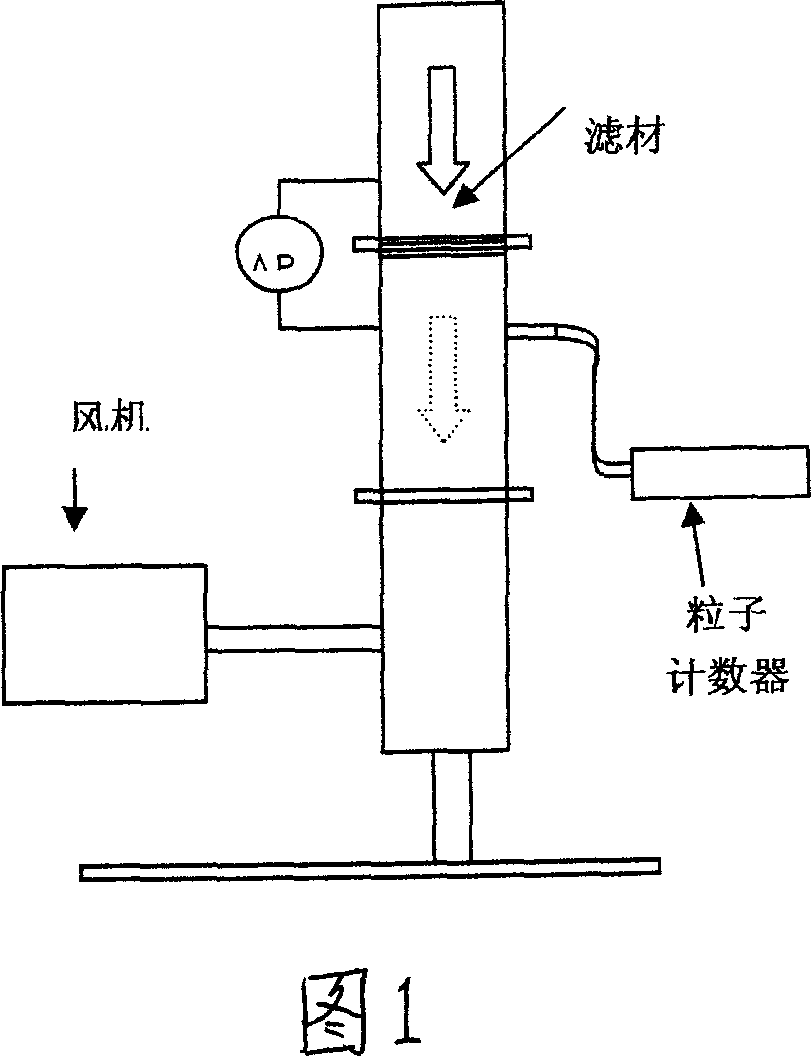
[0093] First, select PPS staple fibers with a fineness of 2.2dtex (diameter of 14.5μm), a length of 51mm, and a number of crimps of 12.3 / 25mm ("Tekang" brand produced by Toray Co., Ltd. of Japan), and first spun into 7s / 1, 20s / 1 single yarn, and then 20s / 1 single yarn is spun into 20s / 2 strands (total denier: 600dtex). Among them, 20s / 2 strands are used as warp yarns, 7s / 1 single yarns are used as weft yarns, and the PPS substrate fabric with a warp density of 28 threads / 2.54cm and a weft density of 18 threads / 2.54cm is woven by plain weaving. The air permeability of the substrate fabric is tested according to the 8.27.1A method of the JIS L 1096 standard at a pressure of 50Pa, and the value is 1400L / dm 2 .min.
[0094]Then, select 50% of PPS staple fibers ("Tekang" brand produced by Toray Co., Ltd. of Japan) with a fineness of 2.2dtex (diameter is 14.5 μm), a length of 51mm, and a crimp number of 12.3 / 25mm, a length of 50mm, and a fineness of 0.75dtex (fiber diameter 6μm) ...
Embodiment 2
[0098] First, select at least one of polysulfone fiber (or polytetrafluoroethylene fiber, polyimide fiber, meta-aramid fiber, para-aramid fiber) and / or glass fiber, basalt fiber, At least one of the carbon fibers, and the inorganic fibers have at least a crimp of 1.0 pieces / 25mm or more) to make the base fabric. The air permeability of the substrate fabric is tested according to the 8.27.1A method of the JIS L1096 standard at a pressure of 50Pa, and the value is 700-2000L / dm 2 .min.
[0099] Then, select PPS staple fibers (or polytetrafluoroethylene fibers, polyimide fibers, meta-aramid fibers, para- At least one of aramid fibers) 30% (or 70%), 55% (or 25%) of uncrimped glass fibers with a length of 50 mm and a fineness of 0.75 dtex (fiber diameter 6 μm), a length of 25.4 mm, and a fineness of 2.3dtex (fiber diameter 10μm), glass fiber (or basalt fiber, carbon fiber) 15% (or 5%) with a crimp of 1 to 5 pieces / 25mm, processed by opening and carding, and then the needling densi...
PUM
| Property | Measurement | Unit |
|---|---|---|
| Fineness | aaaaa | aaaaa |
| Diameter | aaaaa | aaaaa |
| Length | aaaaa | aaaaa |
Abstract
Description
Claims
Application Information
 Login to View More