Check patentability & draft patents in minutes with Patsnap Eureka AI!

Plasticiser for phenolic foam, and a process for producing phenolic foam

A technology of phenolic foam and plasticizer, which is applied to the plasticizer for phenolic foam, can solve the problems of unsatisfactory degradation of foam wall time, failure to achieve foam insulation stability, etc., to inhibit degradation and improve long-term The effect of adiabatic stability

Active Publication Date: 2010-12-22
KINGSPAN HLDG (IRL) LTD
View PDF5 Cites 0 Cited by
  • Summary
  • Abstract
  • Description
  • Claims
  • Application Information

AI Technical Summary

Problems solved by technology

These modifications are still not ideal in controlling the degradation of the foam cell wall over time
Long-term adiabatic stability of the foam cannot be achieved with such plasticizers and surfactants

Method used

the structure of the environmentally friendly knitted fabric provided by the present invention; figure 2 Flow chart of the yarn wrapping machine for environmentally friendly knitted fabrics and storage devices; image 3 Is the parameter map of the yarn covering machine
View more

Image

Smart Image Click on the blue labels to locate them in the text.
Viewing Examples
Smart Image
  • Plasticiser for phenolic foam, and a process for producing phenolic foam
  • Plasticiser for phenolic foam, and a process for producing phenolic foam
  • Plasticiser for phenolic foam, and a process for producing phenolic foam

Examples

Experimental program
Comparison scheme
Effect test

Embodiment 1

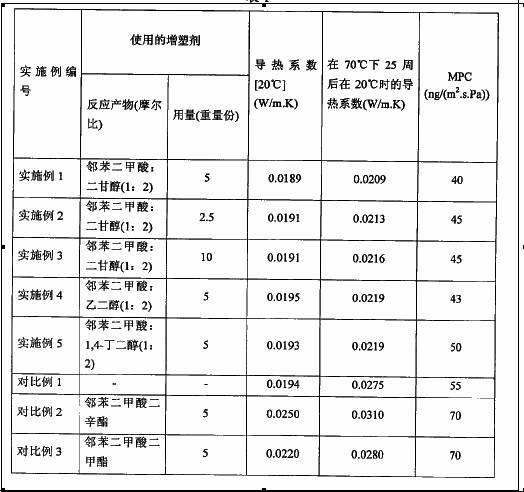
[0072] Polyester polyols are obtained by reacting phthalic acid with diethylene glycol at a molar ratio of 1:2. The weight average molecular weight of the polyester polyol thus obtained is 450-500. To 103 parts by weight of a resol resin PF-328 (manufactured by Asahi Organic Chemicals Industry Co Ltd), 5 parts by weight of this polyester polyol was added and mixed. The PF-328 resin comprises 100 parts by weight of resole resin prepared by reacting phenol and formaldehyde at a molar ratio of 1:2.0, and then 3 parts by weight of silicone oil surfactant is mixed thereinto to complete the PF-328 resin mixture.

[0073] Add 8 parts by weight of pentane as foaming agent in the phenolic resin mixture obtained, and pump 20 parts by weight of p-toluenesulfonic acid and xylenesulfonic acid (weight ratio is 2: 1) in the mixer The mixture acts as a catalyst to obtain a foamable phenolic resin composition. The composition was poured into a formwork lined with a glass fiber nonwoven. Foa...

Embodiment 2

[0075] A sample of the phenolic foam was prepared in the same manner as in Example 1, except that the amount of the polyester polyol was changed to 2.5 parts by weight based on the weight of the phenolic resin. The properties of the foam are shown in Table 1.

Embodiment 3

[0077] A sample of the phenolic foam was prepared in the same manner as in Example 1, except that the amount of the polyester polyol was changed to 10 parts by weight based on the weight of the phenolic resin.

[0078] The properties of the foam are shown in Table 1.

the structure of the environmentally friendly knitted fabric provided by the present invention; figure 2 Flow chart of the yarn wrapping machine for environmentally friendly knitted fabrics and storage devices; image 3 Is the parameter map of the yarn covering machine
Login to View More

PUM

PropertyMeasurementUnit
thicknessaaaaaaaaaa
Login to View More

Abstract

A plasticiser for phenolic foam comprises a polyester polyol, especially a polyester polyol which is a reaction product of a polybasic carboxylic acid selected from a dibasic to a tetrabasic carboxylic acid with a polyhydric alcohol selected from a dihydric to a pentahydric alcohol. A phenolic foam including the plasticiser is also described. The plasticiser improves cell flexibility so that the long-term stability of the thermal insulation of the phenolic foam including the plasticiser is improved.

Description

technical field [0001] The present invention relates to plasticizers for phenolic foams, phenolic foam products and methods of making phenolic foams using said plasticizers. More particularly, the present invention relates to plasticizers that impart toughness to the cell walls of phenolic foams, inhibit degradation of phenolic foams over time, and improve thermal insulation properties. Additionally, the present invention relates to phenolic foams with improved thermal aging properties and methods of making said phenolic foams. Background technique [0002] Due to its superior thermal insulation and fire resistance properties, phenolic foam is used in thermal insulation applications in building materials. It is well known that the thermal conductivity of polymeric insulation materials, including phenolic foam, changes with time. This phenomenon is caused by the gradual diffusion of gas inside the cells. The gas present inside the cells originates from the blowing agent us...

Claims

the structure of the environmentally friendly knitted fabric provided by the present invention; figure 2 Flow chart of the yarn wrapping machine for environmentally friendly knitted fabrics and storage devices; image 3 Is the parameter map of the yarn covering machine
Login to View More

Application Information

Patent Timeline
no application Login to View More
Patent Type & Authority Patents(China)
IPC IPC(8): C08L61/06C08K5/12C08J9/00
CPCC08K5/12C08L61/06C08J2361/06C08J2467/00C08J9/0061C08L67/00C08L2666/18C08J9/00
Inventor R·泽格加拉
Owner KINGSPAN HLDG (IRL) LTD
Features
  • R&D
  • Intellectual Property
  • Life Sciences
  • Materials
  • Tech Scout
Why Patsnap Eureka
  • Unparalleled Data Quality
  • Higher Quality Content
  • 60% Fewer Hallucinations
Social media
Patsnap Eureka Blog
Learn More