Biodegradable sustained-release medicament stent for TMR and preparation method

A degradable and degradable polymer technology, applied in stents, medical science, surgery, etc., can solve the problems of tumor-promoting mutagenesis, poor targeting, and less research on myocardial stents, and achieve the effect of promoting angiogenesis

A degradable and degradable polymer technology, applied in stents, medical science, surgery, etc., can solve the problems of tumor-promoting mutagenesis, poor targeting, and less research on myocardial stents, and achieve the effect of promoting angiogenesis

CN101347642AInactive Publication Date: 2009-01-21TEDA INT CARDIOVASCULAR HOSPITAL +1

Image

Smart Image Click on the blue labels to locate them in the text.
Viewing Examples
Smart Image
  • Biodegradable sustained-release medicament stent for TMR and preparation method
  • Biodegradable sustained-release medicament stent for TMR and preparation method
  • Biodegradable sustained-release medicament stent for TMR and preparation method

Examples

Experimental program
Comparison scheme
Effect test

Embodiment 1

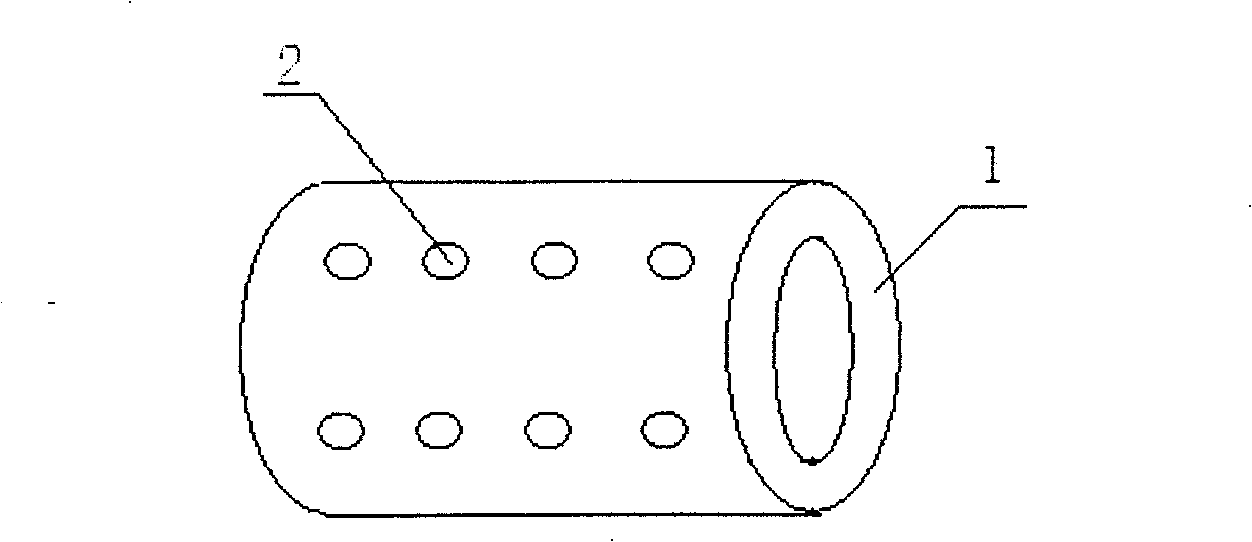
[0028] A biodegradable slow-release stent for transmural myocardial revascularization, comprising a hollow tube 1, the inner diameter of the tube is 0.5 mm, the wall thickness of the tube is 0.3 mm, and the length of the tube is 0.3 mm. mm, the wall of the tube is provided with a small hole 2 through the wall, the material of the tube is polycaprolactone loaded with basic fibroblast growth factor and heparin, the basic fibroblast growth factor, heparin and The ratio of polycaprolactone is 30ug:20mg:0.5g.

Embodiment 2

[0030] A biodegradable drug slow-release stent for transmural myocardial revascularization, comprising a hollow tube 1, the inner diameter of the tube is 0.2 mm, the wall thickness of the tube is 0.1 mm, and the length of the tube is 0.1 mm. mm, the wall of the tube is provided with a small hole 2 through the wall, the material of the tube is polylactic acid loaded with vascular endothelial growth factor and heparin, and the ratio of the vascular endothelial growth factor, heparin and polylactic acid is 50ug: 20mg:0.1g.

Embodiment 3

[0032] A biodegradable slow-release stent for transmural myocardial revascularization, comprising a hollow tube 1, the inner diameter of the tube is 1 mm, the wall thickness of the tube is 0.5 mm, and the length of the tube is 0.5 mm , the wall of the tube is provided with a small hole 2 through the wall, the material of the tube is polyglycolic acid loaded with Ξ²-type transforming growth factor and heparin, the Ξ²-type transforming growth factor, heparin and polyglycolic acid The ratio is 20ug:50mg:1g.

the structure of the environmentally friendly knitted fabric provided by the present invention; figure 2 Flow chart of the yarn wrapping machine for environmentally friendly knitted fabrics and storage devices; image 3 Is the parameter map of the yarn covering machine
Login to View More

PUM

PropertyMeasurementUnit
thicknessaaaaaaaaaa
lengthaaaaaaaaaa
Login to View More

Abstract

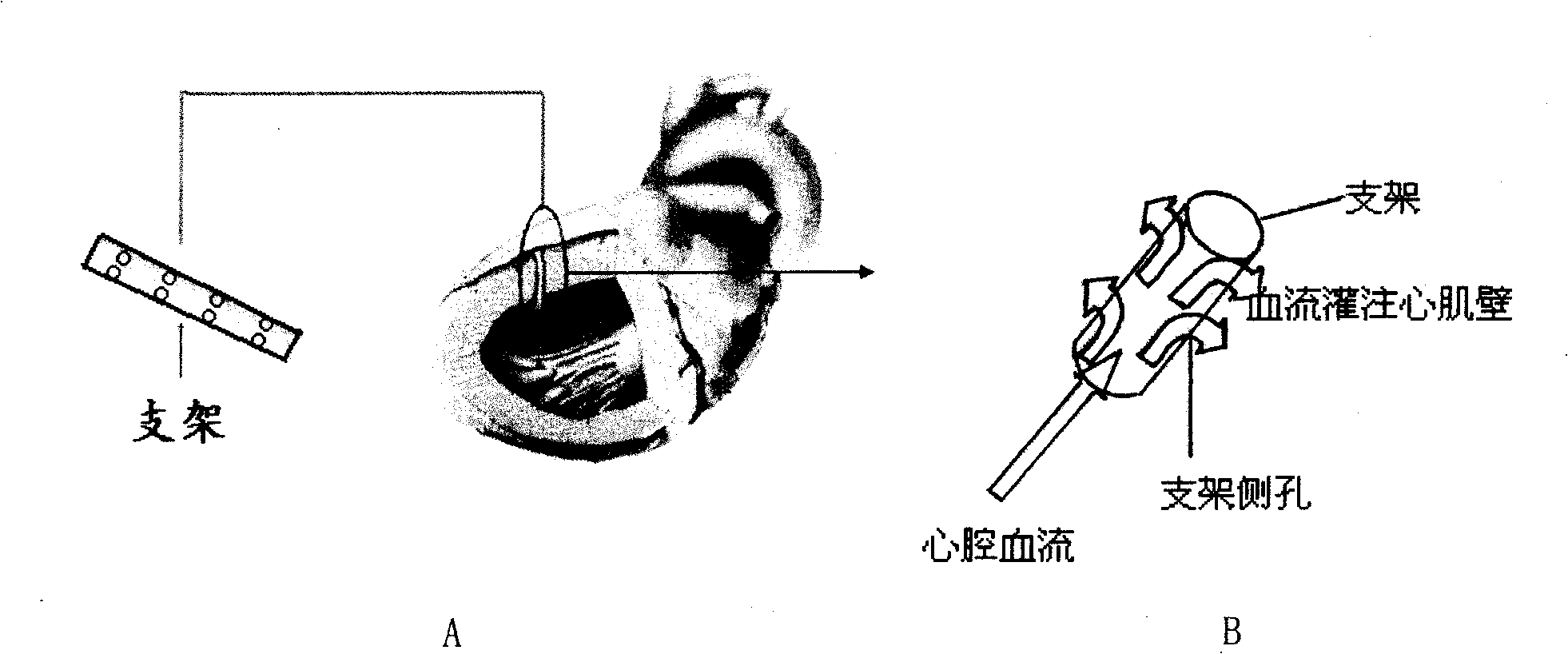
The invention discloses a transmural myocardial revascularization biodegradable drug controlled-release bracket and a preparation method thereof. The transmural myocardial revascularization biodegradable drug controlled-release bracket comprises a hollow tube with the inner diameter of 0.2mm to 1mm, the wall thickness of 0.1 to 0.5mm and the length of 0.1 to 0.5mm, the wall of the tube is provided with a hole that runs through the wall, and the material of the tube is biodegradable polymer that is loaded with cell growth factors and / or heparin. The bracket of the invention can prevent the hole channel of transmural myocardial revascularization (TMR) from closing and keep the blood flow perfusion unobstructed; the bracket can be degraded into micro molecules to be excreted to the outside of the body shortly after the supporting function and drug-controlling function are completed, thus avoiding adverse impact caused by staying in the body for a long time; the drug controlled-release growth factors can promote the revascularization and the heparin has the function of anticoagulation, thus being beneficial to the restoration of partial ischemic myocardium.

Description

technical field [0001] The invention relates to a biodegradable stent and a preparation method thereof, in particular to a biodegradable drug slow-release stent for revascularization of transmural myocardial blood vessels and a preparation method thereof. Background technique [0002] Transmural myocardial revascularization (TMR) is a new surgical technique for refractory angina pectoris through transmural myocardial perforation using laser or mechanical methods. It is primarily indicated for the treatment of patients with advanced angina pectoris who are undergoing coronary artery bypass grafting (CABG) or percutaneous transluminal coronary angioplasty (PTCA) indications. Its role in reducing angina pectoris, improving ischemic myocardial perfusion, and improving heart function has been widely concerned. Recent studies have shown that after TMR, the transmural myocardial vascular channels are occluded due to blood coagulation, which cannot be kept open for a long time, and...

Claims

the structure of the environmentally friendly knitted fabric provided by the present invention; figure 2 Flow chart of the yarn wrapping machine for environmentally friendly knitted fabrics and storage devices; image 3 Is the parameter map of the yarn covering machine
Login to View More

Application Information

Patent Timeline
21 Jan 2009
Publication
CN101347642A
IPC
A61L31/06; A61L31/16; A61F2/82
Inventors
εˆ˜ζ™“η¨‹; εˆ˜ε€©ε†›