

Fluidized bed processing device of printing and dyeing waste water
A printing and dyeing wastewater and treatment device technology, applied in the field of environmental technology and water treatment, can solve the problems of low three-phase separation efficiency, excessive shedding of biofilm, high cost of anaerobic reaction, etc., to improve carrier loss, solve easy clogging, and quickly The effect of efficient degradation
Inactive Publication Date: 2010-06-30
ZHEJIANG UNIV
View PDF0 Cites 21 Cited by
- Summary
- Abstract
- Description
- Claims
- Application Information
AI Technical Summary
Problems solved by technology
However, the three-phase separation efficiency of the traditional biological fluidized bed is not high, resulting in a large loss of carriers; at the same time, the internal structure is relatively complex, resulting in excessive shedding of some biofilms, which affects the treatment effect
Also, the use of gas as a lifting power makes anaerobic reactions too costly or difficult to perform
Method used
the structure of the environmentally friendly knitted fabric provided by the present invention; figure 2 Flow chart of the yarn wrapping machine for environmentally friendly knitted fabrics and storage devices; image 3 Is the parameter map of the yarn covering machine
View moreImage
Smart Image Click on the blue labels to locate them in the text.
Smart ImageViewing Examples

Examples
Experimental program
Comparison scheme
Effect test
Embodiment
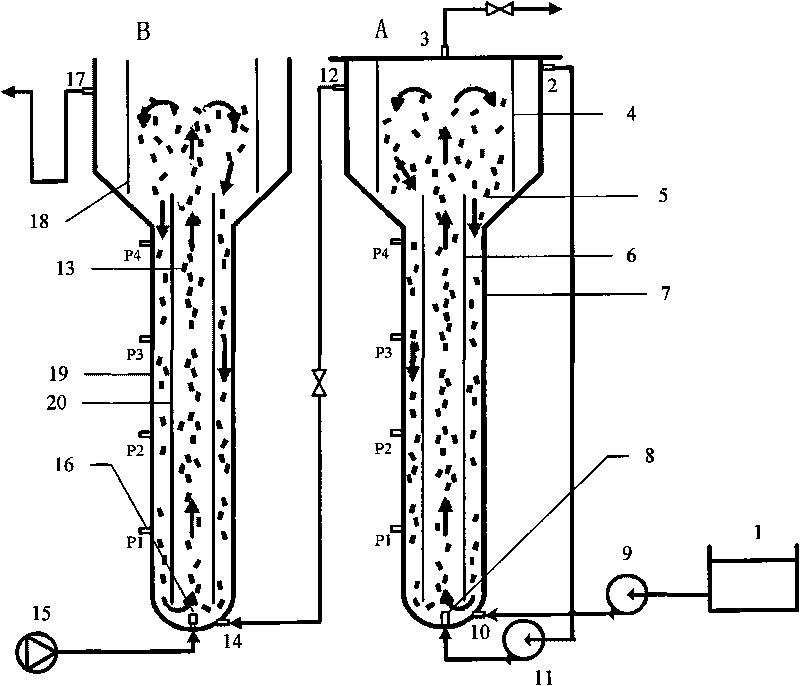
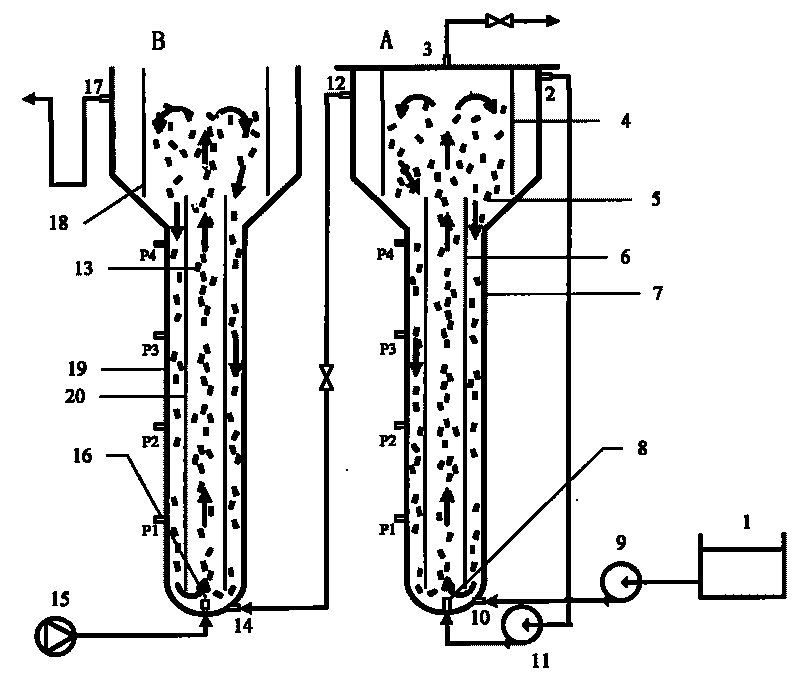
[0019] The fluidized bed treatment device for printing and dyeing wastewater of the present invention is used to treat wastewater containing various dyes with a total concentration of 100 mg / L, a COD of 1000 mg / L, and an initial pH of 7.5. The operating parameters of the fluidized bed are: the circulating water flow rate of the anaerobic fluidized bed is 70L / h, the aerobic aeration rate is 0.4m3 / h, and the total hydraulic retention time is 30 hours. The effluent COD removal rate reaches 94.3%, and the chromaticity removal rate reaches 87.5%. The data show that printing and dyeing wastewater can be treated quickly and thoroughly by using anaerobic-aerobic combined biological fluidized bed.
the structure of the environmentally friendly knitted fabric provided by the present invention; figure 2 Flow chart of the yarn wrapping machine for environmentally friendly knitted fabrics and storage devices; image 3 Is the parameter map of the yarn covering machine
Login to View More PUM
| Property | Measurement | Unit |
|---|---|---|
| diameter | aaaaa | aaaaa |
Login to View More
Abstract
The invention discloses a fluidized bed processing device of printing and dyeing waste water, comprising an anaerobic fluidized bed reactor and an aerobic fluidized bed reactor, wherein circularly flowing microorganism carriers are respectively introduced to the anaerobic and the aerobic fluidized bed reactors, and then the effect of high-efficiently removing azo dyes with difficult degradation is achieved by utilizing an aerobic and anaerobic combined processing technology. The fluidized bed processing device successfully solves the technical problem of easy blockage of the conventional fluidized bed. Compared with the common activated sludge process, the fluidized bed processing device has the advantages of compact and simple structure, small land occupation, high chroma and CODCr removing rate, good quality of discharged water, dynamic and continuous processing and the like.
Description
technical field [0001] The invention relates to a device for treating printing and dyeing wastewater, belonging to the fields of environmental technology and water treatment. Background technique [0002] Printing and dyeing wastewater has a large amount of water, high chroma, and complex components, including dyes, pastes, and auxiliaries left in the dyeing process. It is highly toxic to organisms and is one of the most difficult industrial wastewater to treat. In recent years, with the continuous development of the printing and dyeing industry, the development of new dyes and auxiliaries, especially the increasing number of azo dyes, has led to a large amount of refractory organic matter entering the printing and dyeing wastewater, and ordinary microbial systems and methods are difficult to achieve ideal treatment. As a result, most of the original biological treatment systems have reduced the COD removal rate from 70% to 50% or even lower, and the traditional treatment pr...
Claims
the structure of the environmentally friendly knitted fabric provided by the present invention; figure 2 Flow chart of the yarn wrapping machine for environmentally friendly knitted fabrics and storage devices; image 3 Is the parameter map of the yarn covering machine
Login to View More Application Information
Patent Timeline
 Login to View More
 Patent Type & AuthorityApplications(China)
IPC IPC(8): C02F3/30C02F103/30
Inventor雷乐成张兴旺林君
OwnerZHEJIANG UNIV