Unlock instant, AI-driven research and patent intelligence for your innovation.

Optical code division multiplexing access system

An optical code division multiple access and optical code technology, which is applied in optical multiplexing systems, optical mode multiplexing systems, optical code multiplexing and other directions, and can solve problems such as inability to be widely used and lack of versatility

Inactive Publication Date: 2011-01-19
NAT INST OF INFORMATION & COMM TECH
View PDF0 Cites 1 Cited by
  • Summary
  • Abstract
  • Description
  • Claims
  • Application Information

AI Technical Summary

Problems solved by technology

However, since multi-port AWG encoders / decoders are expensive, systems using AWG encoders cannot be widely used when each user terminal also uses a multi-port AWG decoder for decoding.
Namely, while the performance of multiport AWG encoder / decoders is very desirable, they lack versatility in current

Method used

the structure of the environmentally friendly knitted fabric provided by the present invention; figure 2 Flow chart of the yarn wrapping machine for environmentally friendly knitted fabrics and storage devices; image 3 Is the parameter map of the yarn covering machine
View more

Image

Smart Image Click on the blue labels to locate them in the text.
Viewing Examples
Smart Image
  • Optical code division multiplexing access system
  • Optical code division multiplexing access system
  • Optical code division multiplexing access system

Examples

Experimental program
Comparison scheme
Effect test

Embodiment 1

[0055]

[0056] Figure 8 is a configuration diagram showing the experimental apparatus used to adjust the optical code in Example 1. In this embodiment, a synthesizer is used to obtain a drive signal at 9.95328 GHz. This drive signal is input to an oscillation type synchronous laser diode, and thereby 1.8 ps pulsed light is acquired. This drive signal (C192) is used as a clock signal into a standard pulse oscillator (PPG) and / or a bit error rate tester (BERT). The light output from the oscillating synchronous laser diode is appropriately amplified by the EDFA (amplifier), and then passes through the 7.8nm band-pass filter (BPF), and then enters the phase modulator (PM) through the polarization adjuster (PC). At this moment, a bias voltage is applied to the phase modulator. The drive signal output from the PPG is also input to the phase modulator, and the signal output from the phase modulator is appropriately amplified and then incident on the encoder through a filter an...

Embodiment 2

[0071]

[0072] Figure 19 It is a block diagram showing an experimental device for verifying DPSK-OCDMA at 10 Gbps and 8 users using a composite multiport AWG encoder and an SSFBG decoder.

[0073] Figure 20 ( Figure 20 Medium A~ Figure 20 Middle F) is a diagram showing the wavelength, spectrum and eye diagram of various locations in the experimental setup, Figure 20 In A is the graph representing the location α, Figure 20 where B is the graph at point β, Figure 20 where C is the graph representing the location γ, Figure 20 D is a graph representing the location π, Figure 20 Among them, E is a graph representing the position θ, Figure 20 Middle F is a graph showing the point ξ.

[0074] In this experimental device, an optical pulse with a center wavelength of 1550.8 nm, a repetition frequency of 9.95328 GHz (OC192), and about 1.8 ps was generated by an oscillation-type synchronous laser diode (MLLD). The optical code is modulated using a differential phase...

the structure of the environmentally friendly knitted fabric provided by the present invention; figure 2 Flow chart of the yarn wrapping machine for environmentally friendly knitted fabrics and storage devices; image 3 Is the parameter map of the yarn covering machine
Login to View More

PUM

No PUM Login to View More

Abstract

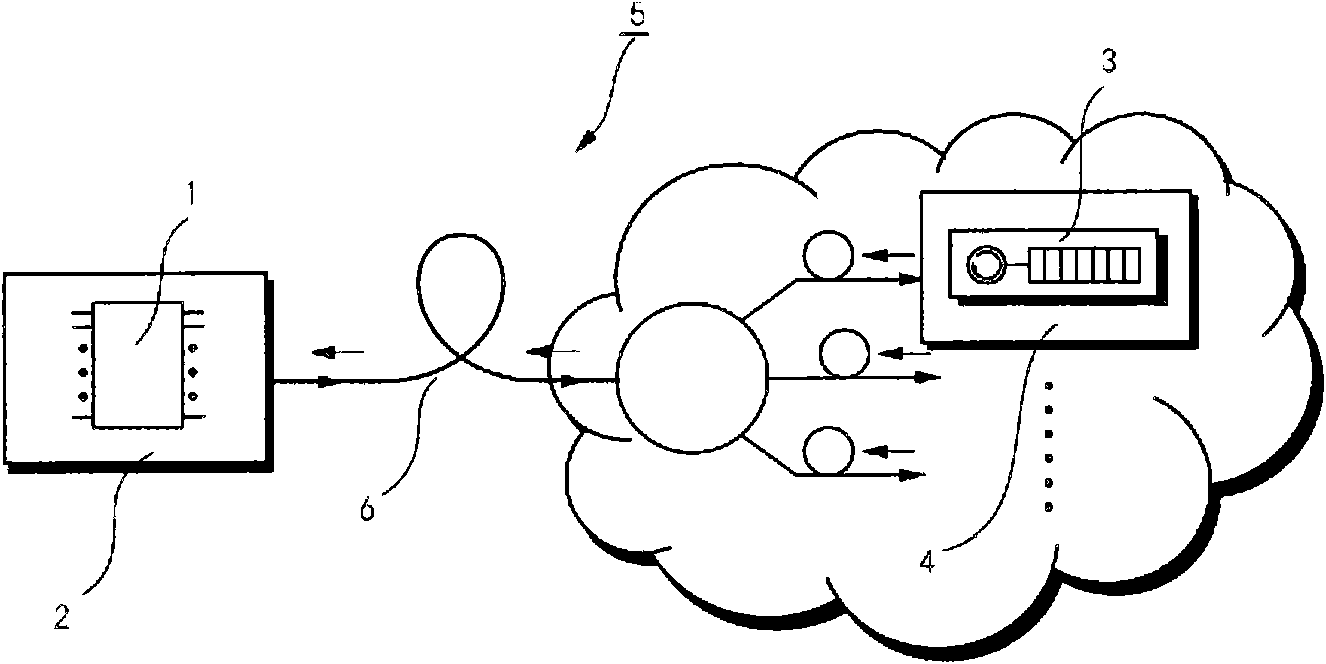
Provided is a versatile optical code division multiplexing access system (OCDMA). An optical code division multiplexing access system (5) comprises a center station (2) including a multiport optical encoder (1) and a decoding unit (4) including a decoder (3) for decoding an optical signal encoded by the multiport optical encoder (1). The multiport optical encoder (1) converts an inputted optical signal into an encoded optical signal, the wavelength of which differs by a predetermined amount from one code pattern to another, and the decoder (3) is a super-structured fiber Bragg grating (SSFBG) having a center wavelength corresponding to the encoded optical signal.

Description

technical field [0001] The invention relates to an optical code division multiple access system and the like. Background technique [0002] Optical code division multiple access (OCDMA) technology not only has the characteristics of good confidentiality, but also has the characteristics of asynchronous communication without delay, fast access and soft capacity when necessary. Therefore, OCDMA gives people more expectations as one of the candidates of the next-generation broadband access network. Moreover, by combining OCDMA technology and wavelength division multiplexing (WDM) technology, the capacity of the access network can be improved, so people expect to achieve the goal of fiber-to-the-home with megabit traffic. [0003] Various OCDMA encoders / decoders have been proposed. In order to realize the coherent time-domain extension (TS) OCDMA technology, a multi-port arrayed waveguide grating (AWG) encoder / decoder for OCDMA has been proposed. This multi-port AWG encoder / d...

Claims

the structure of the environmentally friendly knitted fabric provided by the present invention; figure 2 Flow chart of the yarn wrapping machine for environmentally friendly knitted fabrics and storage devices; image 3 Is the parameter map of the yarn covering machine
Login to View More

Application Information

Patent Timeline
no application Login to View More
Patent Type & Authority Applications(China)
IPC IPC(8): H04J14/00G02B6/12H04B10/20H04J14/04H04J14/06G02F2/00H04B10/27H04B10/272H04B10/508H04B10/516H04B10/548H04B10/61
CPCH04J14/0282G02B6/02057G02B6/12011G02B6/12019H04J14/005H04L5/00
Inventor 片冈伸元和田尚也加布里埃拉·钦科蒂王旭北山研一坂元明
Owner NAT INST OF INFORMATION & COMM TECH
Features
  • R&D
  • Intellectual Property
  • Life Sciences
  • Materials
  • Tech Scout
Why Patsnap Eureka
  • Unparalleled Data Quality
  • Higher Quality Content
  • 60% Fewer Hallucinations
Social media
Patsnap Eureka Blog
Learn More