

Aerobic oxidation of primary aliphatic alcohols by using noble metal polyoxometalate complexes
A polyoxometalate and complex technology, applied in the field of chemistry, can solve problems such as no description
Patent Information
- Authority / Receiving Office
- CN · China
- Patent Type
- Applications(China)
- Current Assignee / Owner
- Publication Date
- 2012-07-18
- Estimated Expiration
- Not applicable · inactive patent
Smart Images
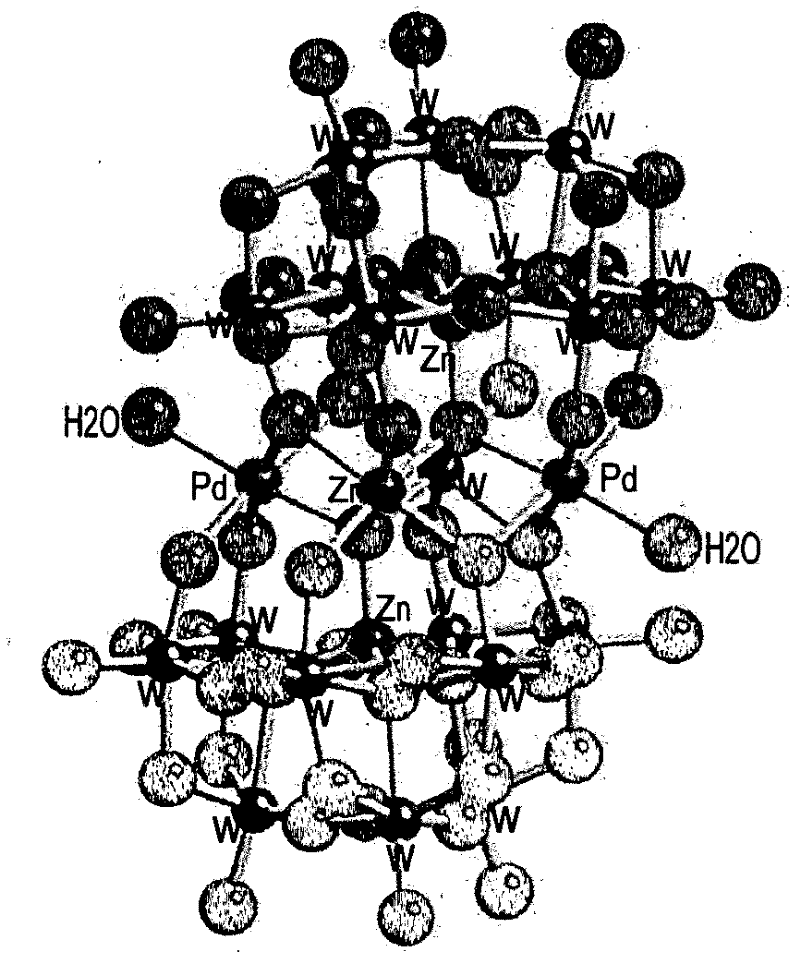
Figure 1 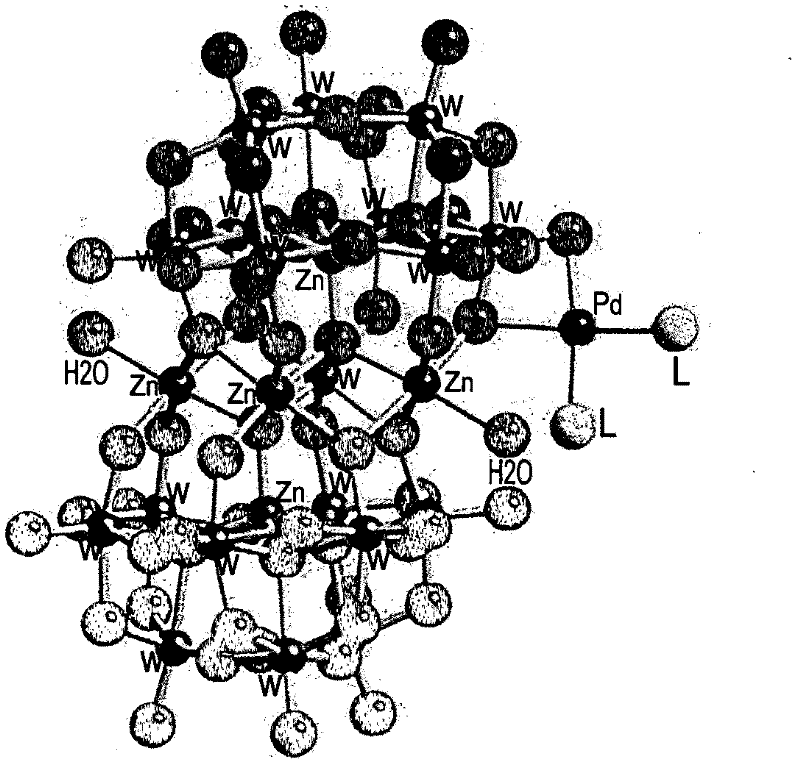
Figure 2 
Figure 3
Abstract
Description
technical field
[0001] The present invention, in some of its embodiments, relates to the field of chemistry, and more particularly, but not exclusively, to novel processes for the oxidation of alcohols to aldehydes, to noble metal-polyoxometalate complexes used in these processes Catalysts (NM-POM) such as palladium(II)-polyoxometalate complexes (Pd-POM), and to processes for the preparation of these complexes. Background technique
[0002] Using ground state molecular oxygen, O 2 , the catalytic oxidation of alcohols as primary oxidants, has focused much effort in recent years and has attracted many researchers who are clearly motivated by the clear ecological benefits of this transformation compared with other methods.
[0003] There are three general rules of thumb that can be used in describing the reactivity and selectivity of these oxidation reactions: i) Benzyl alcohols are the most active substrates, allyl alcohols are moderately active, and saturated fatty alcohols...
Examples
Embodiment 1
[0263] Preparation of typical Pd-POM catalyst
[0264] The preparation of a typical NM-POM complex catalyst containing palladium(II) and commonly referred to as Pd-POM is presented below.
[0265] By dropwise adding 1 mmol of parent (mother) polyoxometalate Na dissolved in 10 ml of water 12 [Zn 5 (H 2 O) 2 W 19 o 68 ]·46H 2 O (prepared by the method described by Tourné, C.M. et al. in J. Chem. Soc., Dalton Trans. 1991, 143-155) to 12 mmol of C 16 h 33 (CH 3 ) 3 N + Cl - (25% in water) prepared quaternary ammonium salts of polyoxometalates, Q 12 [Zn 5 (H 2 O) 2 W 19 o 68 ], where Q=C 16 h 33 (CH 3 ) 3 N + .
[0266] The ensuing precipitate was isolated by centrifugation, filtered and dried under vacuum at 80°C overnight, thermogravimetric analysis showed the absence of water.
[0267] Elemental analysis (exp (calculated) %): C, 33.02 (32.76); H, 6.24 (6.03); N, 1.98 (2.01).
[0268] Dissolve 0.167 g (0.5 mmol) in 4 ml CH at 35 °C dropwise 2 Cl 2 Pd[(C...
Embodiment 2
[0275] Catalytic Oxidation of Primary Alcohols Using Pd-POM Catalyst
[0276] The aerobic oxidation of primary alcohols was studied using 1-heptanol as a model substrate. through at 2 bar O 2 A typical reaction was performed by mixing 0.1 mmol of 1-heptanol and 5 μmol of a typical Pd-based catalyst Pd-POM-1 in 1 ml of α,α,α-trifluorotoluene (TFT) at 110 °C. Typically, after 25-30 minutes, the maximum degree of conversion is reached with a high selectivity for n-heptanal. Some minor alcohol peroxidation to n-heptanoic acid and some alcohol oxidation-dehydrogenation of alkanes to β-unsaturated aldehydes were observed, as seen in Scheme 2 below.
[0277] Scenario 2
[0278]
[0279] Using 1:1 PdCl 2 DMSO 2 and Q 12 [Zn 5 (H 2 O) 2 W 19 o 68 ] A similar reaction of the prepared catalyst showed 90% conversion of 1-heptanol with 91% selectivity to heptanal while producing 5% heptanoic acid.
[0280] Several observations and conclusions were drawn from the above experi...