Passive earthquake monitoring data compression method and control system

A technology for monitoring data and passive earthquakes, applied in seismic signal processing, etc., can solve problems such as large amount of transmitted data, difficult to meet real-time transmission, and occupying large disk resources

CN103207408AInactive Publication Date: 2013-07-17XIAN RES INST OF CHINA COAL TECH& ENG GROUP CORP
5 Cites 13 Cited by

Patent Information

Authority / Receiving Office
CN · China
Patent Type
Applications(China)
Current Assignee / Owner
Publication Date
2013-07-17
Estimated Expiration
Not applicable · inactive patent

Smart Images

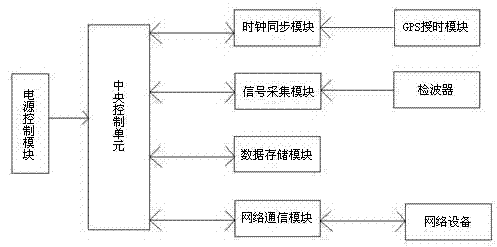
  • Figure 1
    Figure 1
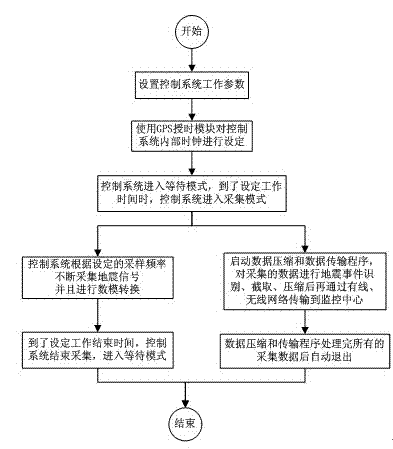
  • Figure 2
    Figure 2
  • Figure 3
    Figure 3
Patent Text Reader

Abstract

The invention relates to a passive earthquake monitoring data compression method and a control system. The sampling rate of the existing devices can reach 10KHz as far as possible, accordingly data generated by monitoring are enormous, wireless long-distance real-time data transmission is led to be difficult, and much disc storage space is occupied. The passive earthquake monitoring data compression method is characterized by including steps of: (1) earthquake event recognition; (2) earthquake event intercepting: earthquake events which are already recognized are intercepted and effective earthquake event signals are separated from earthquake original signals; and (3) earthquake monitoring data compression: lossless compression of earthquake monitoring data is achieved by aid of steim-2coding. The passive earthquake monitoring data compression method and the control system can reduce transmission amount and storage space occupation.
Need to check novelty before this filing date? Find Prior Art

Description

technical field

[0001] The invention relates to the technical field of data collection and processing, in particular to a passive seismic monitoring data compression method and a control system. Background technique

[0002] In the prior art, the transmission of passive seismic monitoring data generally adopts direct transmission or compressed retransmission. However, due to the strong uncertainty and unpredictability of passive seismic events, it is generally necessary to use all-weather real-time monitoring, and the frequency of seismic events Generally, it is 10-1500Hz, and the sampling rate of existing equipment can reach up to 10KHz, so the data generated by monitoring is very large, which causes great difficulties for wireless long-distance real-time data transmission, and takes up a lot of disk storage space. For example, if 20 three-component detectors are deployed on the ground, the sampling rate is 10KHz, and the digital signal precision is 24bit, then 18.31Mb of d...

Examples

Embodiment Construction

[0057] A method for compressing passive seismic monitoring data, comprising the following steps:

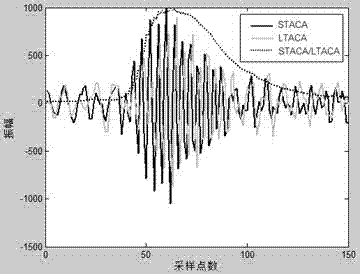
[0058] Step 1. Identification of seismic events: see image 3 , under a certain signal-to-noise ratio condition, the energy of the seismic record before and after the earthquake event, that is, the amplitude in the seismic record will have a relatively obvious difference. The average value of the amplitude of seismic signals in the window changes quickly, and the corresponding increase in the ratio R of the two will be more obvious. When the ratio R is greater than a set threshold T, that is, the threshold set by the control system, and continuously greater than this When the number GW of the R value of the threshold T is greater than the critical window TW, it is determined that a seismic event has occurred; when the energy change is not obvious when the event arrives, the event may be missed by directly calculating the amplitude of the original signal, so the introduction a ne...