
A mass transfer enhanced alkylation reactor and alkylation process method
An alkylation reactor and reactor technology, applied in chemical instruments and methods, chemical/physical/physical chemical mobile reactors, organic chemistry, etc., can solve the problems of increasing side reactions and unsuitable heat release, etc., to achieve Reduction of side reactions, good reaction effect, and effect of increasing octane number
- Summary
- Abstract
- Description
- Claims
- Application Information
AI Technical Summary
Problems solved by technology
Method used
Image

Examples
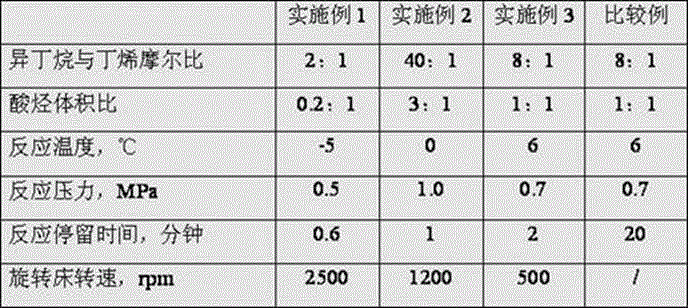
Embodiment 1~3
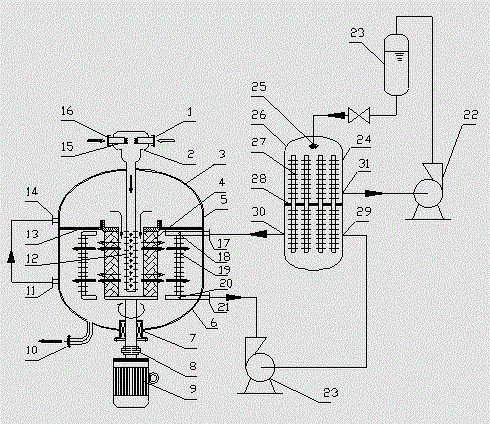
[0039] use as figure 1 In the reactor with the structure shown, the bed of the rotating bed is made of stainless steel mesh packing, the bed porosity of the stainless steel mesh packing is 0.95, and the specific surface area is 4000m 2 / m 3 , the wire diameter is 1mm, and the volume of the rotating bed accounts for 65% of the total volume of the rotating bed reactor. The alkylation reaction is carried out using concentrated sulfuric acid with a mass concentration of 95% as a catalyst and isobutane and butene as raw materials. The number of annular fin assemblies is set to be 10, and the gap distance between the fin assemblies and the rotating bed is 50mm.
[0040] The molar ratio of isobutane to butene is 1:1-300:1, preferably 3:1-50:1. The volume ratio of acid to hydrocarbon is 0.1:1~5:1, preferably 0.5:1~1.5:1. The reaction temperature is -20-15°C, preferably -10-10°C, most preferably -5-5°C. The reaction pressure is 0.2~1.5MPa, preferably 0.3~0.8MPa. The rotational sp...
PUM
| Property | Measurement | Unit |
|---|---|---|
| diameter | aaaaa | aaaaa |
Abstract
Description
Claims
Application Information
 Login to View More