
Hybrid power tail sitting type vertical takeoff and landing long-endurance unmanned aerial vehicle and flight control method thereof
A vertical take-off and landing, hybrid power technology, applied in the aviation field, can solve the problems of high empty weight ratio, power surplus, and short battery life of the tail-sitting UAV, and achieve the weight reduction of the power system and the fuel consumption rate. Low, the effect of improving the load capacity
- Summary
- Abstract
- Description
- Claims
- Application Information
AI Technical Summary
Problems solved by technology
Method used
Image

Examples
Embodiment approach 1
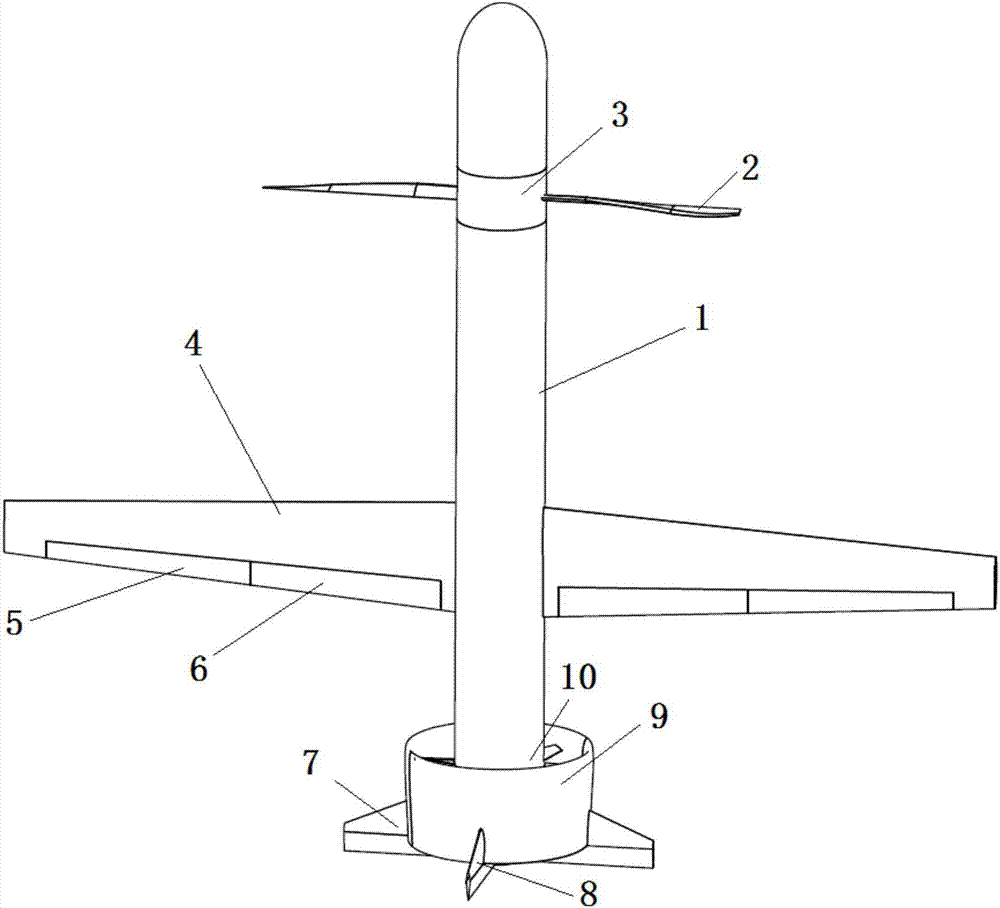
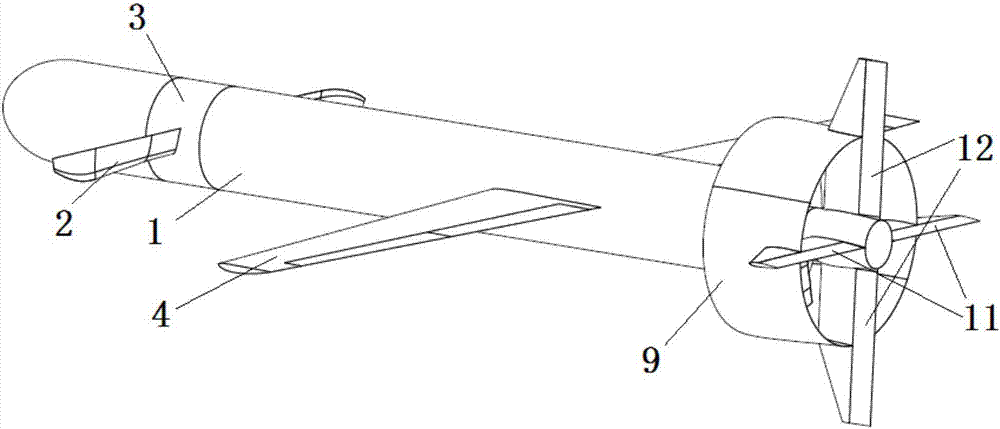
[0025] This embodiment is a hybrid power tail-sitting vertical take-off and landing long-endurance UAV with a design take-off weight of 30kg. This embodiment includes a fuselage 1, a main drive motor 3 installed on the head of the fuselage, and a The main tension propeller 2 folded towards the rear of the fuselage, the large aspect ratio wing 4 is installed in the middle of the fuselage, and the outer aileron 5 and the inner flaperon 6 are arranged on it. The piston engine 10 and the ducted propeller system 9 driven by it are installed at the rear of the fuselage, the horizontal tail 7 and the vertical tail 8 are installed on the duct, and the elevator 11 and the rudder 12 are respectively installed on it, and a part of the deflection rudder surface is in the duct. Inboard propeller slipstream coverage area.
[0026] Fuselage 1 contains the main drive motor battery, fuel oil tank, mission load and necessary flight instruments and equipment, etc., and is designed in a cylindric...
Embodiment approach 2
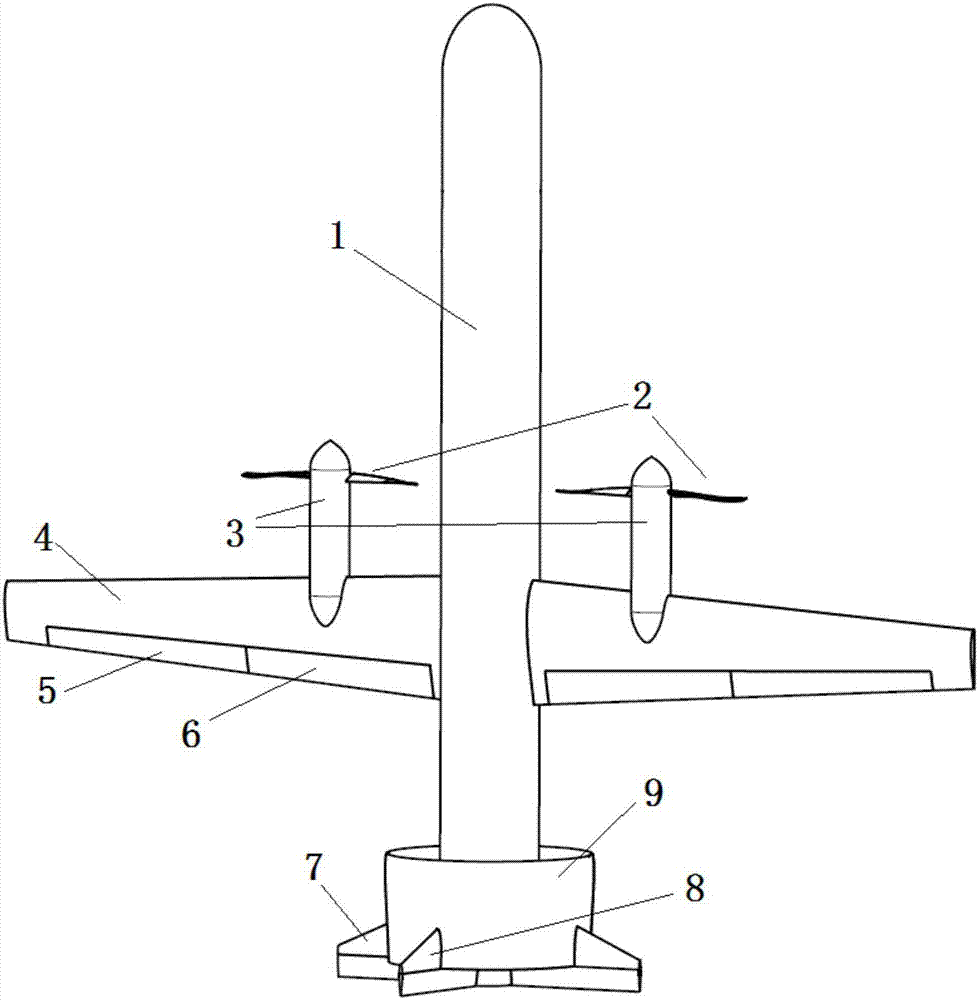
[0030] This embodiment is a hybrid power tail-sitting vertical take-off and landing long-endurance UAV with a design take-off weight of 30kg. This embodiment includes a fuselage 1 and two main drives mounted on the wings. Motor 3 and main tension propeller 2, large aspect ratio wing 4 are installed in the middle of the fuselage, and outer aileron 5 and inner flaperon 6 are arranged on it. The piston engine 10 and the ducted propeller system 9 driven by it are installed at the rear of the fuselage, the horizontal tail 7 and the vertical tail 8 are installed on the duct, and the elevator 11 and the rudder 12 are respectively installed on it, and a part of the deflection rudder surface is in the duct. Inboard propeller slipstream coverage area.
[0031] The present embodiment fuselage, wing, empennage, piston engine and ducted propeller system are the same as embodiment one, the difference is that there are two main drive motors and they are installed on the wing. The diameter o...
PUM
| Property | Measurement | Unit |
|---|---|---|
| Total length | aaaaa | aaaaa |
| Diameter | aaaaa | aaaaa |
| Chord length | aaaaa | aaaaa |
Abstract
Description
Claims
Application Information
 Login to View More