Formation aging method for inhibiting gas expansion of lithium titanate battery

A lithium titanate battery and flatulence technology, which is applied in the direction of non-aqueous electrolyte battery, electrolyte battery manufacturing, climate sustainability, etc., can solve the problems of inability to adapt to the industrialization of lithium titanate battery, high process equipment requirements, and increased production costs , to achieve obvious effects of inhibiting gas production, improving cycle performance, and reducing time consumption

CN107658504AActive Publication Date: 2018-02-02HEFEI GUOXUAN HIGH TECH POWER ENERGY
4 Cites 10 Cited by

Patent Information

Authority / Receiving Office
CN · China
Patent Type
Applications(China)
Current Assignee / Owner
Publication Date
2018-02-02

Smart Images

  • Figure 1
    Figure 1
  • Figure 2
    Figure 2
Patent Text Reader

Abstract

The invention discloses a formation aging method for inhibiting the gas expansion of a lithium titanate battery. The formation aging method is used for solving the gas expansion problem of the lithiumtitanate battery generated in the using process. The method comprises three steps of previous standing, formation and aging. In the formation step, the lithium titanate battery after previous standing adopts a constant-current charging manner of first high current and then low current, the battery is charged to a cut-off voltage higher than a working voltage platform and is discharged to a half-charge state after standing. The formation aging method is based on a lithium titanate battery gas production mechanism; the charging manner of first high current and then small current is adopted in the formation process, the lithium titanate material is promoted to form an SEI film in a forced manner under high potential; the battery is discharged in the half-charge state after formation standing, and the battery is placed in a low temperature environment to promote further growth and densification of the SEI film formed in the formation process. The dense SEI film is formed on the surface ofthe anode lithium titanate material, so that the chemical reaction of an electrolyte is prevented at the position of the anode; and the purposes of inhibiting gas production and reducing expansion are reached.
Need to check novelty before this filing date? Find Prior Art

Description

technical field

[0001] The invention relates to the technical field of lithium batteries, in particular to a formation and aging method for suppressing flatulence of lithium titanate batteries. Background technique

[0002] Lithium titanate material can be used as the negative electrode material of the battery. Lithium titanate battery can achieve a cycle life of tens of thousands of cycles and a rate charge and discharge performance higher than 30C, and has excellent safety performance. It is comparable in terms of cycle, rate and safety. Compared with traditional graphite anode materials, it has huge advantages; however, lithium titanate batteries face the problem of battery flatulence during the commercialization process, and battery flatulence will cause bubbles between the positive and negative electrodes inside the battery, causing + Migration is difficult, and dead lithium areas appear, resulting in reduced capacity and worsened cycle performance. Although there is s...

Examples

Embodiment 1

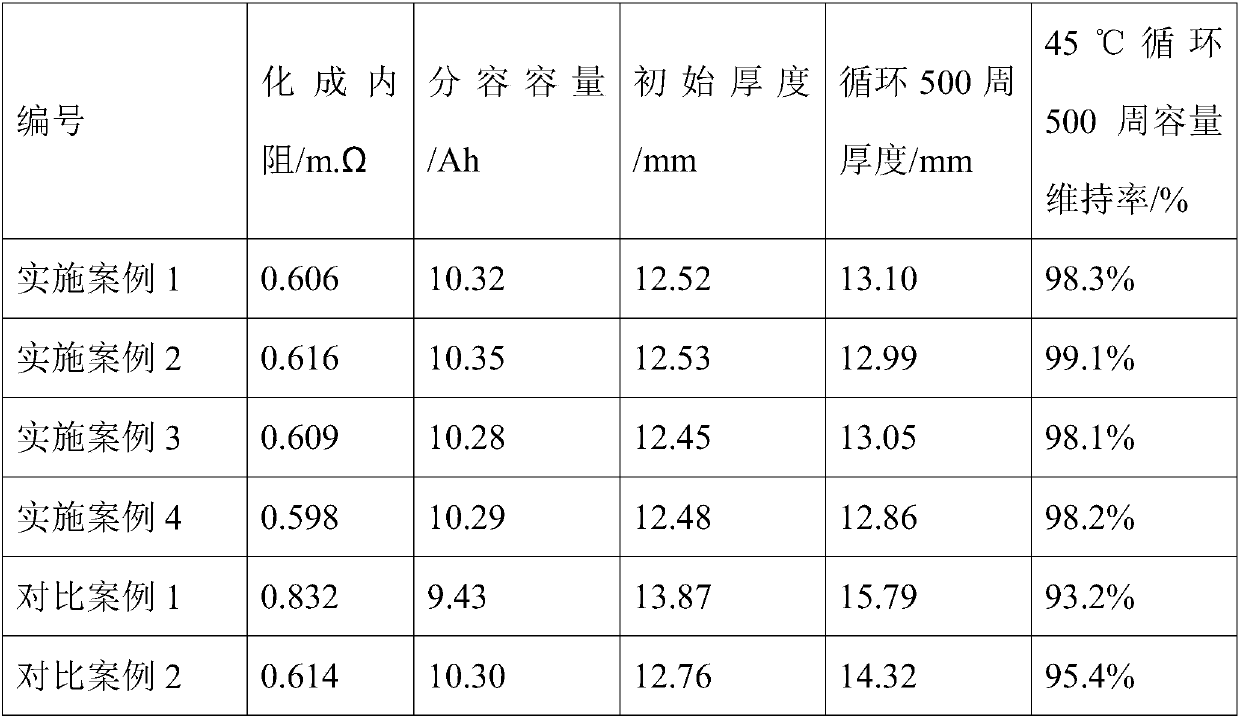
[0027] A chemical aging method for inhibiting flatulence of lithium titanate batteries. After liquid injection, the NCM / LTO battery is placed at 25°C for 24 hours, and charged to 2.6V with a constant current of 1.0C; transferred to a constant current of 0.2C Charge to 2.85V; place the battery in the open state at 55°C, -0.095Mpa, and age at -55°C dew point for 72h, and then discharge it to 2.4V with a constant current of 1C; then place it at -20°C, -0.095Mpa, -55 Aging at ℃ dew point for 12h, sealing after the end; separate volume.

Embodiment 2

[0029] A chemical aging method for inhibiting flatulence of lithium titanate batteries. After liquid injection, the NCM / LTO battery is placed at 25°C for 24 hours, and charged to 2.6V with a constant current of 1.0C; transferred to a constant current of 0.2C Charge to 2.85V; put the battery in the open state at 55°C, -0.095Mpa, and age at -55°C dew point for 72h, and then discharge it to 2.4V with a constant current of 1C; then put it at -10°C, -0.095Mpa, -55 Aging at ℃ dew point for 12h, sealing; separate volume.

Embodiment 3

[0031] A chemical aging method for inhibiting the flatulence of lithium titanate batteries. After liquid injection, the NCM / LTO battery is placed at 45°C for 24 hours, charged with a constant current of 1.0C to 2.6V; transferred to a constant current of 0.1C Charge to 2.85V; put the battery in the open state at 45°C, -0.095Mpa, -55°C dew point for aging for 24h, and then use 1C constant current discharge to 2.4V; then put it at -20°C, -0.095Mpa, -55 Aging at ℃ dew point for 12h, sealing; separate volume.