
Preparation method of modified polypropylene material with low volatile organic compounds (VOC)
A polypropylene material and polypropylene technology, which is used in the preparation of low VOC modified polypropylene materials, achieves good rigidity-toughness balance, excellent mechanical properties, and improves the effect of the process.
- Summary
- Abstract
- Description
- Claims
- Application Information
AI Technical Summary
Problems solved by technology
Method used
Image

Examples
Embodiment 1
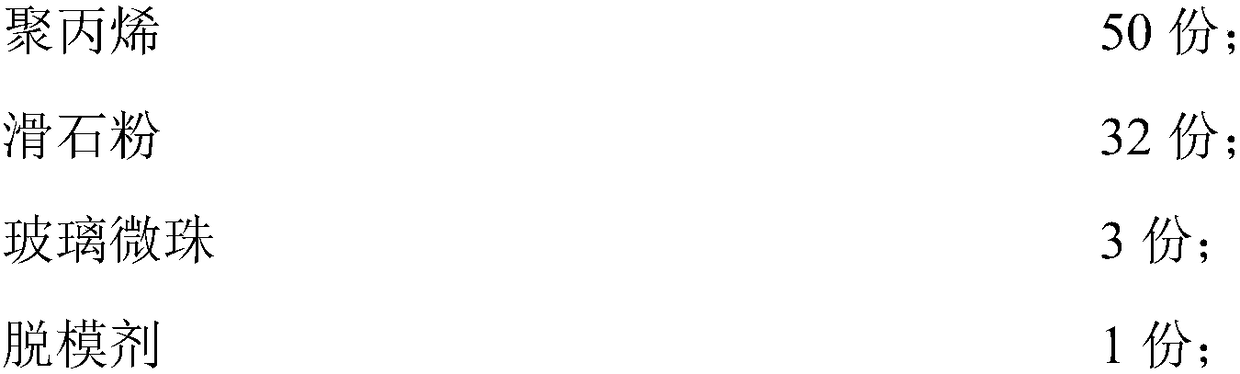
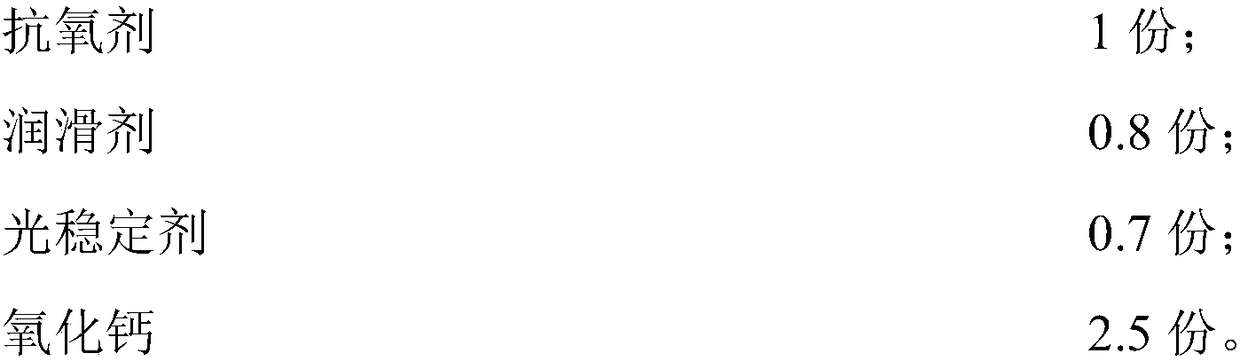
[0026] The low-VOC modified polypropylene material in this example is made up of the following raw materials by weight:
[0027]
[0028]
[0029] Concrete preparation method comprises the following steps:
[0030] (1) Add polypropylene, talcum powder, glass beads, release agent, antioxidant, lubricant, light stabilizer, and calcium oxide to No. 1-8 storage bins by vacuum feeding;
[0031] (2) According to the distribution ratio of each component, each component enters No. 1-8 feeding bin from No. 1-8 storage bin;
[0032] (3) Adjust the feeding speed of No. 1-8 feeding bins respectively, so that each component enters the mixing bin for mixing according to the ratio;
[0033] (4) Adjust the feeding speed, put the above-mentioned mixture into a double-vacuum parallel twin-screw extruder for melting and extruding; Zone 200°C, Zone 5 200°C, Zone 6 200°C, Zone 7 200°C, Zone 8 200°C, Zone 9 200°C, Zone 10 200°C, Zone 11 200°C, Zone 12 200°C, Screen changing zone 200°C, The...
Embodiment 2
[0037] The raw material of embodiment 2 is the same as that of embodiment 1, the only difference is that the VOC eluting agent is added at the side feeding port of the twin-screw extruder, and the VOC eluting agent is not atomized.
Embodiment 3
[0038] The raw material of embodiment 3 is the same as that of embodiment 1, the only difference is that the VOC eluting agent is added at the side feeding port of the twin-screw extruder, and the VOC eluting agent is atomized.
[0039] Odor evaluation was evaluated according to the odor evaluation standard PV3900 of Volkswagen AG. TVOC is evaluated according to PV3341.
[0040] physical properties
PUM
| Property | Measurement | Unit |
|---|---|---|
| particle diameter | aaaaa | aaaaa |
Abstract
Description
Claims
Application Information
 Login to View More